
The Cybersecurity Tool Problem No One Talks About
Here’s a conversation that happens more often than it should in boardrooms across financial services, healthcare, and government sectors:
“Do we have antivirus?” the executive asks.
“Yes,” the IT manager confirms.
“Then we’re protected, right?”
“…Sort of.”
That “sort of” is where data breaches live. That hesitation is where compliance failures are born. And for regulated organizations — those operating under HIPAA, CMMC, SOC 2, PCI-DSS, GLBA, or state-level mandates — “sort of” is not a risk posture. It’s an invitation.
The cybersecurity tools market has matured dramatically. Antivirus (AV), Endpoint Detection and Response (EDR), Identity Threat Detection and Response (ITDR) and Managed Detection and Response (MDR) are not interchangeable. They don’t even compete with each other in most scenarios — they serve entirely different threat models, operational requirements, and compliance functions.
This article breaks down exactly what each tool does, where it falls short, and which combination your regulated organization needs to maintain compliance, reduce risk, and protect stakeholder trust in 2026.
| Not sure which security layer your organization is missing? TorchLight offers a no-obligation security assessment |
What Is Antivirus (AV) — And Why It’s No Longer Enough
Antivirus software has been the cornerstone of endpoint security since the 1980s. It works by scanning files, programs, and processes against a database of known malicious signatures. When it finds a match, it quarantines or removes the threat.
Simple. Effective — in 1994.
How AV Works
Modern antivirus has evolved somewhat. Many solutions now include heuristic scanning, which attempts to identify suspicious behavior patterns rather than just known signatures. Some incorporate machine learning models to flag anomalies.
But fundamentally, AV is a reactive, signature-dependent tool. It’s designed to stop threats it has already seen.
AV’s Critical Blind Spots
The problem is that today’s sophisticated adversaries know this. The most dangerous attacks targeting regulated industries in 2026 include:
- Zero-day exploits — vulnerabilities that have no existing signature
- Living-off-the-land (LotL) attacks — attackers using legitimate system tools like PowerShell or WMI to operate undetected
- Fileless malware — threats that exist only in memory and never write to disk, bypassing file-scanning entirely
- Credential-based intrusions — attackers who log in with stolen credentials rather than installing malware
- Supply chain compromises — attacks delivered through trusted software updates or third-party vendors
None of these are reliably caught by antivirus alone. For a financial institution, government agency, or healthcare provider operating under strict regulatory requirements, relying on AV as your primary security layer is not just insufficient — it may expose you to audit findings, regulatory sanctions, and liability.
Bottom line: AV is a hygiene measure, not a security strategy. It belongs in your stack, but it cannot anchor it.
What Is EDR — Endpoint Detection and Response
Endpoint Detection and Response (EDR) was built to address exactly what AV couldn’t: behavioral, contextual, and post-breach threat detection on endpoints.
How EDR Differs from AV
EDR tools continuously monitor endpoint activity — processes launched, files accessed, network connections made, registry changes, user behaviors — and correlate that telemetry to detect threats that don’t match any known signature.
Where AV asks “Does this match a known bad file?” EDR asks “Is this sequence of behaviors consistent with an attack?”
EDR platforms like CrowdStrike Falcon, Microsoft Defender for Endpoint, and SentinelOne provide:
- Real-time behavioral monitoring across endpoints
- Automated threat containment and quarantine
- Forensic investigation capabilities and full audit trails
- Integration with SIEM platforms for broader visibility
- Threat hunting support for internal security teams
EDR Limitations for Regulated Organizations
EDR is a powerful tool — but it’s a tool that requires skilled operators. This is where many regulated organizations run into serious problems.
EDR generates substantial volumes of alerts and telemetry. Without a trained security team to interpret, prioritize, and respond to those alerts, you’ll face one of two failure modes:
- Alert fatigue — your team ignores or misses critical signals because they’re buried in noise
- Capability gap — you have the data but lack the expertise to act on it effectively
For organizations without a mature, in-house security operations capability — which describes the vast majority of mid-market companies in financial services, healthcare, and government — EDR alone leaves a dangerous gap between detection and meaningful response.
Bottom line: EDR is the right technology — but technology without the right team is just expensive shelf-ware.
| TorchLight’s managed security services fill the EDR capability gap for regulated organizations — without the overhead of building an internal SOC. Learn more at torchlight.io |
What Is MDR — Managed Detection and Response
Managed Detection and Response (MDR) is what happens when you pair best-in-class detection technology with a dedicated team of security analysts who monitor, investigate, and respond to threats on your behalf — 24 hours a day, 7 days a week, 365 days a year.
MDR is not a product. It’s a managed security service. And for regulated industries, it represents the most operationally pragmatic path to a mature security posture without building an internal SOC.
What Makes MDR Different
MDR providers combine:
- EDR and SIEM technology for broad threat visibility
- Dedicated SOC analysts who monitor your environment continuously
- Threat hunting — proactive search for threats that haven’t triggered an alert
- Guided or active incident response, including containment and remediation
- Reporting and documentation aligned to compliance and audit requirements
The MDR model solves the single biggest problem with standalone EDR: the human element. You get the detection capability of enterprise-grade technology backed by expert analysts whose job is to protect your organization — not yours.
For regulated organizations, this translates directly into measurable outcomes:
- Mean Time to Detect (MTTD) shrinks from days or weeks to hours or minutes
- Mean Time to Respond (MTTR) drops dramatically with analyst-guided containment
- Audit trails, incident documentation, and reporting support regulatory examinations
- Continuous monitoring satisfies requirements under HIPAA, CMMC, PCI-DSS, and more
MDR and Regulatory Compliance
One of the most underappreciated values of MDR is its direct support for compliance posture. Regulators across every major framework expect organizations to demonstrate continuous monitoring, documented incident response, and evidence of proactive risk management.
MDR providers like TorchLight deliver exactly that — with reporting, dashboards, and audit-ready documentation that gives your board, auditors, and examiners the visibility they need.
MDR for Financial Services
Financial institutions operating under GLBA, SOC 2, and state-level mandates face rigorous expectations around customer data protection, incident response timelines, and third-party risk management. MDR provides the continuous monitoring and documented response capability that examiners look for — without requiring you to staff a 24/7 internal SOC.
MDR for Healthcare Organizations
HIPAA requires covered entities and business associates to implement technical safeguards, audit controls, and incident response procedures. MDR operationalizes these requirements with monitored endpoints, access logging, and rapid response to potential protected health information (PHI) exposure events.
MDR for Government and Higher Education
Government agencies and higher education institutions face a dual challenge: high-value data targets (citizen records, research data, student PII) and often limited internal cybersecurity resources. MDR provides enterprise-grade protection scaled to the realities of public-sector and academic budgets and compliance requirements, including CMMC, FERPA, and state security frameworks.
| TorchLight’s 24/7 SOC is built specifically for regulated and mission-critical organizations. See how it works at torchlight.io |
What Is ITDR — Identity Threat Detection and Response
If MDR watches your endpoints and network, ITDR watches your identities — and in 2026, that distinction matters enormously.
More than 80% of successful cyberattacks now involve compromised credentials. Attackers don’t “break in” anymore. They log in — with your employees’ usernames and passwords, acquired through phishing, credential stuffing, dark web purchases, or insider threats.
Why Identity Is the New Attack Surface
Traditional security tools focus on endpoints and network traffic. But once an attacker has valid credentials, they can move laterally through your environment — accessing sensitive systems, exfiltrating data, establishing persistence — without triggering most endpoint-based alerts.
Identity Threat Detection and Response addresses this gap by monitoring:
- Active Directory and Azure AD for abnormal authentication patterns
- Privileged account activity and escalation attempts
- Lateral movement across systems using legitimate credentials
- Impossible travel and geolocation anomalies
- Service account abuse and token manipulation
- Changes to critical group policies or administrative permissions
How ITDR Protects Regulated Organizations
For organizations in financial services, government, and healthcare — where privileged access to sensitive data is both operationally necessary and a primary attack target — ITDR provides a detection layer that no other tool in this list replicates.
ITDR is particularly critical for:
- Organizations using Microsoft 365 / Azure AD environments
- Entities with complex multi-cloud or hybrid identity environments
- Any organization subject to audit requirements around privileged access management (PAM)
- Firms recovering from or concerned about insider threat scenarios
Bottom line: ITDR isn’t a replacement for MDR — it’s a complement. Together, they cover the two most exploited attack surfaces in modern enterprise environments: endpoints and identities.
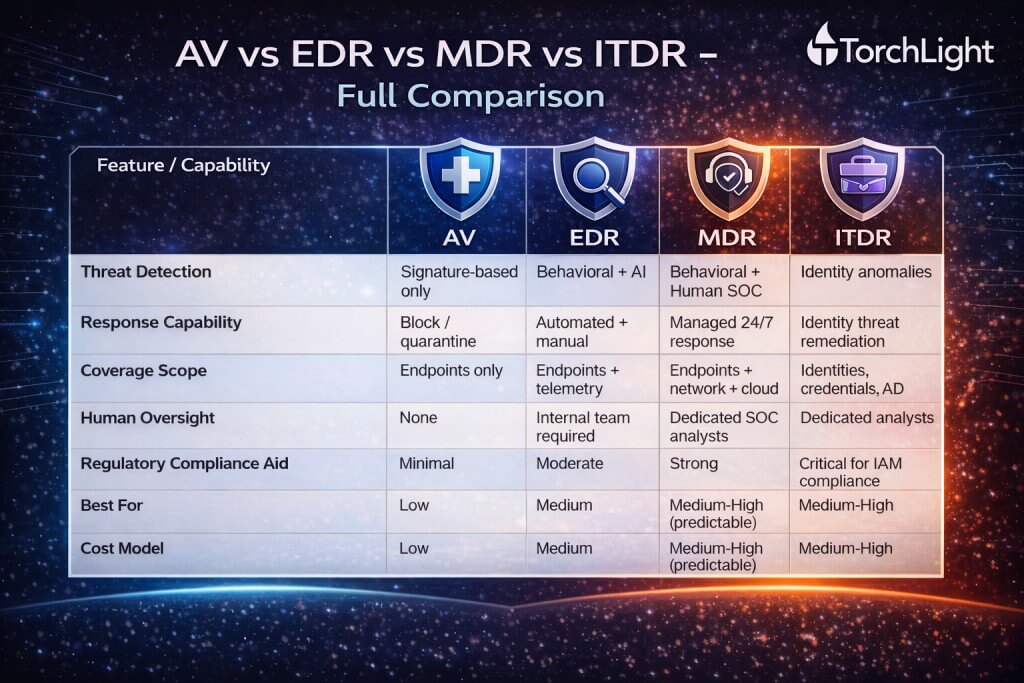
AV vs EDR vs MDR vs ITDR — Full Comparison
Use this table to quickly assess which capabilities your current security stack provides — and where the gaps are.
Which Solution Does Your Regulated Organization Actually Need?
The answer, for most regulated organizations, is not “one of these.” It’s a layered combination. Here’s how to think about where you are — and what you need next.
Signs You’ve Outgrown Antivirus
- You’ve had an incident that AV didn’t detect or catch
- Your compliance framework requires continuous monitoring, not just signature scanning
- You’re storing or processing PHI, PII, financial data, or classified information
- Your auditor or examiner has flagged endpoint protection as a gap
If any of these apply, you need EDR at minimum — and likely MDR, given the operational requirements.
Signs You Need MDR, Not Just EDR
- You don’t have a dedicated internal security team or SOC
- Your IT staff handles security as a secondary responsibility
- You’ve deployed EDR but alerts go unreviewed or unresponded to
- You need 24/7 monitoring but can’t staff or fund it internally
- Your compliance framework (HIPAA, CMMC, SOC 2, PCI-DSS) requires documented incident response
MDR transforms your security posture from reactive to proactive — with the expert coverage your compliance requirements demand.
Signs ITDR Should Be Part of Your Stack
- You’ve experienced phishing attacks, credential theft, or business email compromise (BEC)
- You rely heavily on Active Directory or Azure AD
- Privileged access management is a focus area in your next audit or examination
- You’ve had unauthorized access attempts using valid credentials
- Your environment includes remote workers, contractors, or third-party vendors with system access
For most regulated organizations, the right answer is: AV as baseline, EDR as the detection engine, MDR as the managed security wrapper, and ITDR as the identity layer — all integrated and supported by a single accountable partner.
| TorchLight integrates all four layers under one roof — with full accountability and audit-ready reporting. Contact us at torchlight.io |
Why TorchLight? The Partner That Covers All of It
TorchLight is a security-first managed IT and cybersecurity partner headquartered in Liberty Lake, WA — built specifically for regulated and mission-critical organizations that cannot afford downtime, security breaches, or compliance failures.
We serve organizations where security, reliability, and accountability are non-negotiable: financial institutions, government agencies, healthcare providers, higher education institutions, energy companies, and municipalities across the Pacific Northwest and beyond.
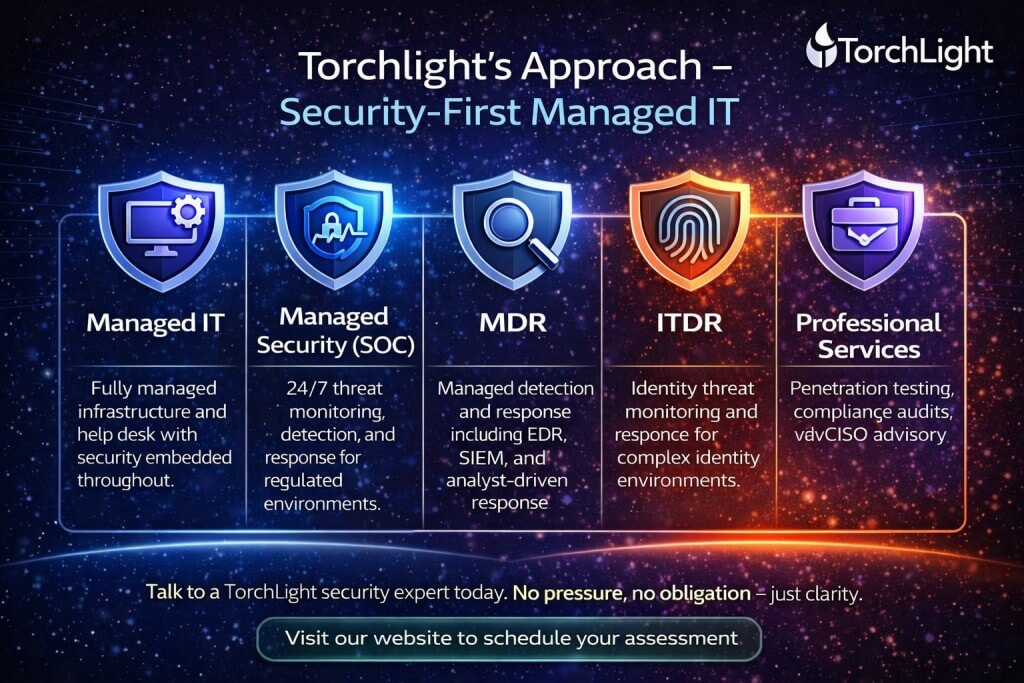
Our Approach – Security-First Managed IT
Unlike traditional MSPs that treat security as an add-on, TorchLight integrates security into every layer of managed IT services. Our model is built on continuous risk management, regulatory alignment, and delivering clear executive visibility into cybersecurity performance.
Our services include:
- Managed IT — fully managed infrastructure and help desk with security embedded throughout
- Managed Security (SOC) — 24/7 threat monitoring, detection, and response for regulated environments
- MDR — managed detection and response including EDR, SIEM, and analyst-driven response
- ITDR — identity threat monitoring and response for complex identity environments
- Professional Services — penetration testing, compliance audits, and vCISO advisory
We operate as a true partner — not a vendor — aligning technology, security, and your business priorities. That means you get a single point of accountability across IT, security, and compliance. No finger-pointing. No coverage gaps.
Compliance-First, Not Compliance-Reactive
Many organizations treat compliance as a destination — something to achieve before an audit and maintain until the next one. TorchLight treats compliance as continuous. Our services are designed to keep you in a state of ongoing audit readiness, with the documentation, reporting, and controls evidence that regulators and examiners expect.
Whether you’re preparing for a HIPAA audit, a CMMC assessment, a SOC 2 examination, or a board-level security review, TorchLight gives your leadership team the visibility and evidence they need to respond with confidence.
Liberty Lake, WA — Built for High-Stakes Organizations
Based in Liberty Lake, WA — in the heart of the Spokane metropolitan region — TorchLight serves organizations across Eastern Washington, North Idaho, and nationally. Our team understands the specific regulatory landscape, threat environment, and operational challenges facing regulated industries in our region.
From regional financial institutions and medical practices to municipal governments and higher education campuses, TorchLight has the experience, the tools, and the team to protect your organization and your stakeholders.
| Talk to a TorchLight security expert today. No pressure, no obligation — just clarity. Visit torchlight.io to schedule your assessment. |
Frequently Asked Questions
What is the main difference between AV and EDR?
Antivirus (AV) uses known malware signatures to detect threats — it blocks what it recognizes. EDR monitors endpoint behavior continuously to detect suspicious activity patterns, including threats with no known signature. EDR is significantly more capable, but requires skilled personnel to interpret its findings.
Does MDR replace EDR?
No — MDR typically includes EDR technology as part of its service stack. MDR adds the human layer: dedicated SOC analysts who monitor, investigate, and respond to the threats that EDR detects. Think of MDR as EDR plus the expert team to act on it, available 24/7.
What does ITDR stand for and what does it do?
ITDR stands for Identity Threat Detection and Response. It monitors identity infrastructure — particularly Active Directory, Azure AD, and privileged accounts — for signs of credential-based attacks, lateral movement, and identity abuse. It protects the attack surface that traditional endpoint tools miss.
Do I need both MDR and ITDR?
For most regulated organizations, yes. MDR covers your endpoints, network, and cloud environments. ITDR covers your identity layer. Since the majority of successful attacks now involve compromised credentials, combining MDR and ITDR gives you defense-in-depth across both primary attack surfaces.
Is antivirus still necessary if I have MDR?
Yes — antivirus remains a baseline hygiene measure. MDR doesn’t eliminate the need for AV; it complements it. AV provides a first line of defense against common, known threats, while MDR provides the deeper detection, response, and human oversight layer that stops sophisticated attacks AV can’t see.
How does MDR support regulatory compliance?
MDR directly supports compliance frameworks including HIPAA, CMMC, PCI-DSS, SOC 2, GLBA, and others by providing continuous monitoring (a common regulatory requirement), documented incident response, audit trails, and reporting that demonstrates your security controls are operating effectively — exactly what regulators and examiners want to see.
What industries does TorchLight serve?
TorchLight serves financial services, government agencies, healthcare organizations, higher education institutions, energy companies, municipalities, and other regulated or mission-critical organizations. We specialize in environments where security, compliance, and operational continuity are non-negotiable.
Ready to Stop Guessing and Start Protecting?
The question isn’t whether your organization needs more than antivirus. In 2026, it does. The question is which combination of EDR, MDR, and ITDR is right for your environment — and whether you have the right partner to implement, manage, and optimize it.
TorchLight exists for exactly this purpose. We bring together security-first managed IT, 24/7 SOC coverage, compliance advisory, and identity threat protection under one roof — with full accountability and executive-level visibility built in.
Whether you’re a financial institution navigating GLBA requirements, a healthcare organization managing HIPAA obligations, a government agency pursuing CMMC certification, or a higher education institution protecting student data — TorchLight has the experience, the tools, and the team to keep you protected, compliant, and operationally resilient.
| Schedule a no-obligation security assessment with TorchLight today. Visit torchlight.io or reach out to our team in Liberty Lake, WA. |