

Cybersecurity & Managed IT for Family Offices.
Protect the business, the family, and the trust between them.
Family offices connect financial assets, private information, principals, staff, advisors, devices, cloud systems, and trusted relationships within one unusually sensitive technology environment. TorchLight brings IT, cybersecurity, and strategic oversight together under one accountable operating model.
Private. Secure. Accountable. Built for technology environments where discretion matters.
Your Threat Surface Is More Personal.
In a family office, the boundary between business technology and personal technology is unusually thin. Email, identities, devices, cloud systems, advisors, staff, and financial workflows can all intersect.
That means effective security has to protect more than servers and endpoints. Strong managed security must account for the people, access, communications, and relationships surrounding the organization.
The goal is not to surround the family office with more technology. It is to create clearer control over who has access, how systems are protected, where risk is emerging, and who is accountable when something changes.
Security for a family office should be strong enough for the organization and discreet enough for the people it protects.
Identity & Impersonation
Principals, executives, assistants, and trusted staff can become high-value targets for phishing, account takeover, and impersonation. Identity protection needs to extend beyond the traditional network perimeter.
Explore Managed SecurityMoney Movement & Trusted Communications
Sensitive instructions often move through email, collaboration platforms, assistants, advisors, and outside partners. Protecting those communications requires secure identities, access controls, and disciplined cloud administration.
Explore Microsoft 365Mobile Principals & Remote Access
Family-office technology has to remain secure while principals and staff travel, work remotely, change locations, and access sensitive systems from multiple devices. The operating model has to move with them.
Explore Managed ITVendors, Advisors & Third Parties
Attorneys, accountants, investment professionals, consultants, household staff, and technology vendors can all become part of the operating environment. Risk management has to include the relationships around the family office.
Assess Risk & Readiness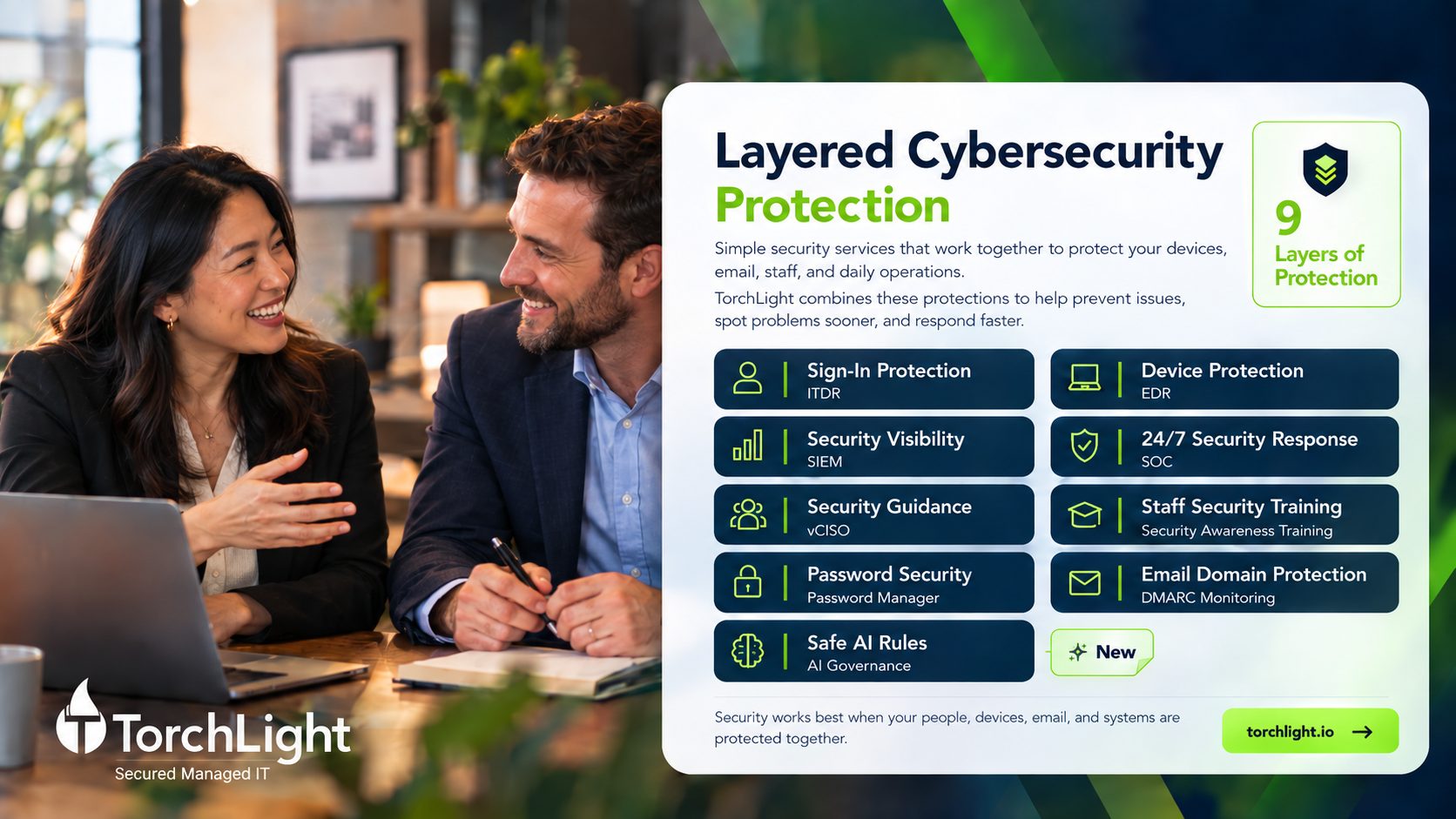
Managed IT
Reliable support, device management, infrastructure, cloud administration, and technology operations for the people who depend on them.
Managed Security
Continuous monitoring, endpoint protection, identity security, threat detection, and human response around the clock.
vCISO & vCIO Leadership
Executive-level guidance for cybersecurity, technology planning, risk decisions, governance, and long-term accountability.
Testing & Assurance
Independent testing helps validate whether security controls actually withstand the attacks they were designed to stop.
Already Have Internal IT or Trusted Technology Partners?
TorchLight can operate alongside an existing internal team, technology leader, investment platform, or trusted advisor. Co-managed IT and security adds capacity and specialized expertise without forcing a replacement model.
One Technology Operation. Multiple Layers of Protection.
Family offices rarely have a single technology problem. Support, cybersecurity, cloud systems, strategic decisions, outside advisors, and risk management all overlap.
When those responsibilities are divided across disconnected providers, gaps can form between who manages the technology, who protects it, and who owns the outcome.
TorchLight brings those responsibilities together under a security-first operating model with clear ownership, escalation, and accountability.
The goal is not more vendors. It is clearer ownership of the systems, risks, and decisions that matter.
Discretion Should Extend toYour Technology.
A family office depends on technology that often sits quietly behind highly consequential work. It should be secure, dependable, well governed, and managed without creating unnecessary friction for the people using it.
TorchLight has worked in high-trust and regulated environments since 2007. Our approach combines technical execution with the ownership, documentation, and accountability expected when the stakes are higher.
That operating philosophy is central to why organizations choose TorchLight and the standards that have shaped our company .
Strong technology should create confidence without demanding attention.
Start With a Private Conversation.
Tell us how your family office is structured, where technology responsibilities sit today, and what needs greater clarity. We can start there.
Talk With TorchLightSecurity First
Security is integrated into the way technology is managed, not added after the operational decisions have already been made.
Clear Accountability
Issues need owners, decisions need context, and important risks need a clear path from identification through resolution.
Take the Managed IT Overview With You.
Review the TorchLight Secured & Managed IT model, including support, monitoring, security, Microsoft 365 management, backups, and the operating capabilities available across our managed service levels.
Download the Data SheetHow We Work
See the operating principles behind TorchLight’s approach to security, ownership, communication, and accountability.
Explore the Service
Go deeper into the support, infrastructure, cloud, security, and accountability built into TorchLight Managed IT.
A Clearer View of What Sits Behind the Service.
Family-office technology decisions rarely happen in isolation. Principals, executives, internal staff, advisors, and other stakeholders may all need enough information to understand how the operating model works.
Our Managed IT data sheet provides a concise overview of the technology, security, monitoring, support, and continuity capabilities that can sit behind a TorchLight relationship.
Use it internally, share it with another decision-maker, or bring it into the conversation when evaluating how technology responsibilities should be structured.
The right technology relationship should be easy to understand before it ever becomes difficult to replace.
Built for Family Offices Where Trust Extends Beyond the Balance Sheet.
Technology should protect the people, information, operations, and relationships surrounding the family office without becoming another source of complexity.
Security-First IT
Nearly two decades helping organizations manage technology where security, continuity, and stakeholder confidence matter.
Human Security Monitoring
Continuous security monitoring and escalation for threats that do not wait for normal business hours.
IT, Security & Strategy Together
One accountable operating relationship across support, infrastructure, cybersecurity, risk, and technology leadership.
Let’s Make Family Office IT Easier to Trust.
Whether you are replacing an existing provider, strengthening cybersecurity, supporting internal IT, evaluating risk, or simply looking for clearer ownership of the technology environment, start with the situation. We will help determine the right next step.
Start the Conversation
Give us a little context about your family office and we’ll connect you with the right person at TorchLight.