

NOC and SOC coverage behind your internal team.
Critical first-response commitment.
Potential savings versus comparable internal capacity.
Co-Managed IT Services That Work Alongside Your Team.
Keep your internal IT team in control.
Add 24/7 monitoring, security operations, and senior engineering depth without building another department.
- No staff displacement.
- NOC, SOC, and Tier 2/3 engineering behind your team.
- One accountable partner. Clear responsibilities. Documented SLAs.
One IT team. Two full-time jobs.
Explore what TorchLight adds to your existing IT team, from stable operations to round-the-clock security and compliance expertise.
Your Team Keeps Ownership. TorchLight Adds Depth.
Your internal team already knows the people, systems, and priorities.
Keep that knowledge where it belongs.
We add the coverage and specialization that are difficult to build around a small internal team.
Your Team Stays in Control.
Frontline support stays close to the business.
TorchLight expands the operating layer behind it.
Keep core infrastructure visible, maintained, backed up, and monitored around the clock.
Add an always-on security operation without asking your internal staff to become the SOC.
Strengthen the systems attackers target most often without creating another silo to manage.
Escalate complex problems without consuming the entire internal team or hiring for every specialty.
The goal is not more IT people. The goal is more capability behind the people you already trust.
Add executive IT and security leadershipOne IT Operation. Clear Responsibilities.
Co-managed IT works when ownership is obvious.
Your team stays close to users, priorities, and the business.
TorchLight builds the operating depth behind them.
One Team. Defined Roles.
Your people keep the relationships.
We make sure the hard work has somewhere to go.
Frontline Support
Users, local priorities, business context, and day-to-day coordination stay close to your team.
Operational Backup
Monitoring, infrastructure, documentation, after-hours coverage, and repeatable processes continue behind the frontline.
Triage & Context
Your team identifies the issue and keeps communication connected to the people affected.
Tier 2/3 Engineering
Complex infrastructure, cloud, network, endpoint, and Microsoft 365 problems move to senior engineering.
Business Awareness
Internal IT knows what is normal, what changed, and which systems matter most to the organization.
24/7 Security Operations
Monitoring, threat validation, investigation, containment, and incident response continue around the clock.
Priorities & Decisions
Leadership and internal IT define business priorities, risk tolerance, and what needs to change.
Reporting & Advisory
TorchLight turns operational data into planning, documentation, security priorities, and accountable next steps.
Our internal team has been able to focus on day-to-day work while they provide us with capabilities an in-house team could never deliver.
Beth Passmore, Director of IT, East Adams Rural Healthcare
TorchLight has supported organizations with complex and regulated environments since 2007.
Why organizations choose TorchLightCommon Co-Managed IT Questions.
01 Will TorchLight replace our IT staff?
No.
Your internal team stays in place.
TorchLight adds monitoring, security operations, engineering depth, and escalation capacity behind them.
02 What does onboarding look like?
We document the environment and establish responsibilities first.
Monitoring, ticketing, documentation, escalation paths, and secure access are then aligned around the existing team.
03 Can we start with engineering support only?
Yes.
Tier 2/3 engineering can provide a smaller entry point when the immediate problem is capacity or specialized expertise.
Larger initiatives can also move through our Professional IT Services .
04 Can co-managed IT strengthen security and compliance?
Yes.
Co-managed IT can add continuous security monitoring, endpoint protection, identity protection, incident response, documentation, and vulnerability visibility.
Those controls can also support audit and compliance readiness without turning compliance into a separate IT silo.
Organizations needing deeper security coverage can also explore our Managed Security Services .
The TorchLight Zero-Cost IT Model.
Most managed IT services and cybersecurity services companies rely on reactive support and disconnected tools. Traditional managed IT company models separate IT and security, creating risk and compliance gaps. TorchLight’s Zero-Cost IT approach brings everything together into one unified system that converts stability and security improvements into measurable and reportable cost offsets.
Stability Foundation
Stop downtime, noise, and operational and financial leakage.
Stability Foundation
Standardize the environment, reduce recurring incidents, and eliminate avoidable downtime, noise, and operational leakage. This predictable foundation is what every higher stage depends on.
Security Layer
24/7 proactive protection and hardening.
Security Layer
Add continuous monitoring, hardening, identity protection, endpoint security, patching, and recovery readiness. The goal is proactive protection rather than waiting for incidents to become emergencies.
Compliance Accelerator
Audit-ready evidence and zero-finding confidence.
Compliance Accelerator
Turn working controls into repeatable, audit-ready evidence. Continuous documentation and evidence collection reduce last-minute compliance scrambles and support stronger exam readiness.
Proof Point
Independent validation plus executive advisory.
Proof Point
Independently validate whether the controls actually work through penetration testing and assessments, while executive vCISO/vCIO guidance helps leadership prioritize technology, risk, and investment.
Competitive Peak
IT becomes a strategic advantage, not a cost center.
Competitive Peak
Once stability, security, compliance, and proof are established, technology can support growth, automation, resilience, and better business decisions.
Co-Managed Intelligence.
Practical guidance for leaders deciding how much IT should stay internal, where outside depth adds value, and how to close the gaps between the two.
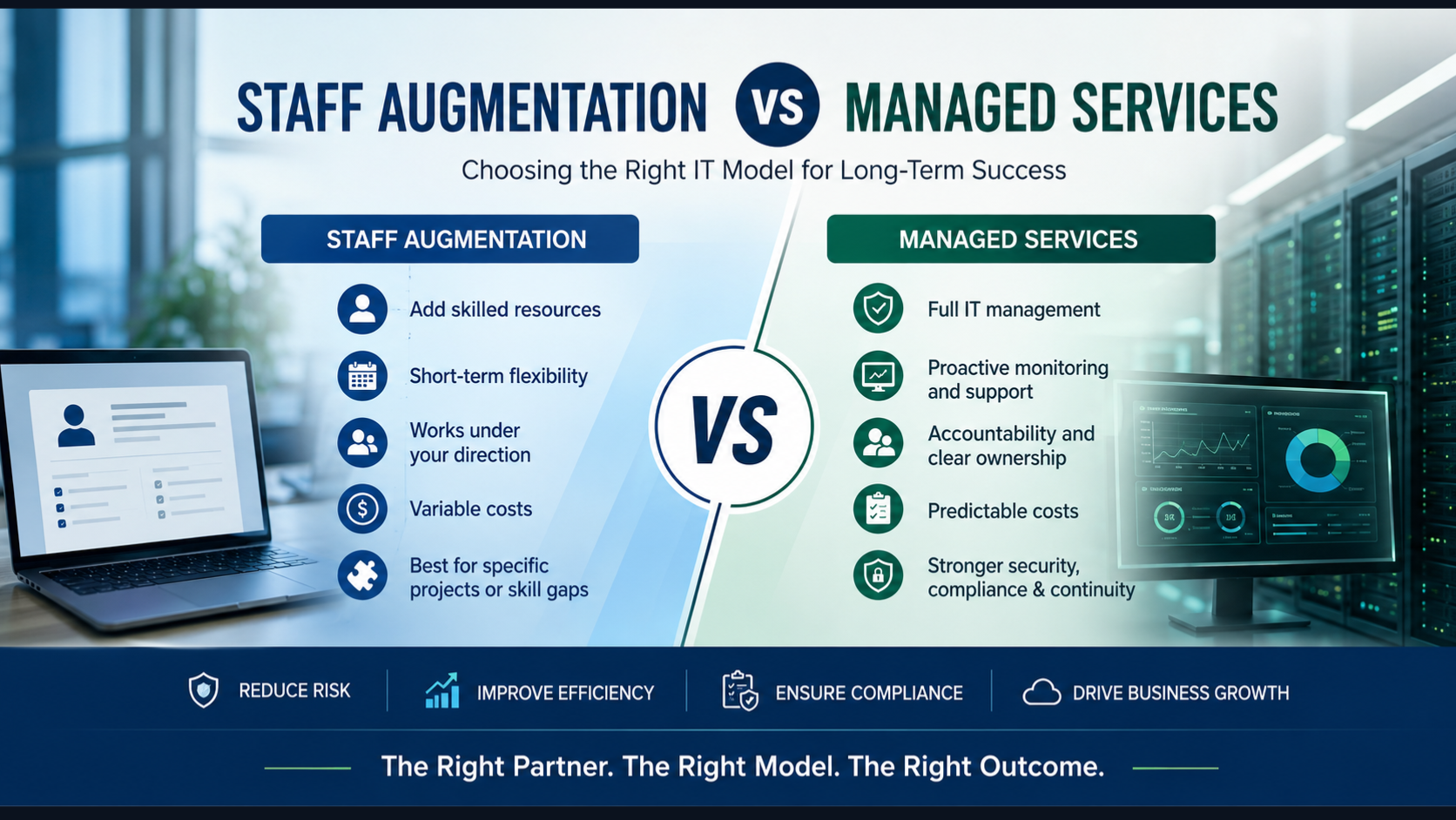
Staff Augmentation vs Managed Services: What IT Leaders Need to Know
More headcount and more accountability are not the same thing.
See where staff augmentation fits and where a managed operating model becomes the stronger answer.
Read the Article
The After-Hours Threat Credit Unions Can’t Ignore
Small IT teams cannot realistically staff a security operation every hour of every day.
See how co-managed IT closes the after-hours gap without replacing the internal team.
Read the Article
How to Choose the Right IT Partner
A good partner should expand your capabilities without creating another layer of vendor confusion.
Use this buyer’s guide to evaluate security, accountability, compliance, and operational depth.
Read the Buyer’s GuideGive Your IT Team Real Backup.
Keep the people you trust.
Add the coverage, engineering, and security capacity they should not have to build alone.
NOC + SOC Coverage
Monitoring continues when the internal team goes home.
Critical First Response
Critical issues have a documented response path around the clock.
Potential Cost Savings
Compared with building equivalent capability entirely through internal headcount.
Start With the Gap.
You do not need to redesign your IT department first.
Tell us where the team is stretched.
We can map the right coverage around it.
Talk With TorchLight.
Give us a little context.
We will start with the problem your team is actually trying to solve.