
Not long ago, the answer to an IT gap was simple: hire a contractor, bring in a temp resource, or extend a vendor engagement. Staff augmentation felt flexible, affordable, and fast. For many organizations, it still has a role to play.
But the IT environment has changed dramatically. Ransomware attacks are targeting mid-market companies and credit unions. Regulators are demanding documented security controls. Cyber insurance carriers are asking hard questions about patch management, access controls, and incident response plans. And internal IT teams are stretched thinner than ever.
In this environment, the question isn’t just how do we fill a skill gap? It’s who actually owns our operational continuity, our security posture, and our compliance readiness?
That’s why the conversation around staff augmentation vs managed services has become increasingly important for businesses evaluating long-term IT strategy.
While both models can provide value, they solve very different problems.
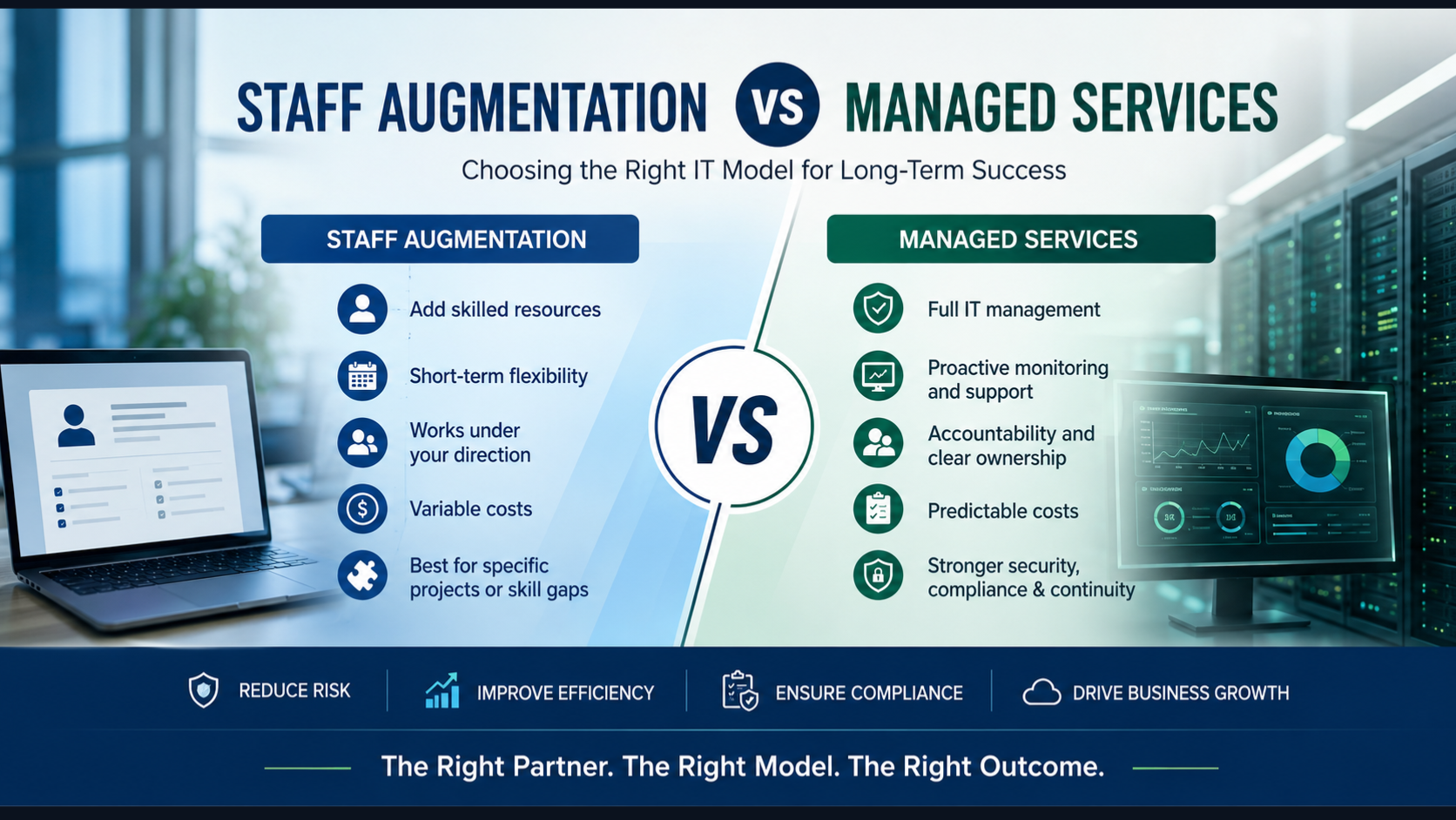
Staff augmentation helps organizations add temporary expertise or additional capacity. Managed services, on the other hand, focus on operational accountability, proactive management, predictable support, and long-term business continuity.
That shift in thinking is why so many IT leaders and operations executives are taking a harder look at the difference between staff augmentation and managed services, and asking which model genuinely serves their organization’s long-term interests.
What Is Staff Augmentation?
Staff augmentation is a model where a business brings in external contractors or consultants to supplement its existing team. These individuals typically work under the direction of internal managers and are placed into specific roles to fill temporary skill gaps or support defined projects.
Common use cases include:
- Covering a leave of absence or open headcount during a slow hiring cycle
- Bringing in specialized expertise for a time-boxed project (e.g., a network migration or ERP implementation)
- Scaling up a development or infrastructure team during peak demand
- Filling a niche technical role while a permanent hire is being sourced
Benefits of Staff Augmentation
Staff augmentation can be valuable in situations where organizations need:
- Specialized expertise quickly
- Short-term project assistance
- Additional bandwidth for internal teams
- Flexible staffing without long hiring cycles
For businesses with mature IT leadership and strong operational governance, staff augmentation can provide targeted support without completely outsourcing operational functions.
Limitations of Staff Augmentation
However, the model also introduces challenges that many organizations underestimate.
Because augmented staff work under the organization’s direction, accountability often remains fragmented. Internal teams must still manage priorities, oversight, vendor coordination, security standards, and operational continuity.
Some common risks include:
- Inconsistent operational ownership
- Limited long-term accountability
- Knowledge silos
- Increased vendor management complexity
- Gaps in documentation and continuity
- Reactive support models
- Difficulty scaling efficiently
This becomes especially problematic in regulated industries where visibility, reporting, governance, and security consistency are critical.
What Are Managed Services?
Managed services involve outsourcing ongoing IT operations, support, monitoring, cybersecurity, and infrastructure management to a dedicated provider.
Rather than simply supplying personnel, managed service providers assume responsibility for defined operational outcomes and service delivery.
Under a managed services model, businesses typically receive:
- Proactive system monitoring
- Help desk support
- Infrastructure management
- Cybersecurity oversight
- Patch management
- Backup and disaster recovery
- Compliance support
- Vendor coordination
- Strategic IT planning
Unlike staff augmentation, managed services focus on accountability and operational continuity rather than temporary staffing support.
Organizations working with providers like TorchLight Managed IT Services often benefit from centralized management, standardized processes, and proactive oversight designed to reduce operational risk over time.
The Core Difference: Accountability
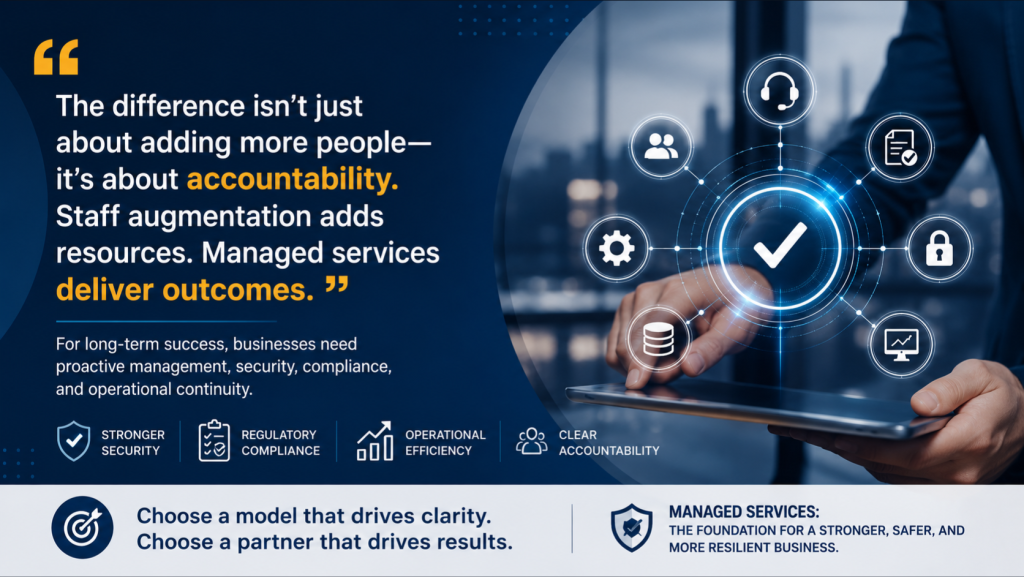
One of the biggest distinctions in the managed services vs staff augmentation discussion is ownership.
With staff augmentation:
- Your organization manages the people
With managed services:
- The provider manages the outcomes
That difference has major implications for operational efficiency, cybersecurity, scalability, and business continuity.
Staff Augmentation vs Managed Services: Key Differences
| Category | Staff Augmentation | Managed Services |
|---|---|---|
| Ownership | Internal team retains ownership | Provider assumes operational responsibility |
| Accountability | Shared or fragmented | Clearly defined service accountability |
| Support Model | Often reactive | Proactive and continuous |
| Scalability | Requires ongoing staffing adjustments | Easier operational scaling |
| Security Oversight | Depends on internal processes | Centralized and standardized |
| Compliance Support | Limited unless internally managed | Often built into operations |
| Vendor Management | Internal responsibility | Managed by provider |
| Cost Predictability | Variable | More predictable monthly costs |
| Business Continuity | Knowledge may remain siloed | Documented and process-driven |
| Operational Efficiency | Dependent on internal leadership | Optimized through standardized workflows |
For organizations evaluating IT managed services vs staff augmentation, the decision often comes down to whether they need additional labor or operational accountability.
When Staff Augmentation Makes Sense
Staff augmentation is a legitimate and effective tool in the right context. It’s worth being direct about that rather than dismissing the model entirely.
It makes the most sense when you have a well-functioning internal IT team that simply needs temporary bandwidth or a specific technical skill for a scoped engagement. A strong internal team with solid processes can absorb augmented resources without introducing operational risk, and many do this successfully.
Good fits for staff augmentation include project-driven work with a clear start and end date, situations where you have internal leadership capable of managing and directing the resource effectively, and engagements where knowledge transfer to your permanent team is the explicit goal.
The model starts to break down when it becomes a long-term workaround for structural understaffing, when augmented resources are expected to own operational functions without clear accountability frameworks, or when the organization lacks the internal capacity to manage, direct, and oversee those resources properly.
When Managed Services Are the Better Choice
For most mid-market businesses, credit unions, healthcare organizations, and professional services firms, outsourced IT support through a managed services model tends to deliver better long-term operational outcomes.
Here’s why:
Compliance-driven environments need documented governance. Financial institutions and healthcare organizations operate under frameworks like NCUA guidance, HIPAA, SOC 2, and state-level data protection requirements. Those frameworks require more than technical expertise; they require documented policies, regular risk assessments, audit trails, and consistent reporting. A managed services partner builds this into the engagement. An augmented contractor typically doesn’t.
Security can’t be reactive. Cyber threats don’t wait for your IT team to notice them. Managed services include continuous monitoring, threat detection, and coordinated incident response. When a phishing email hits or a device starts behaving anomalously, the MSP’s team is already investigating. Staff augmentation, by contrast, responds to what your team surfaces.
Operational continuity requires more than headcount. When an augmented resource leaves, whether at contract end or unexpectedly, the institutional knowledge, configurations, and undocumented processes they carried often leave with them. A managed services team documents the environment, maintains continuity, and doesn’t have single points of failure.
Predictable costs support better planning. The managed services model converts IT support into a known monthly operational expense. That predictability matters for CFOs building annual budgets and for organizations that can’t absorb surprise IT costs.
Security and Compliance: The Hidden Risk in Fragmented IT Ownership
One of the most underappreciated risks in the staff augmentation model is what happens to security and compliance when IT responsibility is spread across multiple parties without clear ownership.
Consider a mid-sized credit union running a combination of an internal IT generalist, two augmented contractors from different firms, and a handful of point-solution vendors. Each party manages its own scope. Nobody has a consolidated view of the environment. Patches fall through the gaps between scopes. Access isn’t reviewed consistently. Documentation is incomplete.
That’s not a hypothetical, it’s a pattern that shows up regularly in IT assessments, and it creates serious exposure in three specific areas:
Cyber insurance: Carriers are increasingly asking whether organizations have centralized monitoring, documented patch management, and formalized incident response. A fragmented environment often can’t answer those questions cleanly, which affects coverage eligibility and premiums.
Ransomware response: When an attack occurs, the response speed depends on knowing who owns what, where backups are, and who has authority to act. Fragmented IT ownership slows that down significantly.
Audit and examination readiness: Regulators examining a financial institution or healthcare organization expect to see coherent evidence of controls. When responsibility is split across multiple parties, assembling that evidence becomes a significant operational burden, and gaps are harder to defend.
A managed services partner, particularly one with a dedicated managed security services practice, gives the organization a single accountable party with visibility across the environment.
Organizations using frameworks like the NIST Cybersecurity Framework are increasingly prioritizing governance, documentation, and centralized operational management.
Additionally, ransomware threats continue to increase operational pressure on businesses across industries. Resources from CISA Cybersecurity Resources consistently emphasize proactive security management, incident readiness, and operational resilience.
Many businesses are also discovering that cyber insurance providers now require stronger documentation, monitoring, and security controls before approving coverage.
This is one reason why organizations often pursue compliance-focused services such as TorchLight vCISO Services to improve governance and strategic oversight.
Why Many Businesses Are Moving Toward Managed Services
The shift toward managed services is not simply about outsourcing IT support.
It reflects a broader operational change in how businesses approach technology management.
Modern organizations increasingly want:
- Predictable IT operations
- Centralized accountability
- Proactive cybersecurity management
- Reduced operational complexity
- Better reporting visibility
- Stronger compliance readiness
- Improved business continuity
- Scalable operational support
In many cases, businesses are realizing that reactive staffing approaches no longer provide enough operational structure to support long-term growth.
The rising cost of downtime, security incidents, and operational inefficiency is pushing organizations toward more mature support models.
Research such as the IBM Cost of a Data Breach Report continues to show how operational gaps and delayed incident response can create substantial financial impact.
For many organizations, managed services are becoming less of a staffing decision and more of a long-term operational strategy.
Final Thoughts
The discussion around staff augmentation vs managed services is ultimately about more than staffing models.
It’s about operational accountability, risk management, scalability, and long-term business resilience.
Staff augmentation has a place in the toolkit. For scoped projects with clear deliverables and strong internal oversight, it can work well. But for organizations carrying real compliance obligations, security risk, and operational complexity, it rarely provides the accountability structure those environments demand.
The managed services model doesn’t just fill gaps, it builds a framework of continuous accountability, proactive management, and documented governance that supports the organization long-term. For most IT leaders evaluating their options seriously, that distinction is increasingly hard to overlook.
If your current IT model leaves you uncertain about who’s responsible when something goes wrong, that uncertainty is worth addressing before something does.
Frequently Asked Questions
What is the difference between staff augmentation and managed services?
Staff augmentation places individual contractors within your existing team structure, with your organization retaining full operational responsibility. Managed services involve a provider taking ongoing accountability for a defined scope of IT functions, including proactive management, monitoring, and compliance support. The core difference is ownership: augmentation adds headcount, managed services adds accountability.
Are managed services better than staff augmentation?
For most mid-market organizations, especially those in regulated industries like financial services or healthcare, managed services typically deliver better long-term outcomes. The managed services model provides proactive support, documented governance, predictable costs, and continuous security coverage, advantages that staff augmentation alone cannot match.
What are the risks of staff augmentation?
The primary risks include unclear accountability for operational outcomes, knowledge loss when contractors exit, gaps in security coverage between scopes of responsibility, and limited compliance documentation. Organizations that rely heavily on augmented resources without strong internal governance often find it difficult to demonstrate coherent security controls to auditors, insurers, or regulators.
What are the benefits of managed IT services?
Key benefits include proactive monitoring and issue resolution, predictable monthly costs, documented compliance support, continuous security oversight, reduced vendor management burden, and operational continuity even as individual team members change. Managed IT services also give leadership a single accountable party for IT performance and security outcomes.
Why do businesses choose managed services?
Businesses choose managed services to reduce operational complexity, improve visibility, strengthen security, and create more predictable IT operations.