

Cyber Insurance & Gap Coverage for Regulated Organizations.
TorchLight helps identify coverage gaps, strengthen the environment behind the policy, and add risk-transfer options where traditional insurance can still leave exposure.
Coverage Is Only One Layer.
Cyber insurance can help transfer part of the financial impact of an incident. It does not replace the security controls, monitoring, recovery planning, or operational discipline that reduce the likelihood and severity of one.
Carriers increasingly ask detailed questions about how an organization protects identities, endpoints, data, email, backups, and privileged access. The exact underwriting requirements vary, but the underlying expectation is consistent: the controls represented during underwriting need to exist and remain operational.
The policy transfers risk. The security program underneath it determines how much risk is left to transfer.
Identity & MFA
Access ProtectionStrong authentication, privileged-access controls, and identity monitoring help reduce account takeover, credential abuse, and unauthorized access.
Endpoint Protection
Detection & ResponseModern endpoint controls help identify ransomware, malicious behavior, lateral movement, and other activity that traditional antivirus alone may not stop.
Managed Security ServicesBackup & Recovery
Resilience After an IncidentProtected backups, tested recovery processes, and clear restoration priorities help reduce operational disruption when systems or data are damaged, encrypted, or unavailable.
Monitoring & Logging
Visibility Across the EnvironmentSecurity telemetry, centralized logging, and human investigation provide the visibility needed to identify suspicious activity before it becomes a larger incident.
Incident Response
Know Who Acts NextEscalation, containment, communication, recovery, and regulatory reporting responsibilities should already be defined before an incident puts the organization under pressure.
Policies & Evidence
Document What Is Actually OperatingPolicies, inventories, configuration records, assessments, remediation history, and control evidence help demonstrate what the organization represented during underwriting.
What Happens Between the Policy and the Incident?
Cyber insurance is an important risk-transfer tool, but every policy has terms, limits, deductibles, exclusions, and conditions. The practical question is what happens to the risk that remains after the policy is in place.
The Cyber Policy
A traditional cyber policy can transfer significant financial risk associated with covered events. The actual protection depends on the policy’s wording, limits, exclusions, sublimits, deductibles, and coverage conditions.
The Risk That Remains
Not every cost, interruption, or incident outcome is necessarily covered in full. Organizations can still carry operational and financial exposure before coverage responds, beyond applicable limits, or where particular terms restrict recovery.
Cyber Warranty & Gap Options
For eligible environments, TorchLight can help evaluate additional cyber warranty and risk-transfer options designed to sit alongside the broader security and insurance strategy.
Cyber warranties and other risk-transfer options are subject to eligibility requirements, terms, limitations, and exclusions. They are not a substitute for a commercial cyber insurance policy or for independent insurance, legal, or regulatory advice.
Official Cybersecurity Guidance by Industry.
Cyber insurance does not exist in a regulatory vacuum. Safeguarding requirements, incident-reporting rules, privacy obligations, contractual standards, and sector guidance all influence the controls an organization may need to demonstrate before or after a cyber event.
Most industries do not have a universal federal law requiring every organization to purchase cyber insurance. The resources below separate enforceable rules from voluntary federal guidance. State laws, contracts, registration status, and insurer-specific underwriting requirements may add additional obligations.

Small Business
FTC GUIDANCE · NIST FEDERAL FRAMEWORKThere is no universal federal cyber-insurance purchase mandate for small businesses. The FTC publishes direct cyber-insurance guidance, while NIST provides a CSF 2.0 Quick-Start Guide designed specifically for smaller organizations.

Credit Unions
NCUA REGULATION · INCIDENT REPORTINGFederally insured credit unions operate under NCUA cybersecurity and information-security requirements. A reportable cyber incident must be reported to the NCUA as soon as possible and no later than 72 hours after the credit union reasonably believes one occurred.

Banks & Financial Institutions
FEDERAL BANKING RULE · FFIEC GUIDANCEFederal banking regulators require covered banking organizations to notify their primary federal regulator of qualifying computer-security incidents as soon as possible and no later than 36 hours after determining an incident occurred.

Family Offices
REGULATORY STATUS · FEDERAL RISK FRAMEWORKFamily-office obligations depend heavily on structure, services, and registration status. The SEC Family Office Rule defines when qualifying family offices are excluded from the Investment Advisers Act, while NIST CSF provides a useful federal risk-management baseline.

Wealth Management & Investing
SEC FINAL RULE · CUSTOMER INFORMATIONAmended Regulation S-P requires covered broker-dealers, investment companies, registered investment advisers and other covered institutions to maintain written incident-response procedures, safeguard customer information, preserve records, and provide required customer notifications.

Healthcare & Life Sciences
HHS SECURITY RULE · FDA CYBER GUIDANCEHIPAA-regulated entities must implement administrative, physical, and technical safeguards protecting ePHI. HHS also publishes healthcare cybersecurity goals, while FDA maintains separate cybersecurity guidance for medical and cyber devices.

Manufacturing
NIST · CISA · DEFENSE CONTRACT REQUIREMENTSThere is no single federal cybersecurity regime covering every manufacturer. NIST and CISA publish voluntary manufacturing and critical-infrastructure guidance. Defense manufacturers may additionally face CMMC and related contractual requirements, depending on the work they perform.

Government
FEDERAL RMF · PUBLIC-SECTOR CYBER GUIDANCEFederal agencies and federal systems operate within FISMA and NIST risk-management requirements. State, local, and special-district obligations vary by jurisdiction, while CISA’s Cybersecurity Performance Goals provide a federal voluntary baseline for reducing common cyber risk.
Cyber Insurance Intelligence.
Underwriting standards, regulatory expectations, security controls, and the threats behind actual claims continue to change. These TorchLight resources help leadership teams understand what insurers, examiners, and security teams are increasingly asking organizations to prove.
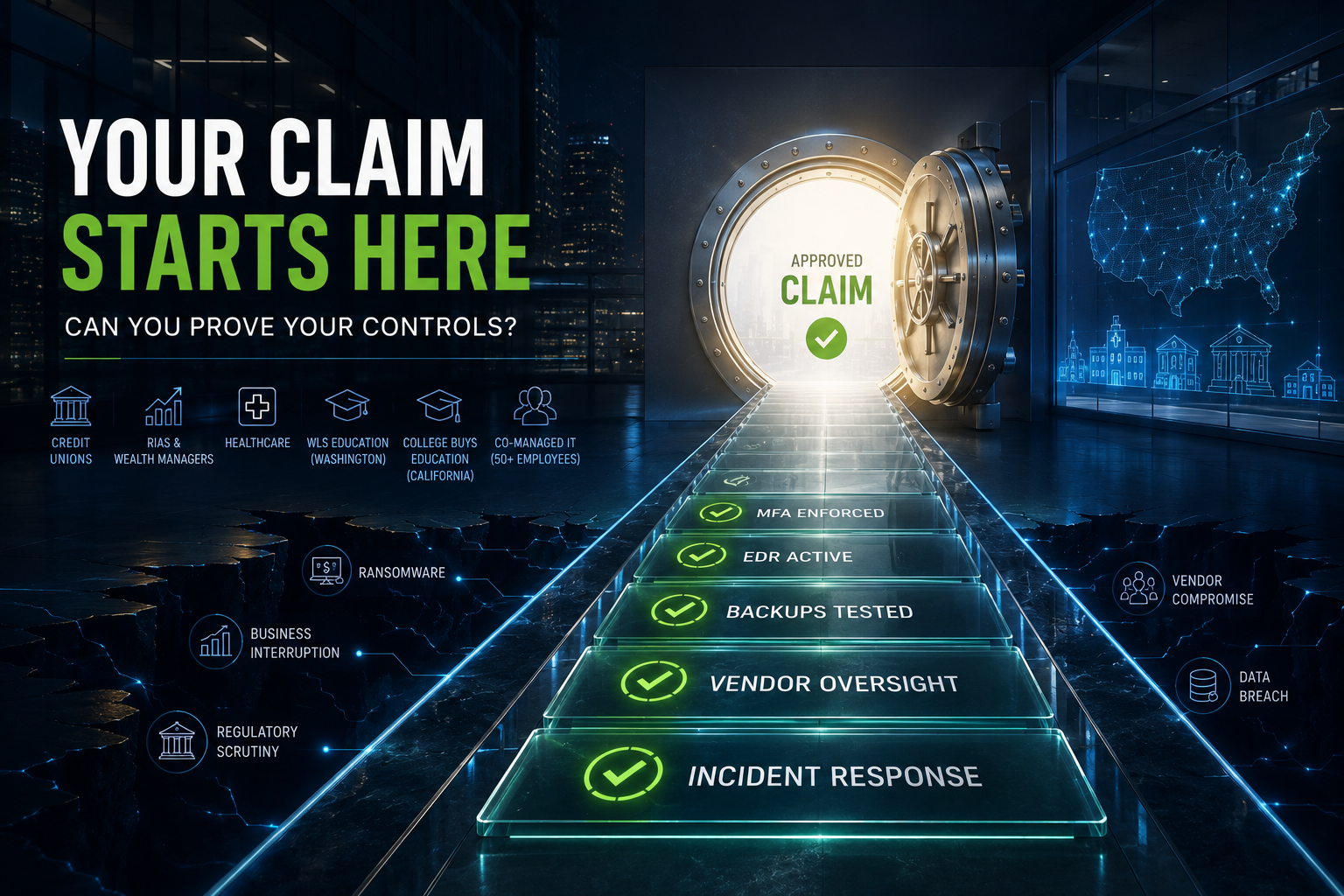
2026 Cyber Insurance Requirements
The controls listed on an insurance application increasingly need to be provable when a claim occurs. See how MFA, EDR, tested backups, vendor oversight, and incident response affect modern cyber insurance readiness.
Read the Article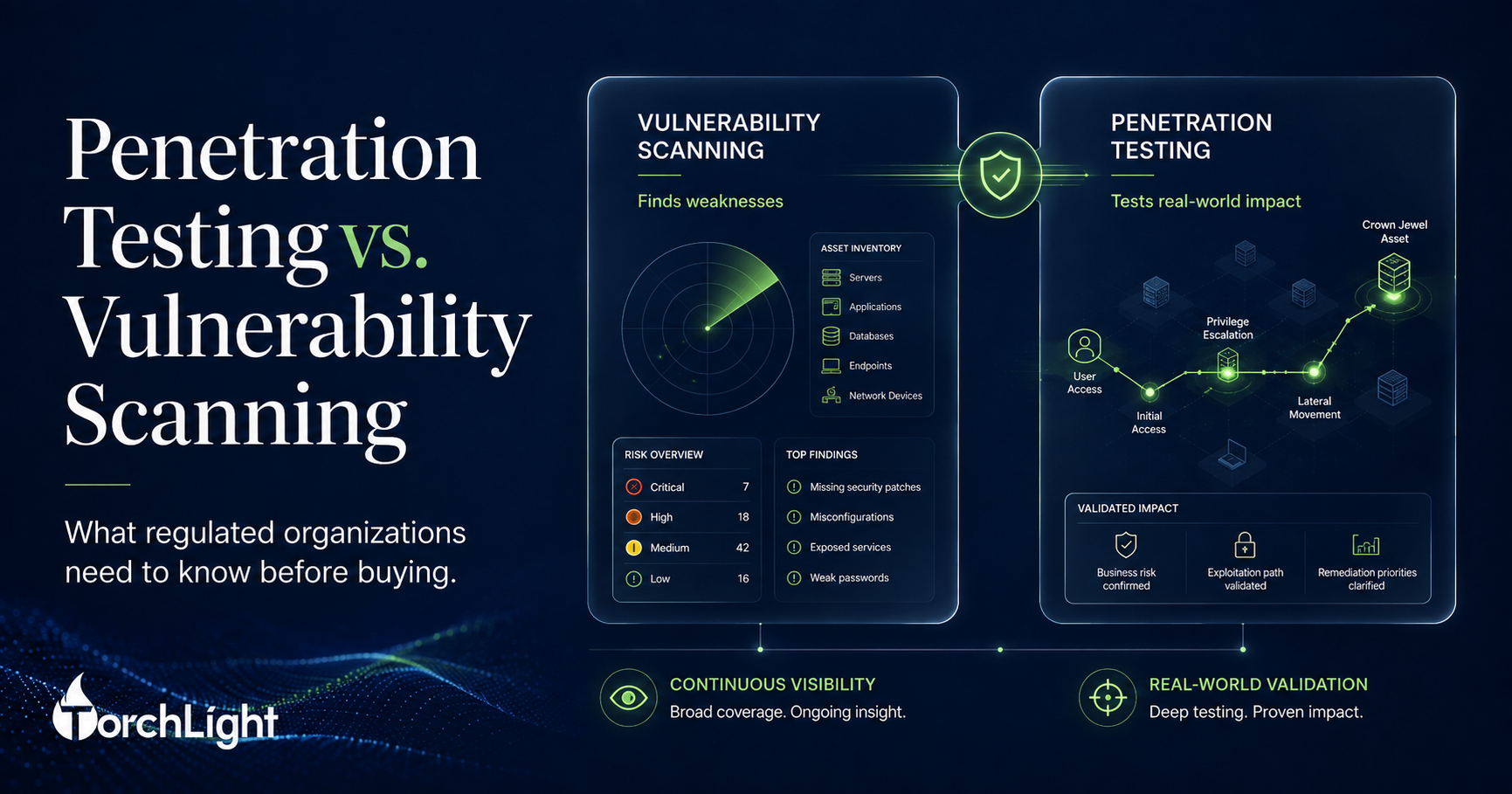
Penetration Testing vs. Vulnerability Scanning
Scanning finds possible weaknesses. Penetration testing demonstrates what can actually be exploited. This guide explains the difference and the evidence regulators, contracts, boards, and insurers may be asking to see.
Read the Article
Why Regulated Businesses Need Managed Security Services
Cyber insurance readiness does not stop when the application is submitted. Continuous monitoring, detection, incident response, and evidence help keep the controls behind the application operating after the policy begins.
Read the ArticleKnow What Your Policy Leaves Behind.
You do not need to know exactly which security control, coverage provision, regulatory requirement, or warranty option needs attention before starting the conversation.
Tell us what your insurer is asking, what your security team is trying to prove, or where leadership is concerned about exposure. TorchLight can help map the technical controls, evidence, and risk-transfer options around the problem.
The best time to understand the gap is before an incident turns policy language into a real-world question.
Start the Conversation.
Give us a little context about your cyber insurance, security controls, or coverage concerns and we’ll connect you with the right person at TorchLight.
TorchLight provides cybersecurity and technology services. Cyber warranty and risk-transfer options are subject to applicable terms and eligibility and do not replace independent insurance or legal advice.