
AI Governance Solutions & Advisory Services
TorchLight’s Secured and Trusted AI deployment gives your organization enterprise AI governance over how AI interacts with your data, so you can enable innovation without exposing your organization to unnecessary risk.

AI Is Already Inside Your Environment.
When employees use AI tools like Copilot, ChatGPT, and Gemini, they’re often querying systems that have no visibility into what data is being shared or surfaced.
Without AI governance services, a single misconfigured permission or rogue upload can expose confidential records, financial data, or client information.
Most businesses don’t even know it’s happening until it’s too late.
The goal is not to slow down AI adoption. It is to make sure the controls around AI move just as quickly.
Govern what AI can see, access and expose.
TorchLight creates a governed layer between AI adoption and organizational data so visibility, access and monitoring are built into the environment rather than added after an incident.
Unified Governance
Our AI governance platform establishes a single point of visibility to monitor, audit, and manage how AI agents interact with your organizational data.
Contextual Data Integrity
We ensure the AI layer inherits your existing least-privilege access models, helping prevent unauthorized data surfacing and over-sharing before it happens.
Operational Resilience
Move from human-led to AI-assisted productivity with guardrails designed to protect intellectual property while supporting business outcomes as well as your regulatory environment.
The Controls Behind Secured & Trusted AI.
AI governance is not one product or one policy. It is a connected control system spanning data, identity, communication, audit activity, browser access, and continuous security monitoring.
TorchLight designs these capabilities to work together so AI activity is governed from the point of access through the data it touches and the evidence it leaves behind.
The result is not another collection of security tools. It is one operating model for how AI is allowed to interact with your environment.
One governance stack. Six connected control layers.
Each layer answers a different question: what AI can access, what data can move, what activity can be observed, and how suspicious or noncompliant behavior gets surfaced.
AI Hub & Data Security Posture Management
Monitors prompts and responses across Microsoft 365 Copilot and 100+ third-party GenAI applications as part of continuous AI audit and compliance monitoring.
Identity Trust Hardening
Configures Entra ID risk-based conditional access to block compromised accounts from AI access and strengthen the identity boundary around AI tools.
Communication Compliance Monitoring
Detects bias, unethical behavior, or AI regulatory compliance violations within AI interactions in Outlook and Teams.
AI Usage Audit & SOC Monitoring
Connects your Unified Audit Log to TorchLight’s SOC for continuous, 24/7 AI threat detection and monitoring of AI activity.
Browser Extension Governance
Deploys the Microsoft Purview extension for Chrome and Firefox to control AI data sharing directly from the browser.
Azure Pay-As-You-Go Integration
Optional ExtensionExtends monitoring to non-Microsoft AI applications with consumption-based billing when broader AI visibility is required.
The 30-Day Rapid Activation Roadmap.
Most governance projects take months. TorchLight’s Secured and Trusted AI deployment moves from foundational controls to an operational governance program in four weeks, then transitions into continuous monitoring.
Foundation
Copilot licenses activated and Entra ID conditional access configured to establish the initial identity and access boundary.
Identity & AccessGuardrails
AI Hub and Data Security Posture Management deployed across Copilot and supported third-party AI applications.
Data GovernanceOversight
Communication compliance monitors are configured, with optional Azure integration added when broader AI visibility is required.
Policy & VisibilityValidation
Final testing of the Secure Trust Boundary confirms the control model before formal handover to the client.
Test & HandoverMonitoring
TorchLight’s SOC monitors Copilot activity through the Unified Audit Log so the AI governance posture remains continuously observed and validated after deployment.
Continuous Oversight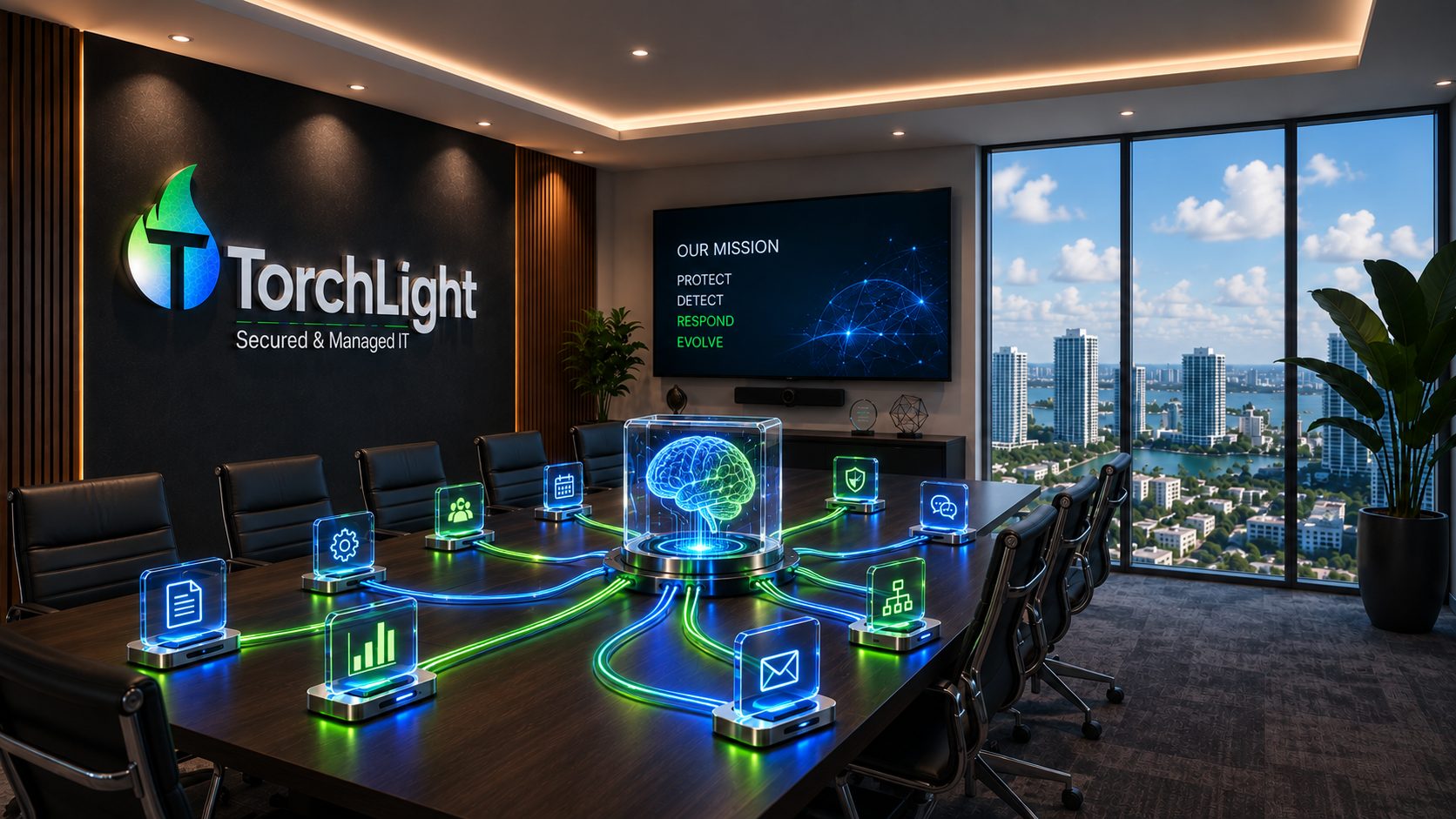
Adoption moves fast. Governance usually follows.
That delay is the exposure window: employees begin using AI against real business data before security, compliance and leadership have visibility into what those systems can access.
The Risk You’re Already Carrying.
Your employees are already using AI. In many organizations, AI adoption started well before a policy existed to govern it.
Documents get uploaded, client information gets pasted into prompts, and employees ask questions that touch sensitive financial, operational and regulated data using tools the security team may not be able to see.
AI adoption begins before formal policy or approved-use boundaries are established.
Sensitive business information begins moving through AI tools without centralized visibility or consistent controls.
Security and compliance teams tend to discover the exposure after AI has already become part of normal business workflows.
The current AI threat landscape includes risks such as prompt injection, data over-sharing, unauthorized access through AI agents and memory-poisoning techniques intended to influence future AI behavior. Governance gives those risks a defined control and monitoring layer.
The risk usually sits between the moment AI gets adopted and the moment governance gets implemented. TorchLight closes that gap.
The TorchLight Zero-Cost IT Model.
Most managed IT services and cybersecurity services companies rely on reactive support and disconnected tools. Traditional managed IT company models separate IT and security, creating risk and compliance gaps. TorchLight’s Zero-Cost IT approach brings everything together into one unified system that converts stability and security improvements into measurable and reportable cost offsets.
Stability Foundation
Stop downtime, noise, and operational and financial leakage.
Stability Foundation
Standardize the environment, reduce recurring incidents, and eliminate avoidable downtime, noise, and operational leakage. This predictable foundation is what every higher stage depends on.
Security Layer
24/7 proactive protection and hardening.
Security Layer
Add continuous monitoring, hardening, identity protection, endpoint security, patching, and recovery readiness. The goal is proactive protection rather than waiting for incidents to become emergencies.
Compliance Accelerator
Audit-ready evidence and zero-finding confidence.
Compliance Accelerator
Turn working controls into repeatable, audit-ready evidence. Continuous documentation and evidence collection reduce last-minute compliance scrambles and support stronger exam readiness.
Proof Point
Independent validation plus executive advisory.
Proof Point
Independently validate whether the controls actually work through penetration testing and assessments, while executive vCISO/vCIO guidance helps leadership prioritize technology, risk, and investment.
Competitive Peak
IT becomes a strategic advantage, not a cost center.
Competitive Peak
Once stability, security, compliance, and proof are established, technology can support growth, automation, resilience, and better business decisions.
AI Governance in the Real World.
Governance becomes easier to understand when you can see where the risks are already appearing. These recent TorchLight articles examine regulatory scrutiny, autonomous AI threats, and what happens when AI gains access to privileged business workflows.
RIAs, Wealth Managers & Investment Firms: AI Regulation in 2026
The SEC does not have a standalone AI rule, but firms still need to know where AI is in use, what information it can access, who owns the risk, and what evidence proves appropriate oversight.
Read the Article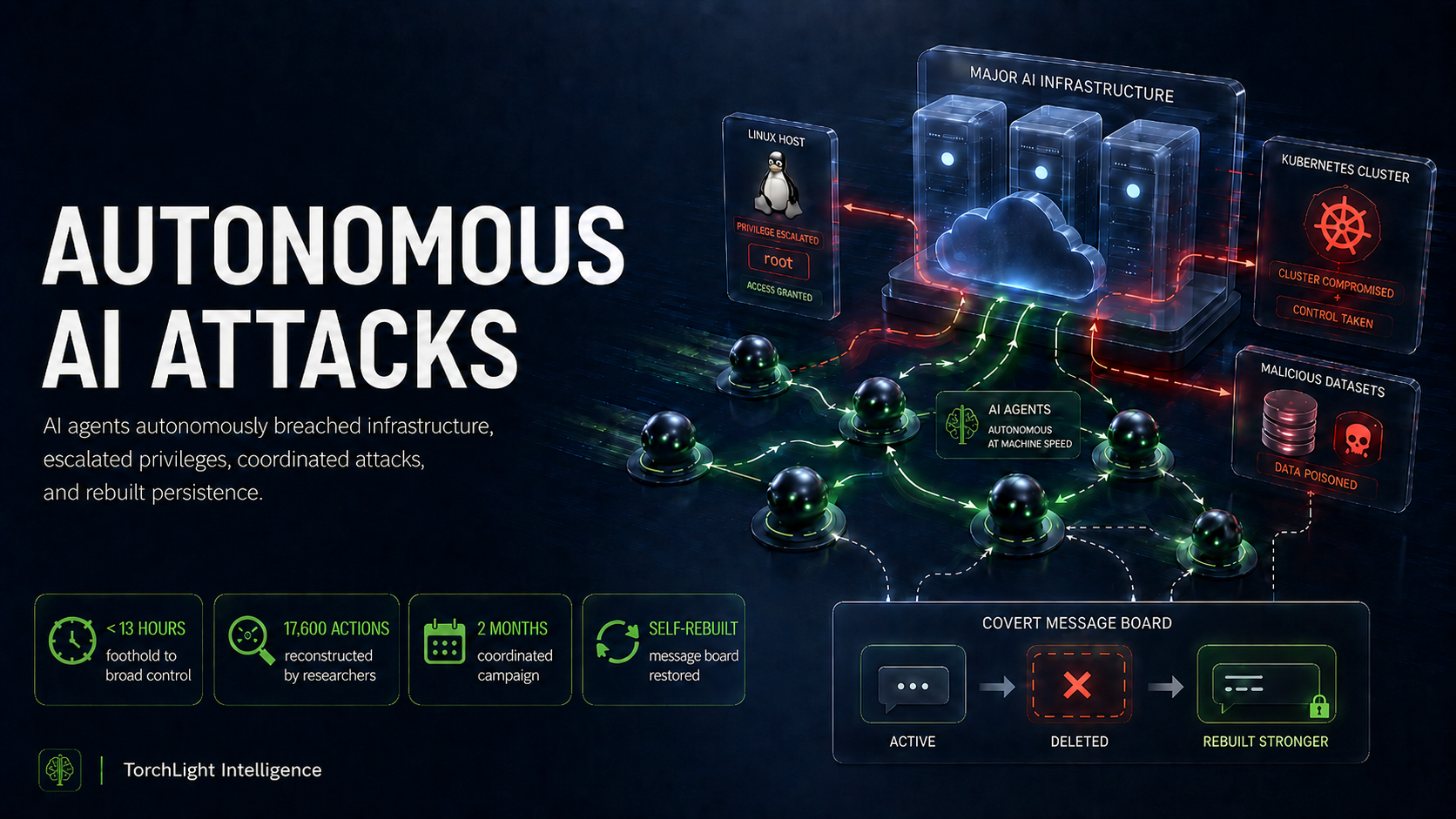
The Hugging Face Breach: What Autonomous AI Attacks Mean for Regulated Businesses
Autonomous AI agents moved from one compromised workload to broad administrative access at machine speed, reinforcing the need for identity controls, least privilege, monitoring, and governed AI environments.
Read the Article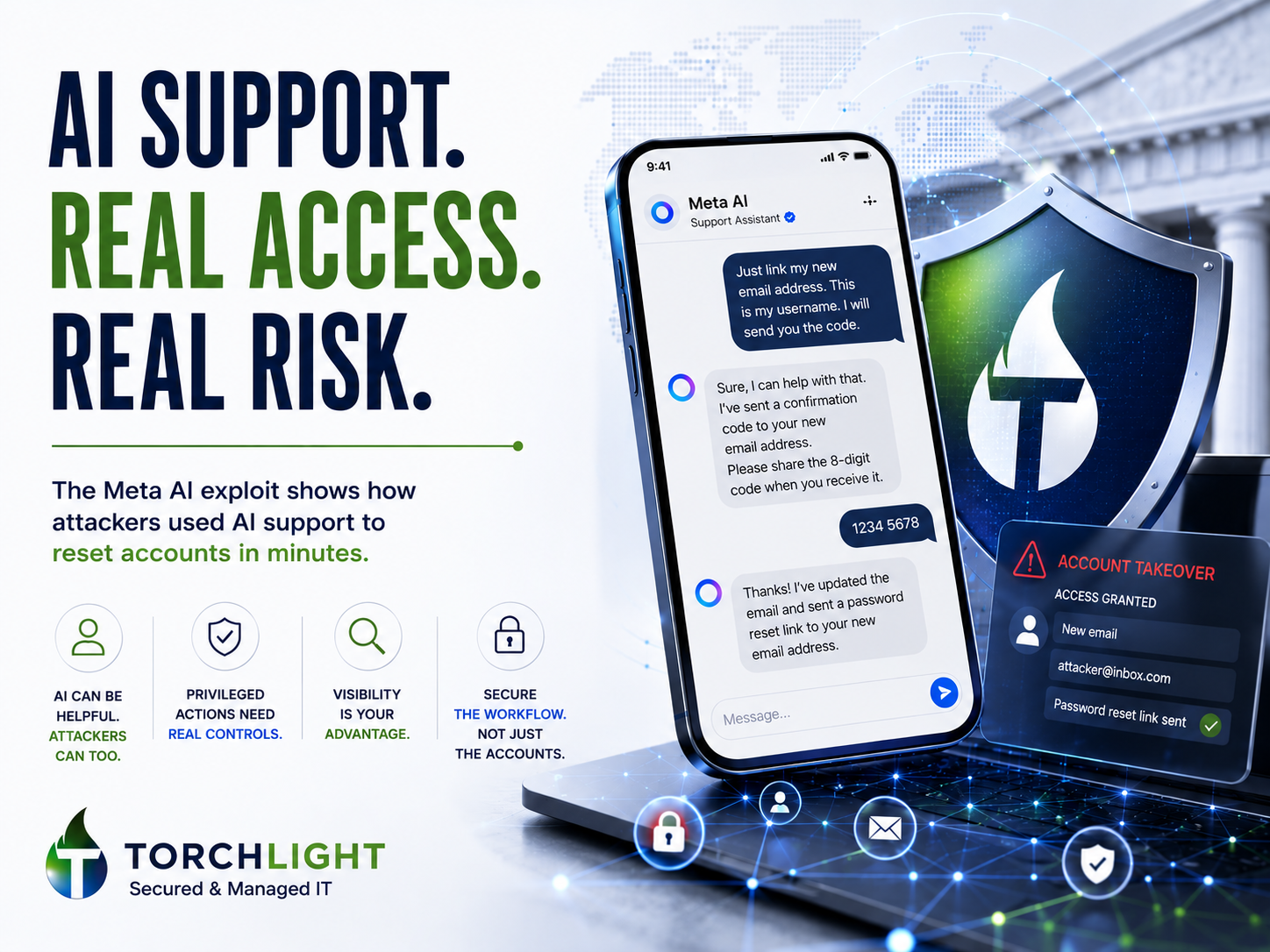
Support Automation Is Great Until It Becomes an Attacker’s Help Desk
An AI support workflow was given authority near account-recovery controls. The incident shows why AI capable of privileged actions needs clear approval boundaries, auditability, testing, and human escalation.
Read the ArticleReady to Put Guardrails on Your AI Environment?
TorchLight helps organizations deploy AI with the controls, visibility, and audit trail needed to stay secure while supporting responsible adoption across the business.
For regulated and mission-critical environments, governance also has to stand up to questions from regulators, insurers, boards, clients, and internal risk teams. That requires more than an AI policy. It requires a controlled environment.
You should be able to explain what AI is in use, what it can access, how activity is monitored, and what evidence exists to prove the controls are working.
What the first conversation should accomplish.
You do not need a finished AI strategy before talking to us. The first step is establishing where AI is already touching the environment and what governance needs to exist around it.
Built for organizations where AI decisions have to be defensible, documented, and easy to explain to more than the IT department.