

How to Choose the Right IT Partner: A Buyer’s Guide for Compliance-Sensitive Organizations
The right IT partner for a regulated organization treats security and compliance as the foundation, not an add-on. This guide gives leaders in financial services, healthcare, and government the criteria, vetting questions, and red flags to find a partner who keeps you audit-ready year-round.
By Calvin Reilly, TorchLight. Published April 13, 2026. Updated July 27, 2026. Reviewed by the TorchLight SOC
The short answer
- Choose security-first DNA, not a generalist MSP that sells security as an add-on
- Demand continuous audit readiness mapped to NIST, FFIEC, and HIPAA
- Require single-point accountability: IT, 24/7 SOC, and compliance under one roof
- Verify identity-centric protection (ITDR), because attackers log in, they do not hack in
What to look for in an IT partner in 2026
Choosing the wrong partner does not just mean slow support. It leads to failed audits, skyrocketing insurance premiums, and breaches that trigger mandatory regulatory notifications. Here are the six criteria that separate a compliance-first partner from commodity IT.
Security as the foundation
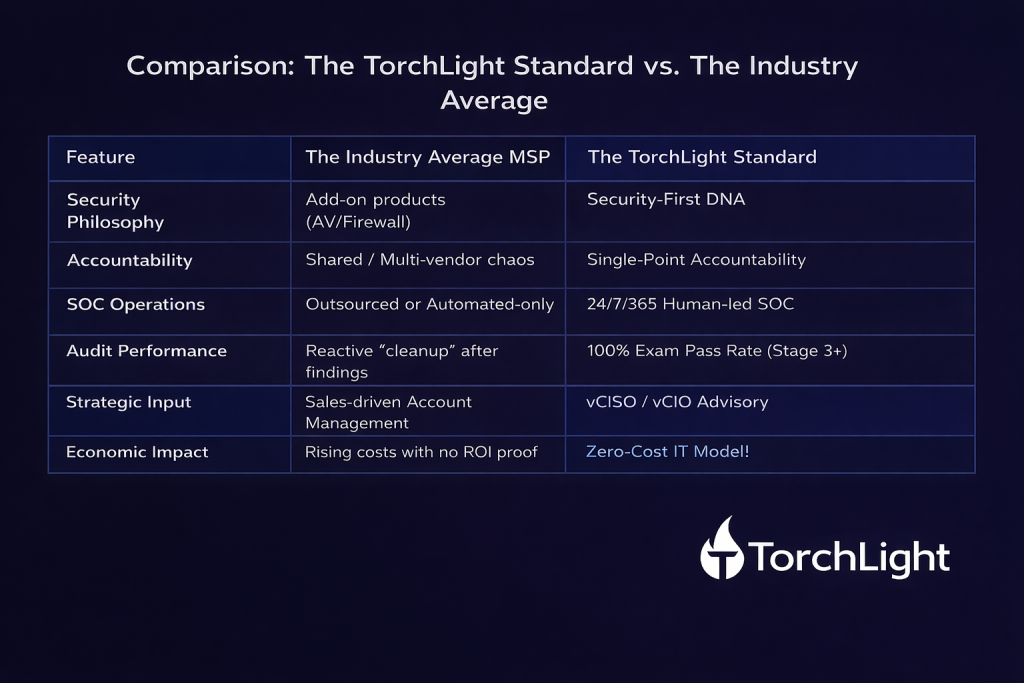
Avoid generalist MSPs that treat security as an add-on. Prioritize partners with security-first DNA, where compliance is baked into every technical process.
Continuous audit readiness
The right partner keeps you prepared for examination at all times, with real-time evidence, automated reporting, and alignment with frameworks like NIST, FFIEC, and HIPAA.
Single-point accountability
Look for a partner that owns the entire outcome: IT operations, a 24/7 managed SOC, and compliance advisory, so there is no vendor finger-pointing.
Identity-centric protection
In 2026 the perimeter is gone. Your partner must excel at Identity Threat Detection and Response (ITDR) to stop breaches at the credential level.
Proven industry expertise
Ensure the provider has a documented track record helping organizations in your sector, such as financial services or government, pass rigorous regulatory exams.
Operational visibility
Demand executive-level dashboards and vCISO advisory that translate complex technical data into clear business risk metrics for your board.
What is a compliance-first IT partner?
A compliance-first IT partner is a managed service provider (MSP) that builds regulatory compliance and security into every layer of the IT stack, rather than selling them as separate add-ons. It manages your risk, not just your devices.
Most MSPs were built on a foundation of uptime. Their goal was simple: keep the lights on and the internet running. While uptime is essential, it is only one small piece of the puzzle for compliance-sensitive organizations. A generalist MSP often treats security as a checkbox. They might install an antivirus and a firewall, but they rarely understand the nuances of NCUA AI compliance or the specific logging requirements of the Gramm-Leach-Bliley Act (GLBA).
A compliance-first partner, like TorchLight, integrates security into every technical decision. This shift from reactive maintenance to proactive risk management is the first thing to look for when evaluating potential partners.
Are you ready for your next examination? Explore our Audit and Compliance services to see how we help you stay audit-ready year-round.
How do you evaluate security-first DNA?
When you interview a potential partner, listen to how they talk about security. Is it a separate department? Is it a product they sell you? Or is it the lens through which they view every technical decision?
The managed SOC advantage
A standard IT shop might alert you when a server goes down. A top-tier partner provides a 24/7/365 Security Operations Center (SOC). This is not just software; it is a team of human experts watching for impossible-travel logins, suspicious identity changes, and emerging threat patterns.
At TorchLight, our Managed Security services provide continuous monitoring that identifies compromised credentials before they escalate into board-level incidents. If your IT partner is not watching your identities and cloud environment around the clock, they are leaving you exposed.
Identity is the new perimeter
In 2026, attackers do not hack in; they log in. Identity Threat Detection and Response (ITDR) is the discipline of monitoring user identities and access patterns so that even if a password is stolen, the unauthorized access is flagged and contained immediately. Your partner must have a deep ITDR focus.
How do you evaluate regulatory alignment and audit readiness?
For regulated organizations, the “IT person” is often the one sitting across the desk from a federal examiner. If your partner is not prepared to defend your technical controls, you are the one who will face the findings.
The Stage 3 confidence
One hallmark of a mature IT partner is their track record with regulators. At TorchLight, we are proud of our 100% regulatory exam pass rate for clients who reach Stage 3 of our maturity model. When vetting a partner, ask:
- Do they provide vCISO advisory services to help with board-level reporting?
- Do they offer an automated Evidence Register that maps your IT controls directly to frameworks like NIST or FFIEC?
- Can they demonstrate a history of helping organizations in your specific sector pass examinations?
Proactive vulnerability management
Standard patching is no longer enough to satisfy auditors. You need a partner that conducts continuous vulnerability monitoring, prioritizing risks by their impact on your specific business so the most critical gaps are closed first.
Why does local accountability matter?
While the world is increasingly remote, there is significant value in a partner who is part of your local ecosystem. Based in Liberty Lake, WA, TorchLight serves a critical role for organizations across the Pacific Northwest. Whether you are a credit union in Spokane or a municipality in the Inland Northwest, a partner who can provide on-site Professional Services when needed is vital.
- Faster response for physical infrastructure. Sometimes boots on the ground are the only way to resolve a mission-critical failure.
- Understanding regional risks. We understand the local regulatory and economic landscape, so our advice is contextually relevant.
- Community trust. We are not just a vendor; we are your neighbors. Our reputation is built on the success of the local institutions we protect.
What should the service catalog actually include?
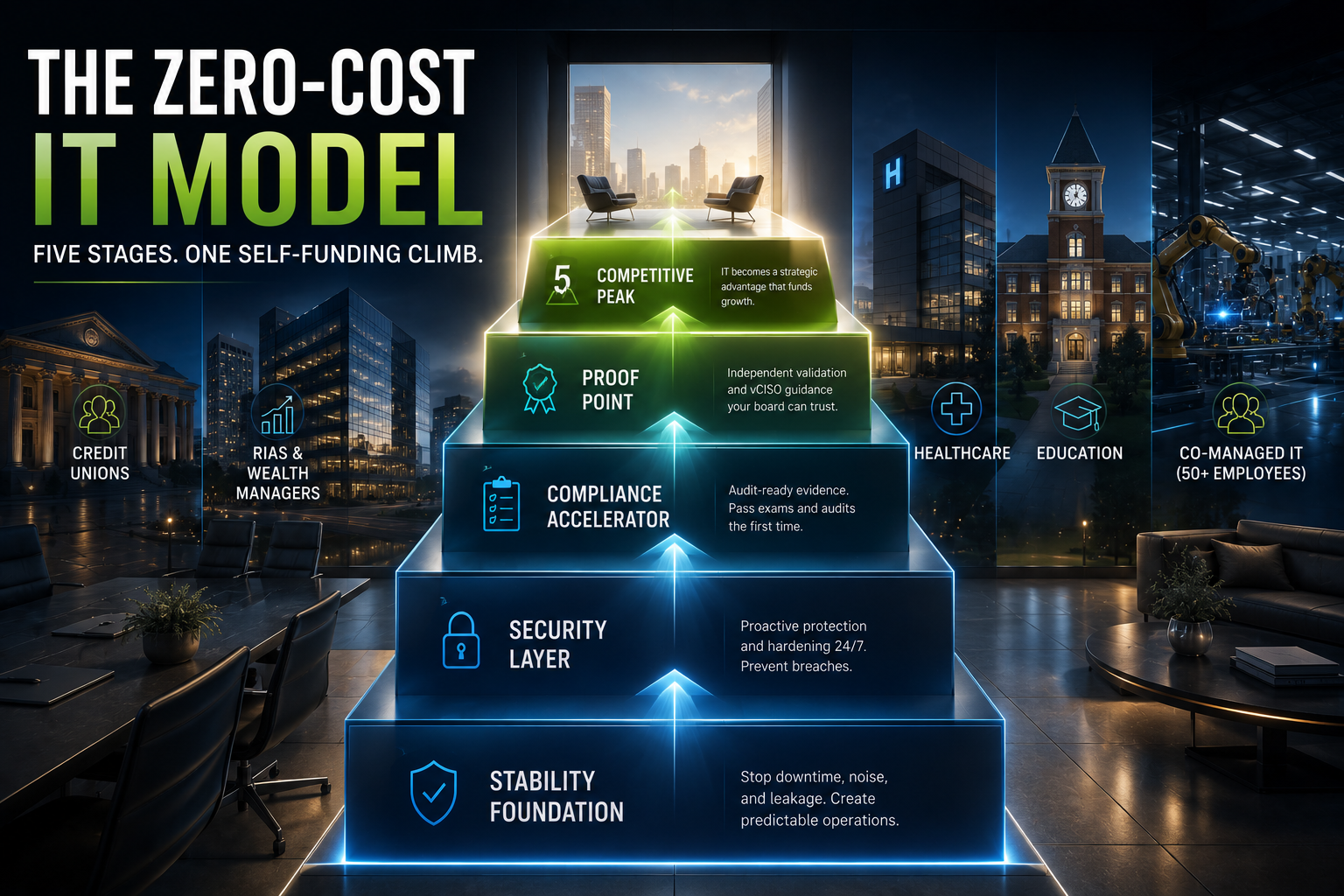
For high-risk organizations, the catalog should go far beyond “help desk.” Many leaders see IT as a black hole for capital. Our Zero-Cost IT model challenges that: the program is designed to pay for itself.
- Reduced cyber insurance premiums. By implementing the controls carriers demand, our clients see an average 30-35% reduction in premiums.
- Operational efficiency. Eliminating vendor sprawl and technical debt reclaims staff productivity.
- Preventing downtime. The cost of a single hour of downtime for a financial institution often exceeds the annual cost of managed IT.
Already have an internal IT team? You do not need to replace them; you need to empower them. Co-Managed IT and Security lets your staff handle daily user requests while TorchLight manages the complex compliance, SOC monitoring, and infrastructure security.
What are the red flags in a potential IT partner?
Not all IT providers are created equal. When evaluating your options, be on the lookout for these warning signs.
The one-size-fits-all stack
If they propose the same solution for a retail shop as they do for your bank, they do not understand compliance.
Opaque reporting
If you cannot get a clear health scorecard or risk heatmap for your board, they are not providing true visibility.
Finger-pointing culture
If they blame your cloud provider or software vendors for every issue, they are not taking single-point accountability.
Lack of testing
A partner who does not suggest regular penetration testing is asking you to trust them without proof.
Tired of the finger-pointing? Learn about our Managed IT services and how we take full ownership of your technology outcomes.
Is your partner ready for the 2026 regulatory landscape?
The rules are changing. In 2026, regulators like the National Credit Union Administration (NCUA) are placing a massive emphasis on operational resilience and third-party risk management.
AI governance
As AI becomes an operational reality, it introduces new risks, from data leakage to model bias. Your IT partner should be helping you build an AI use case inventory and aligning your AI controls with the NIST framework. We detail exactly what this looks like in our guide on NCUA’s AI Compliance Plan.
Vendor oversight
You are responsible for the security of your vendors. A top-tier partner provides the documentation and due-diligence evidence you need to satisfy committees and boards that your supply chain is secure.
The TorchLight standard vs. the industry average
Choose a partner who helps you pass exams, not just close tickets
“TorchLight has been more than a vendor to our multi-branch credit union, they are more like our partner … delivered for almost 20 years.”
— Annettee Babb, CEO, PrimeSource Credit Union- Built for regulated industries: credit unions, community banks, government, wealth management, and healthcare
- Security and IT operated as one system, with a 24/7/365 SOC behind every engagement
- Critical security gaps like identity protection and backups prioritized in the first 30 days
- A stable, secure, audit-ready environment that supports your growth
What buyers often ask
How does a security-first IT partner help with cyber insurance?
Cyber insurance carriers in 2026 are incredibly strict. They want to see Endpoint Detection and Response (EDR), multifactor authentication (MFA), and immutable backups. We do not just implement these; we provide the attestations and proof-point reporting that carriers accept to stabilize or reduce your premiums. Our clients see an average 30-35% premium reduction.
Can you work with our existing IT director or internal team?
Absolutely. Most of our high-stakes clients use our Co-Managed model. We act as a force multiplier, taking the 2:00 AM security alerts and compliance documentation off their plate so they can focus on internal business projects.
What industries does TorchLight specialize in?
We are built for Credit Unions and Community Banks, Government agencies, Wealth Management firms, and Healthcare providers. Essentially, any organization where downtime or data loss is non-negotiable.
How long does onboarding to a new IT partner take?
A full transition to our secured environment typically takes 60 to 90 days. However, we prioritize critical security gaps, like identity protection and backups, in the first 30 days to reduce your immediate risk exposure.
What questions should I ask when vetting an IT partner?
Ask whether they provide vCISO advisory for board-level reporting, whether they offer an evidence register that maps your controls to frameworks like NIST or FFIEC, whether they run a 24/7 human-staffed SOC, whether they conduct regular penetration testing, and whether they can show a track record of clients in your sector passing regulatory examinations.
What is Identity Threat Detection and Response (ITDR)?
ITDR is the discipline of continuously monitoring user identities, credentials, and access patterns to detect and contain unauthorized access. Because modern attackers log in with stolen credentials rather than breaking through the perimeter, ITDR flags events like impossible-travel logins and suspicious identity changes so a stolen password does not become a breach.