
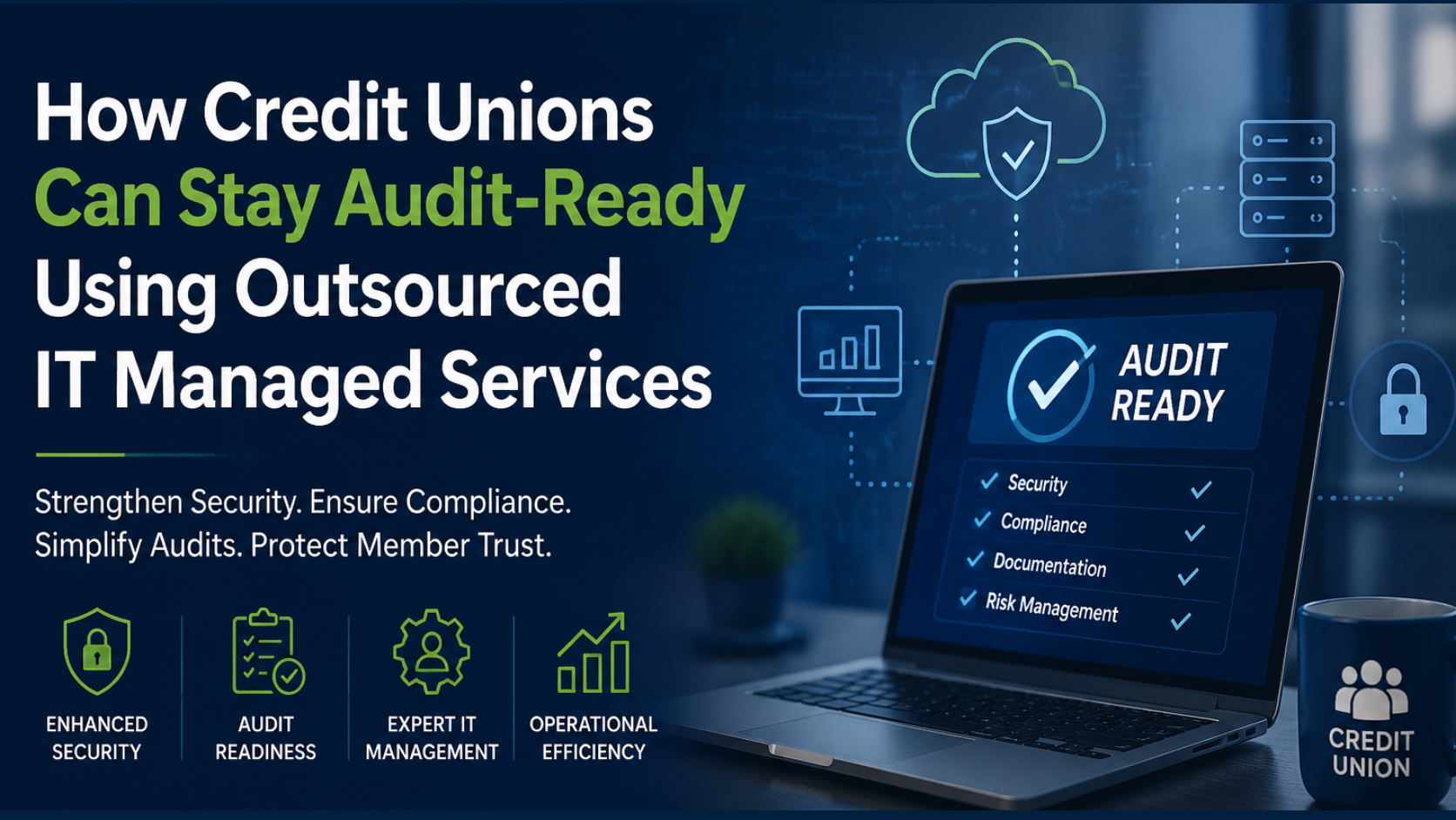
How Credit Unions Can Stay Audit-Ready Using Outsourced IT Managed Services
Every credit union leader knows the feeling: an NCUA exam is approaching, and the scramble begins, pulling together logs, chasing down documentation, trying to prove that controls are actually in place. It’s stressful, expensive, and entirely avoidable.
The root problem is almost always the same. IT and compliance have been treated as separate disciplines, handled reactively, and managed with limited internal resources. For most credit unions, especially those under $1 billion in assets, building a fully staffed, always-on IT security and compliance function in-house simply isn’t financially realistic.
That’s precisely why more credit unions are turning to outsourced IT managed solutions. Not just for day-to-day helpdesk support, but for a comprehensive, compliance-embedded approach that keeps them exam-ready 365 days a year.
This guide explains how outsourced managed IT services work within the credit union context, what audit-readiness actually requires in 2026, and how to evaluate whether your current setup is truly prepared, or just hoping for the best.
What “Audit-Ready” Actually Means for Credit Unions in 2026
Before exploring how outsourced IT managed services help, it’s worth understanding what regulators are actually looking for. The NCUA’s 2026 Supervisory Priorities make the expectations clear:
- Cybersecurity remains a top-tier concern, with a specific focus on third-party and vendor risk management
- Information Security Examination (ISE) procedures require documented controls, continuous logging, and evidence of proactive risk management
- The 72-hour cyber incident notification rule demands that credit unions have automated documentation workflows in place, not something assembled manually after the fact
- Board-level governance of cybersecurity is now expected, with examiners reviewing whether leadership understands and can account for the credit union’s risk posture
Audit-readiness, then, is not a one-week project before an exam. It’s a continuous operational state. Controls must be mapped to frameworks like 12 CFR Part 748 and GLBA. Evidence must be captured daily. Reporting must be structured so that examiners and your board can understand it without a translation layer.
This is exactly the kind of discipline that outsourced managed IT providers purpose-built for regulated industries can deliver systematically.
Why In-House IT Alone Falls Short
Most credit unions rely on one to three internal IT staff members to manage everything from workstation support to network security to regulatory documentation. That team is stretched thin under normal conditions. When an exam is imminent or an incident occurs, the gaps become painfully visible.
Here’s a practical comparison of what internal-only IT typically looks like versus what leading managed IT services for outsourced work provide:
| Capability | Internal IT Only | Outsourced Managed IT Services |
| 24/7 threat monitoring | Rarely feasible | Standard offering |
| NCUA/GLBA control mapping | Manual, inconsistent | Embedded in daily operations |
| Audit-ready documentation | Compiled pre-exam | Continuously maintained |
| Incident response & 72-hr reporting | Ad hoc | Automated documentation workflow |
| Board-level reporting | Minimal | Structured quarterly proof-point reports |
| Vendor/third-party risk management | Often overlooked | Proactively managed |
| Penetration testing | Infrequent or skipped | Scheduled and validated |
| Cyber insurance alignment | Reactive | Evidence package prepared for carriers |
The delta between these two columns is where regulatory findings happen, and where member trust erodes.
The Core Components of Outsourced Managed IT Support for Credit Unions
When evaluating outsourced managed IT support, credit unions should look for providers that deliver more than basic monitoring and helpdesk tickets. True audit-readiness requires a layered, integrated approach.
1. Continuous Threat Monitoring and Active Response
A qualified outsourced managed IT service provider runs 24/7 Security Operations Center (SOC) coverage, meaning your environment is actively watched even at 3 am on a Sunday. Threats are not just detected, they’re contained, documented, and reported in a format that satisfies NCUA’s incident notification requirements.
2. SIEM and Log Management
Security Information and Event Management (SIEM) systems aggregate logs from across your environment, endpoints, network devices, cloud services, and core banking integrations. For NCUA examiners, log completeness and retention are non-negotiable. Your outsourced managed IT partner should not only deploy and maintain SIEM infrastructure but also generate the compliance reports examiners expect to see.
3. Endpoint Detection and Response (EDR) with Identity Threat Detection
Modern attacks frequently exploit stolen credentials rather than malware, making traditional antivirus software insufficient. Comprehensive outsourced managed IT services include EDR paired with Identity Threat Detection and Response (ITDR), protecting both devices and user accounts, including remote staff accessing core systems.
4. Compliance-Embedded Operations
This is the differentiator that separates compliance-aware MSPs from generic IT providers. Rather than treating NCUA exam preparation as a separate annual project, a true credit union IT partner builds control mapping, evidence capture, and audit artifact generation into the day-to-day operational workflow. When the examiner arrives, documentation is already organized, not assembled overnight.
5. Vendor and Third-Party Risk Management
The NCUA has made vendor oversight a central focus in both 2025 and 2026 supervisory priorities. Your outsourced managed IT partner should actively assist with third-party risk assessments, helping you document due diligence on core processors, digital banking platforms, and other critical vendors.
6. Board-Ready Reporting
Examiners now expect credit union boards to demonstrate meaningful oversight of cybersecurity. This requires reporting that communicates risk, control maturity, and incident history in plain language, not raw technical logs. Leading managed IT services for outsourced work produce quarterly proof-point reports designed to be handed directly to your board or supervisory committee.
How the Right Outsourced IT Managed Partner Transforms Exam Outcomes
Consider what changes when outsourced managed IT is embedded into operations correctly:
Before an exam: Documentation is already organized. Control mapping to NCUA frameworks is current. Risk assessments are completed. The examiner’s standard request list can be fulfilled within hours, not days.
During an exam: Your team isn’t scrambling. Examiners receive the artifacts they need, logs, incident reports, policy documentation, vendor oversight records, structured in the format they’re trained to review.
After an exam: Findings (if any) come with a remediation roadmap already prepared. Evidence of ongoing progress is captured automatically, so the next cycle starts strong.
Credit unions that achieve this level of operational maturity consistently report zero regulatory findings at examination, not because auditors are lenient, but because there’s genuinely nothing to find.
What to Look for in an Outsourced Managed IT Service Provider
Not all MSPs are equipped for the unique demands of credit union compliance. When evaluating partners, look for:
| Evaluation Criteria | Why It Matters |
| NCUA/GLBA-specific experience | Generic MSPs don’t know what ISE examiners look for |
| Certifications (CISSP, CISA, CISM) | Validates security and compliance expertise |
| Former examiner on staff | Ensures documentation is structured as regulators review it |
| Exam pass rate track record | Concrete evidence of outcomes, not promises |
| Core banking system integration experience | Covers the systems where member data actually lives |
| Automated 72-hour incident documentation | NCUA’s notification rule requires speed and accuracy |
| Transparent co-management options | Preserves internal IT’s role while filling critical gaps |
| Cyber insurance alignment | Helps reduce premiums through documented controls |
For a deeper look at recent FFIEC IT Examination Handbook guidance, review the OCC bulletin on the FFIEC Development, Acquisition, and Maintenance booklet, which outlines examiner expectations for controls and risk management.
The Cost Case: Why Outsourced IT Managed Services Often Pay for Themselves
A common objection from credit union leadership is the budget. Bringing in an outsourced managed IT partner feels like an added expense. In practice, the math often tells a different story.
Consider the typical cost leakage that a mature managed IT program eliminates or reduces:
- Unplanned downtime – member-facing systems going dark, even briefly, carries real operational and reputational cost
- Vendor sprawl – many credit unions are paying for overlapping or underutilized security tools with no unified oversight
- Pre-exam scrambles – staff time spent assembling documentation before every examination cycle adds up significantly
- Cyber insurance premiums – credit unions with documented, continuously maintained controls regularly see 30–35% reductions at renewal
- Regulatory findings – a single material finding can trigger follow-up examinations, remediation costs, and reputational exposure that dwarfs annual IT service fees
When these offsets are factored in alongside the strategic value of consistent exam readiness, outsourced managed IT services frequently reach cost-neutral or net-positive outcomes, particularly as the partnership matures.
Co-Managed vs. Fully Outsourced: Which Model Fits Your Credit Union?
Outsourced managed IT doesn’t have to mean handing over everything. Two primary models serve different credit union needs:
Fully Outsourced IT: The managed IT provider handles all aspects of IT operations, security, and compliance documentation. This model suits smaller credit unions without internal IT staff, or institutions that have decided to consolidate all technology accountability under one partner.
Co-Managed IT: Internal IT staff retain ownership of certain functions (member-facing support, system administration) while the MSP provides specialized capabilities they can’t replicate in-house: 24/7 SOC coverage, SIEM management, compliance reporting, vCISO advisory, and penetration testing. This model is common in credit unions with 2–5 IT staff who are capable but simply can’t cover every domain simultaneously.
Both approaches can achieve full audit-readiness when structured correctly. The key is clear accountability, knowing exactly who owns what, with no gaps between internal and external responsibility.
For credit unions evaluating their options, TorchLight’s Managed IT Services and Co-Managed IT offerings are designed specifically for this decision point, supporting both full outsourcing and collaborative models.
Common Gaps That Lead to NCUA Findings and How Outsourced IT Managed Services Close Them
Based on examiner focus areas, these are the most frequently cited gaps at ISE examinations:
1. Incomplete or missing log management. Logs are foundational evidence. If your SIEM isn’t capturing complete, tamper-evident logs across all critical systems, examiners will flag it. A good outsourced managed IT service maintains SIEM continuously and produces log completeness reports on demand.
2. Undocumented incident response procedures. Having a plan in a drawer isn’t the same as having a documented, tested, operational procedure. Managed IT partners formalize, test, and update incident response plans aligned to NCUA’s notification requirements.
3. Weak vendor risk management. Third-party oversight has become one of the most scrutinized areas in credit union examinations. If your due diligence on vendors is thin or outdated, that’s a finding waiting to happen. Leading outsourced managed IT providers include vendor risk management as a core service component.
4. Board governance gaps Examiners want evidence that the board receives meaningful cybersecurity reporting and engages with it. Quarterly board-ready reports, written in business language, not technical jargon, are a standard deliverable from mature outsourced managed IT service engagements.
5. No independent validation. Self-assessment without independent verification doesn’t satisfy modern examiner expectations. Penetration testing and independent security assessments, coordinated through your managed IT partner, close this gap.
For a full picture of what TorchLight’s compliance-focused approach looks like in practice, explore the Credit Union Cybersecurity and IT Services page or review the Audits, Assessments & Compliance service offerings.
Outsourced IT Managed Services and Cyber Insurance: A Direct Connection
Cyber insurance has become both more expensive and more demanding in recent years. Underwriters are requiring detailed documentation of controls before issuing or renewing policies, and they’re reducing coverage or increasing premiums for credit unions that can’t demonstrate continuous security discipline.
Outsourced managed IT providers who understand the insurance landscape align controls directly to underwriting requirements. The result is an evidence package, documented endpoint protection, identity management procedures, incident response records, penetration test results, and continuous monitoring proof that carriers evaluate without lengthy back-and-forth.
Credit unions with mature managed IT partnerships routinely achieve meaningful premium reductions at renewal simply because the documentation carriers want already exists. This is one of the more tangible financial returns on the outsourced managed IT investment.
For a current overview of how cyber insurance underwriting is evolving for financial institutions, the CISA Cybersecurity Resources for Financial Institutions provides relevant federal-level guidance on controls and risk frameworks.
Getting Started: Steps to Evaluate Your Current Audit-Readiness
If you’re not sure where your credit union stands, these questions are a useful starting point:
- Can you produce a complete log of all security events from the past 90 days within 24 hours?
- Does your board receive structured cybersecurity reporting at least quarterly?
- Has your incident response plan been tested in the last 12 months?
- Do you have documented due diligence on all critical vendors updated within the last year?
- Has an independent penetration test been completed within the last 12 months?
- Can you demonstrate control mapping to the NCUA and GLBA frameworks?
- Do you have automated documentation in place to support the 72-hour incident notification requirement?
If the answer to any of these is “no” or “I’m not sure,” those are the gaps your outsourced managed IT partner should be closing before the next examination cycle begins.
Conclusion: Audit-Readiness Is an Operational Discipline, Not a One-Time Project
Credit unions that consistently pass NCUA examinations with zero findings share a common trait: they’ve stopped treating compliance as a seasonal event and started treating it as an embedded operational discipline. Outsourced IT managed services, when delivered by a partner with genuine credit union expertise, are the most practical and cost-effective way to achieve this.
From 24/7 monitoring and automated incident documentation to board-ready reporting and vendor risk oversight, the right outsourced managed IT service eliminates the scramble, reduces regulatory exposure, and builds the kind of demonstrable, documented trust that keeps members and examiners confident.
The question isn’t whether your credit union can afford outsourced managed IT support. For most institutions, the real question is whether they can afford to continue without it.
Outsourced IT Managed Services – Frequently Asked Questions
What is outsourced IT managed support for credit unions?
Outsourced IT managed support means engaging a third-party provider to handle some or all of your IT operations, security monitoring, compliance documentation, and strategic advisory, rather than relying solely on internal staff. For credit unions, this typically includes 24/7 SOC monitoring, SIEM management, NCUA/GLBA compliance reporting, and vendor risk oversight.
How does outsourced managed IT help credit unions pass NCUA exams?
By embedding compliance-mapped controls, continuous log management, and audit-ready documentation into daily operations, outsourced managed IT providers ensure that all the evidence examiners require is already organized before the exam begins. This eliminates last-minute scrambles and dramatically reduces the likelihood of regulatory findings.
What is the difference between co-managed and fully outsourced IT managed services?
Fully outsourced managed IT means the provider handles all IT functions. Co-managed means your internal IT team handles certain functions while the MSP fills specialized gaps, such as 24/7 monitoring, SIEM, compliance reporting, and penetration testing. Both models can achieve full audit-readiness when structured with clear accountability.
Can outsourced IT managed services reduce cyber insurance premiums?
Yes. Credit unions that maintain documented, continuously verified security controls, aligned to underwriting requirements through their outsourced managed IT service partner, typically see 30–35% reductions in cyber insurance premiums at renewal.
How do I know if my credit union’s IT setup is audit-ready?
Key indicators include: complete log retention and SIEM coverage, documented and tested incident response procedures, board-level cybersecurity reporting, current vendor risk assessments, and independent penetration testing completed within the past 12 months. If any of these are missing, an outsourced IT managed assessment is the right starting point.
What should I look for in leading managed IT services for outsourced work in the credit union space?
Look for NCUA/GLBA-specific experience, certifications (CISSP, CISA, CISM), a track record of exam pass rates, core banking system integration experience, automated 72-hour incident documentation, and transparent reporting designed for board-level audiences, not just technical dashboards.