

Washington K-12 Cybersecurity Readiness Starts With Five Questions.
Student data. Internet safety. Incident response. Security controls. Recovery.
Use TorchLight’s free Washington K-12 Cybersecurity Readiness Checklist to see where your district has clear answers today and where the next conversation should start.
Five practical questions covering cybersecurity framework adoption, student-data protection, CIPA and E-Rate readiness, incident response, and recovery and access controls.
One District. Several Requirements. One Security Program.
Washington K-12 cybersecurity is not one checkbox, one policy or one annual project.
District technology teams have to protect student information, maintain internet-safety requirements, prepare for incidents, satisfy increasingly specific security expectations and still keep schools operating every day.
The readiness checklist turns those overlapping responsibilities into five practical questions your team can evaluate right now.
Student Data Protection
Know where sensitive student information lives, who can access it and how that access is controlled.
CIPA & E-Rate Readiness
Internet-safety controls, filtering and documented practices need to remain supportable as technology changes.
Incident Response
A district should know who acts, what gets preserved, how decisions are escalated and how communications begin.
Explore assessment & complianceSecurity Controls
Identity, endpoint protection, monitoring and other foundational controls have to work together as one operating program.
Explore managed securityRecovery, Access & Evidence
Backups, privileged access, recovery capability and documentation matter most when your district has to prove that safeguards exist and that critical systems can actually be restored.
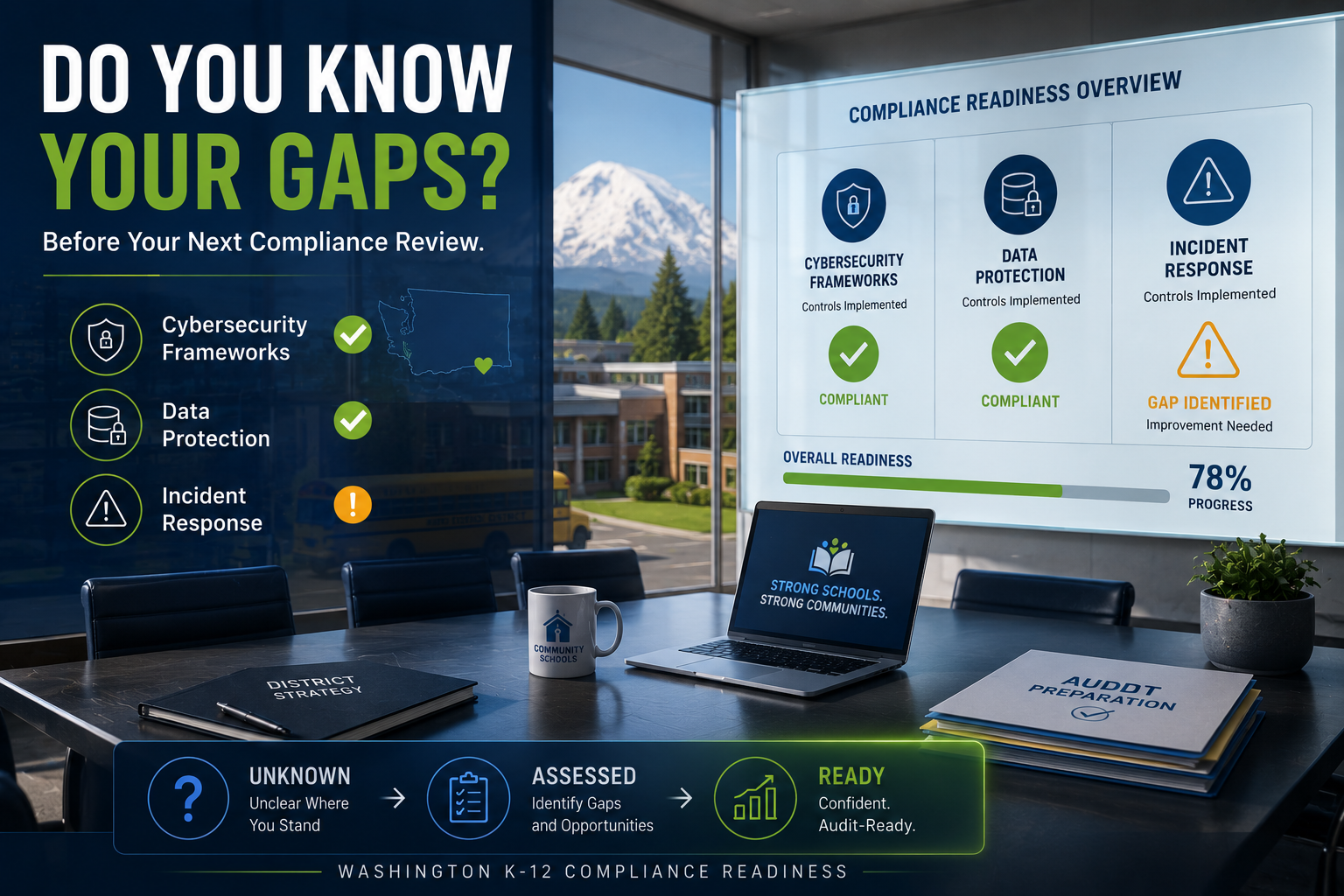
Five Questions Every District Should Be Able to Answer.
A strong cybersecurity program is easier to evaluate when the conversation starts with practical questions instead of a hundred technical controls.
TorchLight’s Washington K-12 Cybersecurity Readiness Checklist gives district leaders a simple way to begin that conversation with IT, administration and leadership.
If one of these questions produces an uncertain answer, the checklist helps identify where to look next.
Have we adopted a cybersecurity framework we can actually measure against?
Policies are useful, but leadership also needs a repeatable way to evaluate whether security practices are improving.
Do we know where student data lives and who can access it?
Sensitive information can move across applications, vendors, cloud platforms and internal systems faster than most inventories change.
Can we demonstrate that our internet-safety controls remain effective?
Filtering and acceptable-use requirements should remain supportable as devices, networks and classroom technology evolve.
Does everyone know what happens during the first hours of a cyber incident?
Roles, escalation, evidence preservation and communication should already be understood before an incident begins.
Could we restore critical systems and explain who had privileged access if we had to do it tomorrow?
Recovery readiness, administrative access and documentation become especially important when normal operations have already been disrupted.
Washington K-12 Security Is More Than One Compliance Requirement.
Washington school districts operate where cybersecurity, student privacy, internet safety, public-sector breach response and federal funding requirements overlap.
TorchLight helps district leaders understand how those requirements translate into the technology, controls, documentation and operating practices their teams manage every day.
Washington Student Privacy
Chapter 28A.604 RCW establishes Washington-specific requirements around student personal information, its use and the security practices surrounding education technology.
Electronic Resources & Internet Safety
Washington districts maintain electronic-resource and internet-safety policies that require ongoing review as technology, instructional use and online risks change.
CIPA & E-Rate
Internet safety policies, technology protection measures, filtering, documentation and related practices matter when districts participate in applicable E-Rate funding programs.
Washington Breach Response
Security incidents can create state notification obligations, making preparation, evidence preservation, escalation and accurate incident documentation critical.
Our job is to connect regulatory expectations to the real environment: identities, endpoints, cloud systems, vendors, backups, monitoring, policies and the people responsible for all of it.
Would You Rather Speak to One of Our Experts?
You can book a meeting directly with a member of our team. Bring the questions your district is working through and we can start there.
Book A MeetingOr Start the Conversation Here.
Give us a little context and we’ll connect you with the right person at TorchLight.
You do not need to know exactly which service you need. Tell us what your district is working through and we can help identify the right next step.