
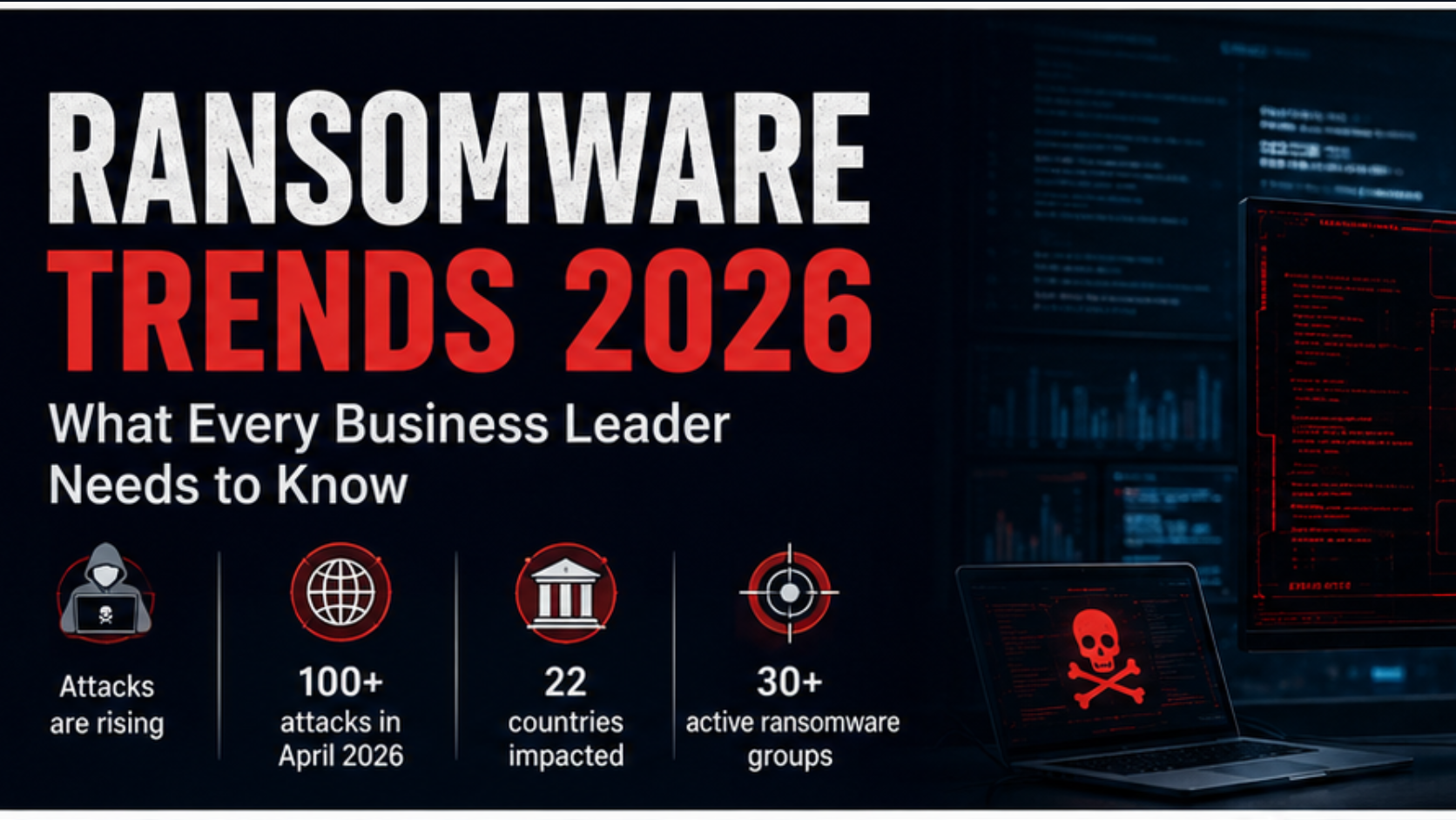
Ransomware in 2026 looks very different from the ransomware most organizations prepared for just a few years ago. Today’s attackers are faster, more specialized, and increasingly focused on data theft, identity compromise, and compliance pressure rather than simply encrypting files.
April 2026 alone saw more than 100 publicly disclosed ransomware attacks across 22 countries, making it one of the most active ransomware periods ever recorded. Healthcare organizations, financial institutions, government agencies, manufacturers, and educational institutions continue to face relentless targeting from increasingly fragmented ransomware groups.
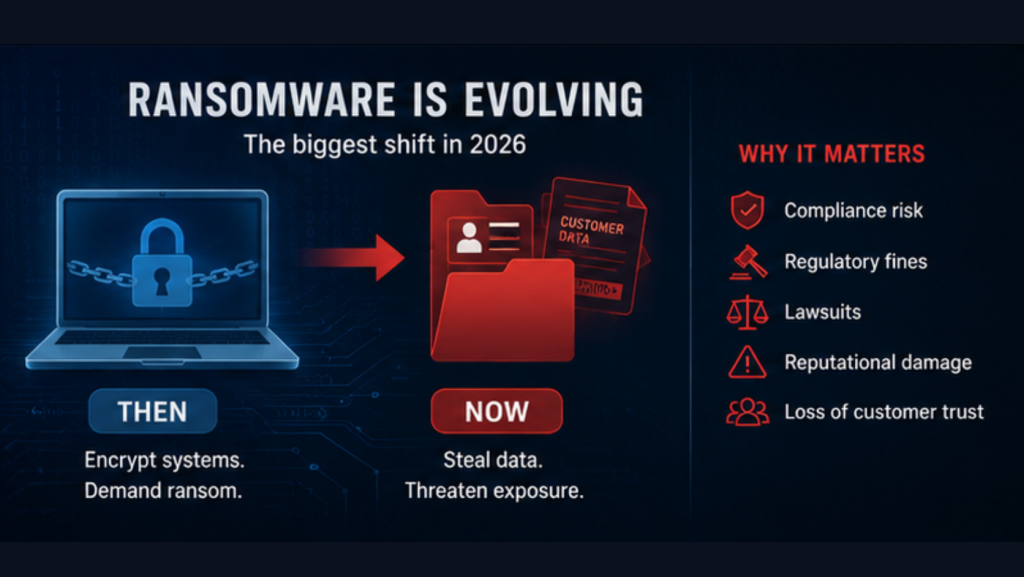
The biggest shift is this: ransomware is no longer only an operational threat. It has become a legal, regulatory, reputational, and business continuity crisis.
For regulated organizations, including credit unions, banks, healthcare providers, and wealth management firms, a ransomware event can now trigger:
- Mandatory breach notifications
- Regulatory investigations
- Cyber insurance disputes
- Compliance findings
- Customer trust erosion
- Long-term reputational damage
This guide breaks down the most important ransomware trends of 2026, what they mean for regulated businesses, and the practical actions organizations should take now to reduce risk and improve resilience.
The 2026 Ransomware Landscape at a Glance
The current state of ransomware in 2026 shows that attackers are adapting faster than many organizations can defend.
Key ransomware statistics in 2026 include:
- Global ransomware incidents are projected to exceed 12,000 attacks this year
- US organizations account for roughly 60% of publicly disclosed incidents
- Healthcare remains the most targeted sector
- Government and manufacturing organizations continue to see major disruptions
- More than 30 active ransomware groups operated simultaneously during peak activity periods in Q2 2026
- Ransom payments continue to decline, but overall business losses continue rising
This last point is especially important.
While fewer organizations are paying ransoms compared to previous years, the indirect costs of ransomware incidents continue to increase dramatically. These include:
- Downtime
- Regulatory fines
- Legal costs
- Cyber insurance complications
- Third-party forensic investigations
- Customer notification expenses
- Operational disruption
- Brand damage
In other words, organizations no longer need to pay a ransom to suffer a catastrophic business impact.
This is why many regulated organizations are moving toward proactive, compliance-aligned cybersecurity strategies that combine continuous monitoring, identity protection, incident readiness, and governance frameworks such as those offered through TorchLight Managed Security Services.
Trend 1: Encryptionless Extortion Is Becoming the Primary Threat
One of the biggest ransomware trends in 2026 is the rise of encryptionless extortion. Traditional ransomware encrypts systems and demands payment for decryption keys. Today, many attackers skip encryption entirely and focus purely on stealing sensitive data before threatening public exposure.
Groups like ShinyHunters have become known for this approach, targeting major organizations through large-scale data theft and extortion campaigns. This shift changes the entire security equation. Backups alone no longer protect organizations because the real threat is exposure of stolen information, not just operational downtime.
For regulated businesses, this creates serious consequences:
- HIPAA breach notifications
- NCUA or FDIC reporting obligations
- Potential lawsuits
- Regulatory investigations
- Cyber insurance disputes
- Reputational damage
Even if systems remain operational, stolen customer or patient data can still trigger major compliance and legal exposure.
Attackers favor encryptionless extortion because:
- It reduces attack complexity
- It lowers detection risk
- It speeds up monetization
- It bypasses backup recovery strategies
Organizations should respond by prioritizing:
- Data Loss Prevention (DLP)
- Identity governance
- Sensitive data classification
- Third-party access monitoring
- Continuous cloud security monitoring
Businesses that only focus on backup recovery are preparing for yesterday’s ransomware model.
Trend 2: EDR Killers and BYOVD Attacks Are Going Mainstream
Another major ransomware cybersecurity trend in 2026 involves BYOVD attacks.
BYOVD stands for “Bring Your Own Vulnerable Driver.”
In these attacks, cybercriminals load legitimate but vulnerable Windows drivers to gain deep system-level access and disable endpoint security tools before ransomware is deployed. Groups including Qilin, Akira, and DragonForce have reportedly used this technique extensively.
The dangerous reality is that attackers can now disable endpoint detection tools silently before launching encryption or data theft operations. This means organizations can no longer rely on EDR solutions alone. A layered security model is now essential.
Businesses should combine:
- Endpoint Detection and Response (EDR)
- Identity Threat Detection and Response (ITDR)
- Network anomaly monitoring
- Behavioral analytics
- 24/7 security monitoring
- Zero Trust access controls
Organizations should also:
- Enable Microsoft’s Vulnerable Driver Blocklist
- Harden administrative privileges
- Monitor unusual driver activity
- Implement continuous security telemetry analysis
Modern ransomware attacks increasingly occur during overnight hours or weekends when internal IT visibility is lowest.
This is why many regulated businesses are adopting managed detection and response services like TorchLight EDR, ITDR, and DMARC Services to improve continuous monitoring and reduce response times.
Trend 3: Initial Access Brokers Are Industrializing Cybercrime
Ransomware-as-a-Service (RaaS) 2026 ecosystems are becoming increasingly specialized. One of the fastest-growing segments is the rise of Initial Access Brokers (IABs).
These groups focus exclusively on compromising networks and selling that access to ransomware operators.
In many cases:
- One group steals credentials
- Another gains persistence
- Another deploys ransomware
- Another handles negotiations
Cybercrime now operates like a supply chain.
Attackers increasingly target:
- Remote Desktop Web Access (RDWeb)
- VPN appliances
- Cloud identities
- Exposed remote management portals
- Stolen employee credentials
Credential theft has become more valuable than malware itself. Once attackers obtain valid credentials, traditional antivirus tools often become ineffective because the activity appears legitimate.
Organizations should immediately:
- Eliminate publicly exposed RDP and RDWeb access
- Enforce MFA everywhere
- Monitor for compromised credentials
- Use least-privilege access models
- Implement Zero Trust Network Access (ZTNA)
Dark web credential monitoring is rapidly becoming a baseline cybersecurity requirement for regulated industries.
Trend 4: Post-Quantum Ransomware Is Emerging
One of the most forward-looking ransomware trends 2026 analysts are monitoring is post-quantum ransomware. Some newer ransomware families are beginning to adopt post-quantum cryptographic methods designed to resist future quantum computing decryption capabilities.
This includes the use of advanced algorithms aligned with emerging NIST post-quantum cryptography standards. The long-term implication is significant.
Historically, law enforcement agencies occasionally recovered ransomware decryptors after infrastructure seizures or operational mistakes by threat groups. Post-quantum encryption may eliminate many of those future recovery opportunities.
While this trend is still emerging, it reinforces an important reality:
Prevention is becoming far more important than recovery.
Organizations should focus on:
- Early threat detection
- Identity security
- Data governance
- Network segmentation
- Continuous monitoring
- Security resilience planning
Once post-quantum ransomware reaches broader adoption, decryption may become effectively impossible.
Trend 5: Social Engineering Through Legitimate Tools
Many ransomware attacks in 2026 no longer begin with obvious malware. Instead, attackers increasingly exploit legitimate collaboration and remote access tools.
Common examples include:
- Fake Microsoft Teams helpdesk calls
- OAuth phishing requests
- Remote support impersonation
- Quick Assist abuse
- Cloud identity takeover attempts
AI-powered phishing campaigns are also becoming dramatically more convincing. Attackers now use generative AI to:
- Mimic executive writing styles
- Personalize messages
- Reference internal business terminology
- Target specific departments
- Generate grammatically flawless phishing emails
This creates a serious risk because technical defenses alone cannot fully stop socially engineered attacks. Organizations must strengthen their “human firewall.” Best practices include:
- Frequent phishing simulations
- Security awareness training
- Remote access approval controls
- Verification policies for helpdesk requests
- Restricting external Teams communication
- Monitoring OAuth permissions carefully
Cybersecurity awareness training is no longer optional. It is now a foundational security control.
Trend 6: Ransomware Group Fragmentation Is Accelerating
The ransomware ecosystem in 2026 is highly fragmented. Following law enforcement actions against several major groups in recent years, smaller ransomware operators and affiliate networks have rapidly emerged to fill the gap.
Major active groups currently include:
- Qilin
- Akira
- DragonForce
- INC Ransom
- Clop
- ShinyHunters
At the same time, new groups continue appearing regularly, often formed by former affiliates from dismantled ransomware operations. This fragmentation creates several challenges:
- Attribution becomes harder
- Attack methods evolve faster
- Threat intelligence becomes more complex
- Smaller groups are harder to disrupt
- Entry barriers for attackers continue falling
The rise of Ransomware-as-a-Service platforms means cybercriminals no longer require advanced technical expertise to launch attacks. Today, affiliates can effectively “rent” ransomware infrastructure and target organizations at scale.
This industrialization of cybercrime is one reason ransomware attacks 2026 analysts track, continue to rise despite major law enforcement disruptions in 2026.
Trend 7: Regulated Industries Are Being Targeted Aggressively
Healthcare ransomware 2026 attacks remain among the most damaging and disruptive. Healthcare organizations continue to face:
- Patient data theft
- Appointment disruption
- Delayed treatments
- Emergency diversion incidents
- Compliance investigations
Financial institutions and credit unions are also heavily targeted due to:
- Sensitive customer information
- Financial transaction access
- Regulatory pressure
- Cyber insurance leverage
Manufacturing organizations increasingly face ransomware because operational downtime directly impacts revenue generation and supply chains. Government and education sectors remain vulnerable due to:
- Legacy infrastructure
- Large attack surfaces
- Limited cybersecurity staffing
- Extensive sensitive data holdings
For regulated organizations, ransomware creates overlapping risk layers:
- Operational disruption
- Compliance obligations
- Legal exposure
- Insurance reporting
- Public trust impact
- Audit scrutiny
This is why many organizations now require cybersecurity partners capable of supporting both technical security and regulatory readiness.
Services such as TorchLight vCISO Consulting and TorchLight Audit, Assessment, and Compliance Services help regulated businesses align cybersecurity controls with evolving compliance expectations.
What Regulated Businesses Should Do Right Now
Organizations should approach ransomware defense using a prioritized roadmap.
Immediate Priorities (0–30 Days)
Audit Remote Access Exposure
- Eliminate exposed RDP or RDWeb systems
- Harden VPN access
- Review administrative privileges
Enable MFA Everywhere
Prioritize:
- VPN access
- Cloud applications
- Administrative accounts
Patch Internet-Facing Infrastructure
Immediately review:
- FortiGate
- SonicWall
- Cisco ASA
- Remote access gateways
Check for Credential Exposure
Monitor for compromised credentials using dark web intelligence services.
Review Vulnerable Drivers
Enable Microsoft’s Vulnerable Driver Blocklist protections.
Short-Term Priorities (30–90 Days)
Deploy or Validate EDR + ITDR
Continuous monitoring is essential for detecting identity-based attacks.
Conduct a Tabletop Ransomware Exercise
Include:
- Leadership
- Legal
- Compliance
- IT
- Communications teams
Validate Backup Integrity
Ensure backups are:
- Offline
- Immutable
- Tested regularly
Review Cyber Insurance Requirements
Many organizations discover too late that security controls do not align with policy obligations.
Implement Network Segmentation
Limit lateral movement across systems and business units.
Strategic Priorities (90+ Days)
Build a Compliance-Aligned Security Program
Map controls to:
- HIPAA
- NCUA
- FDIC
- PCI-DSS
- GLBA
Develop a Board-Level Incident Response Strategy
Prepare for:
- Regulatory notifications
- Public communications
- Legal coordination
- Operational continuity
Conduct Penetration Testing
Validate defenses against real-world attack paths using services such as TorchLight Penetration Testing.
Engage a Security Partner
Continuous monitoring, governance, evidence collection, and incident readiness are difficult to maintain internally without dedicated expertise.
TorchLight works with regulated industries, including:
- Credit unions
- Community banks
- Healthcare organizations
- Manufacturers
- Wealth management firms
Organizations can request a Zero-Cost IT Assessment to evaluate their current risk posture and identify security gaps proactively.
Frequently Asked Questions
1. What are the biggest ransomware trends in 2026?
The most significant current ransomware threats 2026 organizations face include encryptionless extortion, BYOVD attacks, AI-powered phishing, industrialized initial access brokers, ransomware-as-a-service expansion, and post-quantum ransomware development.
2. Which industries are most targeted by ransomware in 2026?
Healthcare, financial services, government, manufacturing, and education remain the most targeted sectors due to their sensitive data, operational dependency, and regulatory exposure.
3. Why is encryptionless extortion more dangerous?
Traditional ransomware focused on encryption, which backups could often mitigate. Encryptionless extortion focuses on stolen data exposure, creating legal, regulatory, and reputational consequences even if operations remain functional.
4. What is BYOVD, and why does it matter?
BYOVD (Bring Your Own Vulnerable Driver) allows attackers to disable endpoint security tools using legitimate but exploitable system drivers before deploying ransomware or stealing data
5. How can financial institutions reduce ransomware risk?
Banks and credit unions should prioritize:
- MFA enforcement
- Continuous monitoring
- EDR + ITDR deployment
- Offline backups
- Network segmentation
- Tabletop exercises
- Compliance-aligned cybersecurity programs
Organizations serving the financial sector can also benefit from specialized security guidance for Banks and Financial Institutions and Credit Unions.
6. Does paying a ransom solve the problem?
No. Paying a ransom does not guarantee data deletion, operational recovery, or protection from future extortion. Many organizations still face data leaks, compliance consequences, and reputational damage even after payment.
Conclusion
The state of ransomware 2026 shows a threat landscape that is more adaptive, more fragmented, and more data-focused than ever before. Attackers are no longer relying solely on file encryption. They are exploiting identities, disabling security tools, weaponizing legitimate platforms, and targeting regulated industries where compliance pressure increases leverage.
For healthcare organizations, banks, credit unions, manufacturers, and other compliance-sensitive businesses, ransomware is no longer just an IT problem. It is a business continuity, regulatory, legal, and reputational challenge.
The organizations that will navigate ransomware successfully in 2026 are those investing in:
- Continuous monitoring
- Identity security
- Layered defenses
- Incident readiness
- Governance and compliance alignment
TorchLight helps regulated businesses build cybersecurity programs designed for both attackers and auditors through managed security, vCISO leadership, compliance support, penetration testing, and continuous monitoring.
To evaluate your organization’s current ransomware readiness, request a Zero-Cost IT Assessment today.