
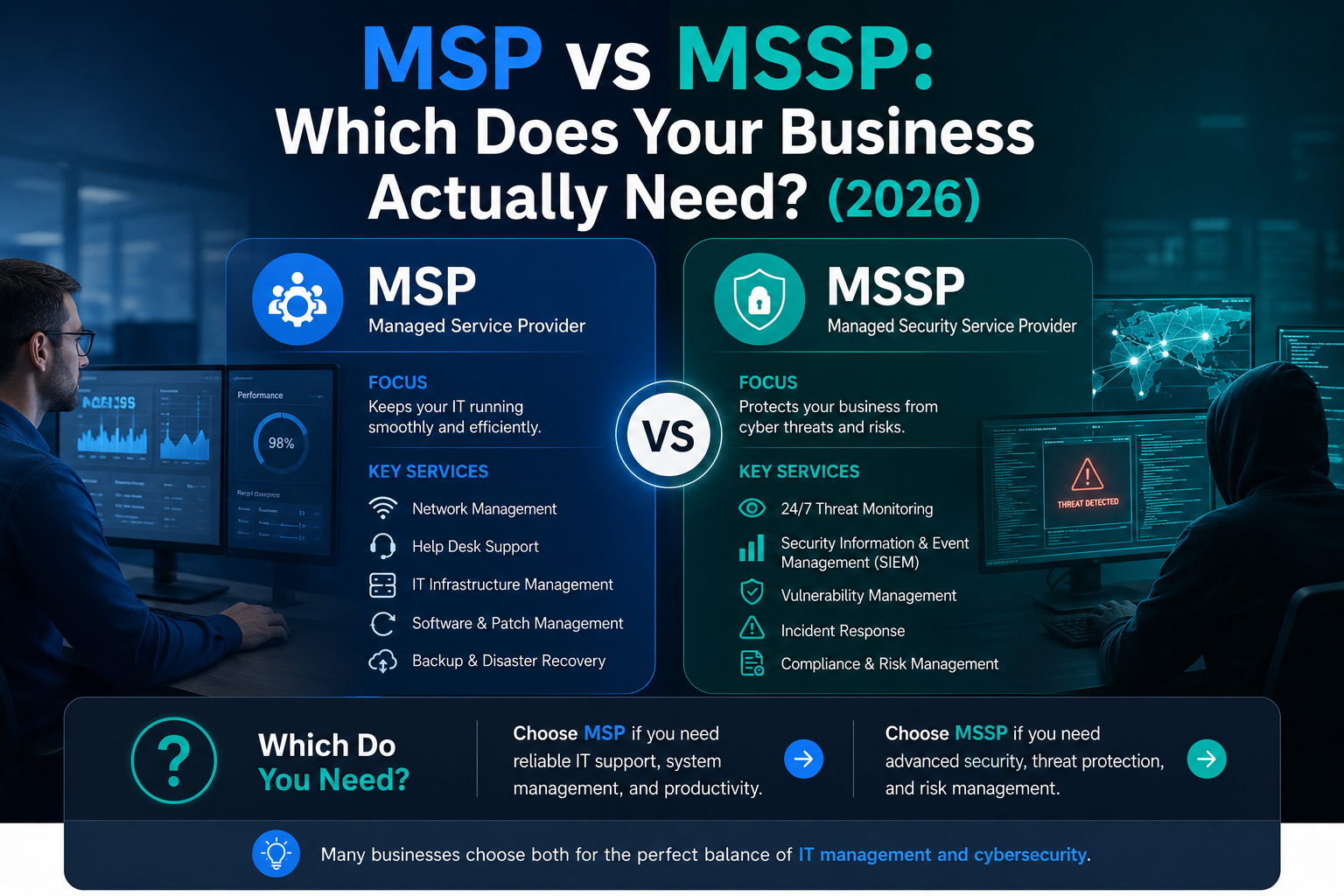
Choosing between an MSP and an MSSP is becoming increasingly difficult as cyber threats grow more sophisticated and compliance requirements become more demanding. Many businesses invest in outsourced IT services expecting comprehensive protection, only to discover later that traditional IT support doesn’t necessarily include proactive cybersecurity.
If you’re comparing MSP vs MSSP, understanding the difference can help you make better technology decisions, reduce cyber risk, and ensure your organization has the right level of protection. This guide explains the differences between the two models, when each makes sense, and why many businesses ultimately benefit from combining both.
What Is an MSP (Managed Service Provider)?
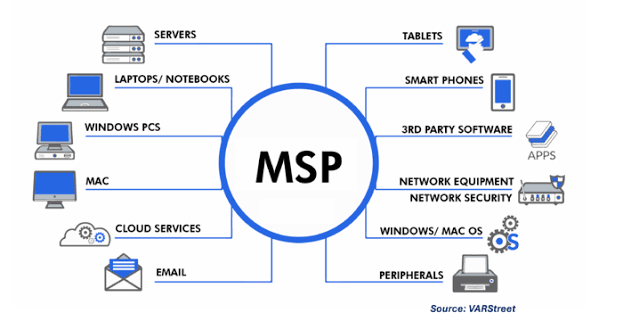
A Managed Service Provider (MSP) is a company that remotely manages a business’s IT infrastructure, devices, networks, and end-user systems through a proactive, subscription-based service model. Their primary goal is to keep technology running efficiently while minimizing downtime and improving operational productivity.
Unlike break-fix IT support, MSPs provide continuous technology management through ongoing maintenance, monitoring, updates, and user support. Typical MSP cybersecurity services may include basic security tools, but cybersecurity is generally only one part of a much broader IT management offering.
Common MSP Services
Most managed service providers offer services such as:
- IT help desk support
- Network management
- Server administration
- Microsoft 365 management
- Cloud infrastructure support
- Device management
- Software updates and patching
- Backup and disaster recovery
- User onboarding and offboarding
Many MSPs also provide antivirus software, firewall management, and endpoint protection. However, these services often focus on maintaining systems rather than actively detecting sophisticated cyber threats.
What an MSP Doesn’t Typically Do
A traditional MSP usually does not provide:
- 24/7 Security Operations Center (SOC)
- Continuous threat hunting
- Advanced threat detection
- Security Information and Event Management (SIEM)
- Managed Detection and Response (MDR)
- Digital forensics
- Security compliance consulting
- Incident response leadership
Businesses operating in highly regulated industries often discover they need additional cybersecurity expertise beyond standard IT support.
Who Should Consider an MSP?
An MSP is often the right choice for businesses that need:
- Reliable IT support
- Technology management
- User help desk services
- Infrastructure maintenance
- Cloud administration
- Predictable IT costs
Organizations without internal IT teams frequently rely on MSPs to function as their outsourced technology department.
What Is an MSSP (Managed Security Service Provider)?

A Managed Security Service Provider (MSSP) is a company that delivers outsourced monitoring and management of cybersecurity systems and operations, including 24/7 threat monitoring, security analytics, incident response, compliance support, and risk management.
Unlike an MSP, whose primary objective is operational efficiency, an MSSP exists to reduce cyber risk and protect organizations against evolving security threats.
Today’s cyberattacks occur around the clock, making continuous monitoring essential for businesses handling sensitive customer information, financial data, or regulated workloads.
Typical MSSP Services
A modern managed security service provider typically delivers:
- Security Operations Center (SOC)
- 24/7 threat monitoring
- Security Information and Event Management (SIEM)
- Endpoint Detection and Response (EDR)
- Managed Detection and Response (MDR)
- Vulnerability management
- Security awareness training
- Incident response
- Compliance support
- Risk assessments
- Security reporting
Rather than simply maintaining technology, an MSSP continuously analyzes security events, investigates suspicious activity, and helps organizations respond before attacks become major incidents.
Who Should Consider an MSSP?
Organizations often need an MSSP when they:
- Handle sensitive customer data
- Must meet regulatory requirements
- Lack an internal security team
- Need continuous security monitoring
- Have cyber insurance requirements
- Face increasing phishing or ransomware threats
For businesses asking what is an MSSP, the simplest answer is this:
An MSSP protects your business from cyber threats while helping improve compliance and overall security maturity.
MSP vs MSSP: Key Differences at a Glance
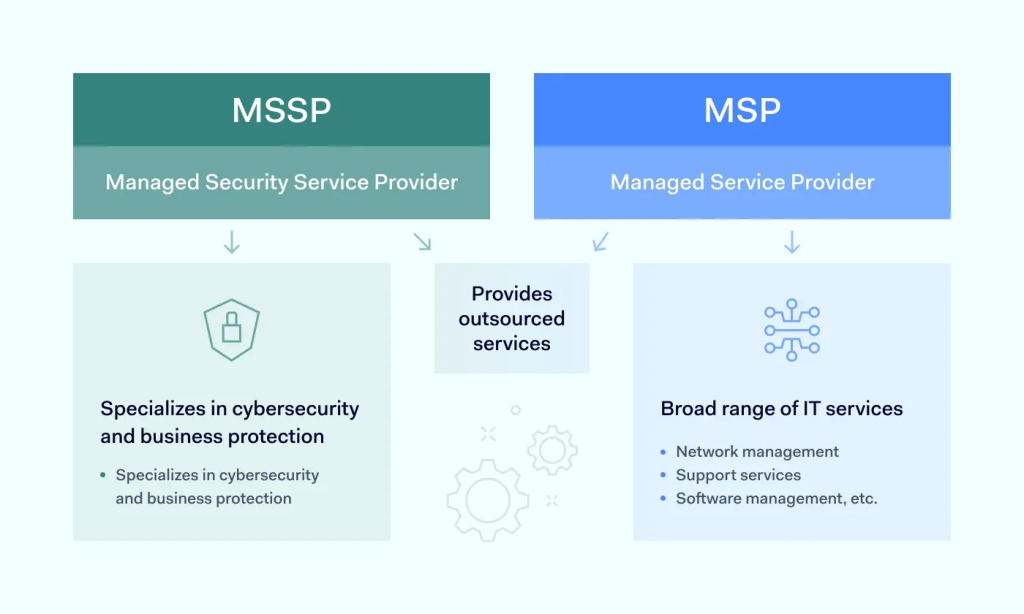
If you’re evaluating MSSP vs MSP, the biggest difference is their primary objective. An MSP focuses on keeping your technology operational, while an MSSP focuses on keeping your business secure.
| Feature | MSP | MSSP |
| Primary Focus | IT operations | Cybersecurity |
| Core Services | Infrastructure & support | Threat detection & response |
| 24/7 Monitoring | IT monitoring | Security monitoring |
| Compliance Support | Limited | Extensive |
| Incident Response | Basic IT issues | Cyber incidents |
| Security Expertise | General IT | Dedicated security specialists |
| Best For | IT management | Cybersecurity protection |
| Pricing | Monthly IT subscription | Monthly security subscription |
Many growing businesses ultimately benefit from both. TorchLight delivers managed IT and managed security services through a single integrated partnership, eliminating gaps between IT operations and cybersecurity.
MSP vs MSSP vs MDR: What’s the Difference?
Businesses often compare MSP vs MSSP vs MDR, but these services solve different problems.
1. MSP
An MSP manages your technology infrastructure and keeps your systems running efficiently.
2. MSSP
An MSSP provides broader cybersecurity management, including monitoring, compliance, risk management, and incident response.
3. MDR
Managed Detection and Response (MDR) is a specialized security service focused primarily on detecting, investigating, and responding to cyber threats.
Think of it this way:
- MSP = IT Operations
- MDR = Threat Detection
- MSSP = Complete Security Program
Many MSSPs include MDR capabilities as part of a broader managed security offering.
Do You Need an MSP, an MSSP, or Both?
The right choice depends on your organization’s technology environment, cybersecurity risks, and regulatory requirements. While some businesses only require IT support, others need dedicated cybersecurity expertise, or a combination of both.
Choose an MSP if…
- Your biggest challenge is day-to-day IT management.
- You need help desk support and infrastructure maintenance.
- You lack internal IT staff.
- Your primary goal is improving operational efficiency.
Choose an MSSP if…
- You need continuous threat monitoring.
- Your organization handles sensitive customer information.
- You must meet cybersecurity compliance requirements.
- You’re concerned about ransomware, phishing, or data breaches.
- You require ongoing security reporting and incident response.
Choose Both if…
Many organizations achieve the strongest results by combining IT operations with cybersecurity expertise.
You likely need both if you:
- Operate in a regulated industry.
- Have cyber insurance requirements.
- Manage cloud environments.
- Support remote employees.
- Store confidential customer or financial information.
- I want a single partner responsible for both IT performance and security.
For Regulated Businesses: Why Most Need Both
- Organizations in highly regulated industries rarely have the luxury of separating IT from cybersecurity.
- Credit unions must meet NCUA expectations.
- Banks face FFIEC guidance.
- Healthcare organizations must comply with HIPAA.
- Registered Investment Advisors (RIAs) follow SEC cybersecurity requirements.
For these organizations, combining MSP cybersecurity services with MSSP services for small business creates stronger operational resilience, better compliance readiness, and fewer security gaps.
Not Sure What Your Business Needs?
TorchLight’s Zero-Cost IT Assessment helps identify whether your organization has IT gaps, cybersecurity gaps, or both. In about 45 minutes, our team provides practical recommendations tailored to your environment, helping you determine whether an MSP, MSSP, or integrated approach is the best fit.
Managed Detection and Response vs MSSP
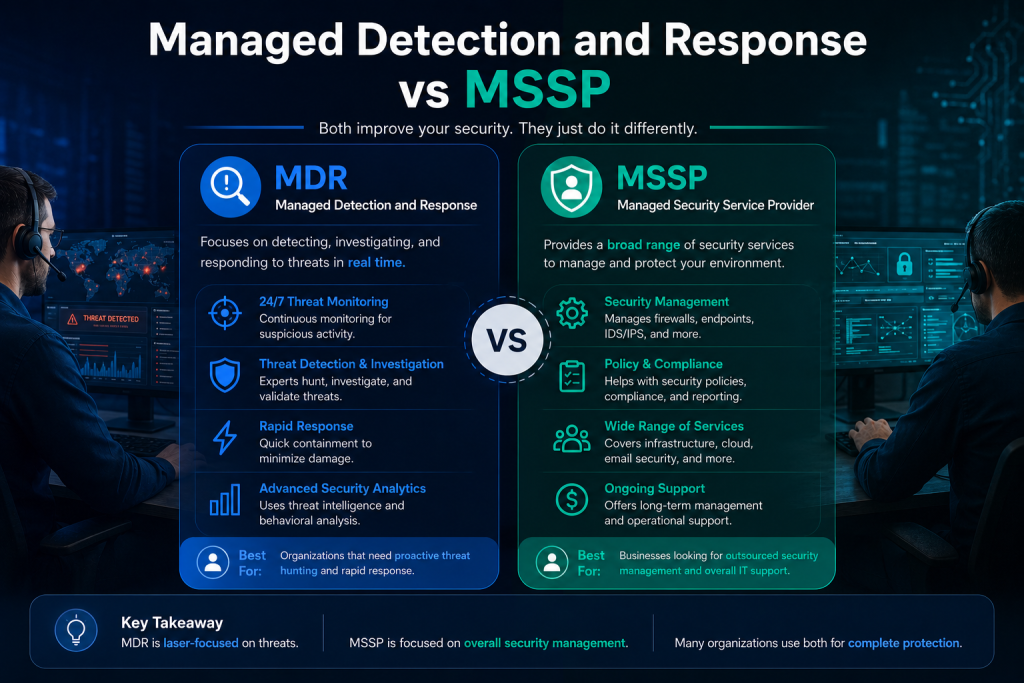
Managed Detection and Response (MDR) is a specialized cybersecurity service focused on detecting and responding to threats, while an MSSP delivers broader security management that includes MDR alongside compliance, risk management, and security operations.
Many businesses comparing managed detection and response vs MSSP assume they offer the same capabilities. While there is some overlap, MDR is typically one component of a comprehensive managed security program.
What MDR Provides
An MDR provider typically offers:
- 24/7 threat detection
- Security monitoring
- Threat hunting
- Incident investigation
- Rapid threat response
- Endpoint detection and response (EDR)
MDR is designed to quickly identify and contain cyber threats before they can disrupt business operations.
What an MSSP Provides Beyond MDR
An MSSP builds on these capabilities by offering:
- Security Operations Center (SOC) services
- Security Information and Event Management (SIEM)
- Compliance support
- Vulnerability management
- Risk assessments
- Security awareness training
- Security policy development
- Incident response planning
- Executive security reporting
If your organization only needs threat detection, MDR may be sufficient. However, businesses seeking long-term cybersecurity strategy, governance, and compliance support often benefit more from a full-service MSSP.
How Much Does an MSSP Cost Compared to an MSP?
MSPs and MSSPs have different pricing models because they solve different business challenges. MSP pricing is typically based on IT support and infrastructure management, while MSSP pricing reflects the level of cybersecurity protection and monitoring required.
Several factors influence pricing, including:
- Company size
- Number of users and devices
- Cloud environment complexity
- Compliance requirements
- Monitoring requirements
- Security maturity
- Response time expectations
In general:
| Service | Typical Pricing Model |
| MSP | Per user, per device, or monthly subscription |
| MSSP | Monthly subscription based on security scope |
| Combined MSP + MSSP | Integrated managed services agreement |
Although an MSSP may require a higher monthly investment than a traditional MSP, proactive security monitoring and faster incident response can significantly reduce the financial impact of ransomware, downtime, regulatory penalties, and data breaches.
For many organizations, the cost of prevention is far lower than the cost of recovering from a successful cyberattack.
What Should You Look for in an MSP or MSSP?
Choosing the right provider requires evaluating expertise, responsiveness, security capabilities, and long-term partnership potential.
When comparing providers, consider the following:
1. Industry Experience
Choose a provider that understands your industry’s regulatory requirements and operational challenges.
2. Security Expertise
If cybersecurity is a priority, look beyond basic antivirus and firewall management. Ask whether the provider offers:
- 24/7 monitoring
- SOC services
- Incident response
- Vulnerability management
- Compliance guidance
3. Scalability
Your technology needs will evolve. Select a provider that can support your business as it grows without requiring frequent vendor changes.
4. Compliance Support
Organizations in regulated industries should confirm the provider has experience supporting frameworks such as:
- NCUA
- FFIEC
- HIPAA
- SEC
- PCI DSS
- NIST Cybersecurity Framework
Response Times
Ask about:
- Help desk availability
- Security monitoring hours
- Incident response procedures
- Escalation timelines
- Service level agreements (SLAs)
A proactive partner should offer clear communication, measurable service levels, and strategic guidance.
Why Many Businesses Choose an Integrated MSP and MSSP
As IT environments become more complex, many organizations find that separating IT operations from cybersecurity creates unnecessary gaps.
For example:
- An MSP may manage user accounts but not monitor for credential compromise.
- An MSSP may detect suspicious activity but rely on another provider to remediate affected systems.
- Multiple vendors can lead to delayed communication and slower incident response.
An integrated approach eliminates these disconnects by bringing IT operations and cybersecurity together under one strategy.
Benefits include:
- Unified IT and security management
- Faster incident response
- Better visibility across systems
- Simplified vendor management
- Improved compliance readiness
- Reduced operational complexity
Rather than coordinating between multiple providers, businesses have one trusted partner responsible for both technology performance and security outcomes.
Why Businesses Trust TorchLight
Technology and cybersecurity should work together, not operate in separate silos.
TorchLight delivers managed IT services and managed security services through a single integrated model, giving organizations one team, one strategy, and one point of accountability. This approach helps businesses improve operational efficiency while strengthening cybersecurity, reducing risk, and supporting ongoing compliance.
Whether your organization needs day-to-day IT management, advanced security monitoring, or both, TorchLight provides practical guidance tailored to your business goals and regulatory requirements.
Final Thoughts
Understanding the MSP vs MSSP difference is essential for choosing the right technology partner. While an MSP focuses on maintaining your IT environment, an MSSP is dedicated to protecting your organization from cyber threats through continuous monitoring, threat detection, and incident response.
For many growing and regulated businesses, the answer isn’t choosing one over the other, it’s combining both. An integrated approach ensures technology remains reliable while cybersecurity stays proactive, helping organizations reduce risk, simplify operations, and confidently support future growth.
Ready to determine what your business actually needs? Request a meeting with TorchLight to identify your IT and cybersecurity gaps. Our experts will help you determine whether an MSP, an MSSP, or an integrated solution is the best fit for your organization.
Frequently Asked Questions
1. Can an MSP also provide cybersecurity services?
Yes, many MSPs offer basic cybersecurity services, but they typically do not provide the advanced monitoring, threat detection, incident response, or security operations that a dedicated MSSP delivers. Organizations with higher security or compliance requirements often benefit from combining MSP and MSSP capabilities.
2. What is the difference between MDR and MSSP?
MDR focuses specifically on detecting, investigating, and responding to cyber threats, while an MSSP provides a broader range of cybersecurity services that often includes MDR alongside compliance, risk management, vulnerability management, and security strategy.
3. How much does an MSSP cost compared to an MSP?
MSP pricing generally depends on IT support needs, while MSSP pricing is based on cybersecurity services such as monitoring, threat detection, and incident response. Costs vary depending on business size, regulatory requirements, and the scope of services required.
4. Do small businesses need an MSSP?
Many small businesses benefit from MSSP services, especially if they handle sensitive customer data, operate in regulated industries, or lack dedicated cybersecurity staff. An MSSP provides enterprise-grade security expertise without the cost of building an in-house security team.
5. What should I look for in an MSP or MSSP?
Look for a provider with proven technical expertise, strong cybersecurity capabilities, industry experience, responsive support, and the ability to scale with your business. If your organization has compliance obligations or elevated cyber risks, choose a partner that can deliver both managed IT and managed security services through an integrated approach.