

Managed Security Services for Regulated Businesses.
Get an always-on security operation without having to build and staff an internal SOC. TorchLight monitors endpoints, identities, email, and security telemetry around the clock, validates suspicious activity, and carries real incidents from detection through containment, remediation, and executive reporting.
- 24/7/365 SOC monitoring with a 30-minute critical first-response commitment
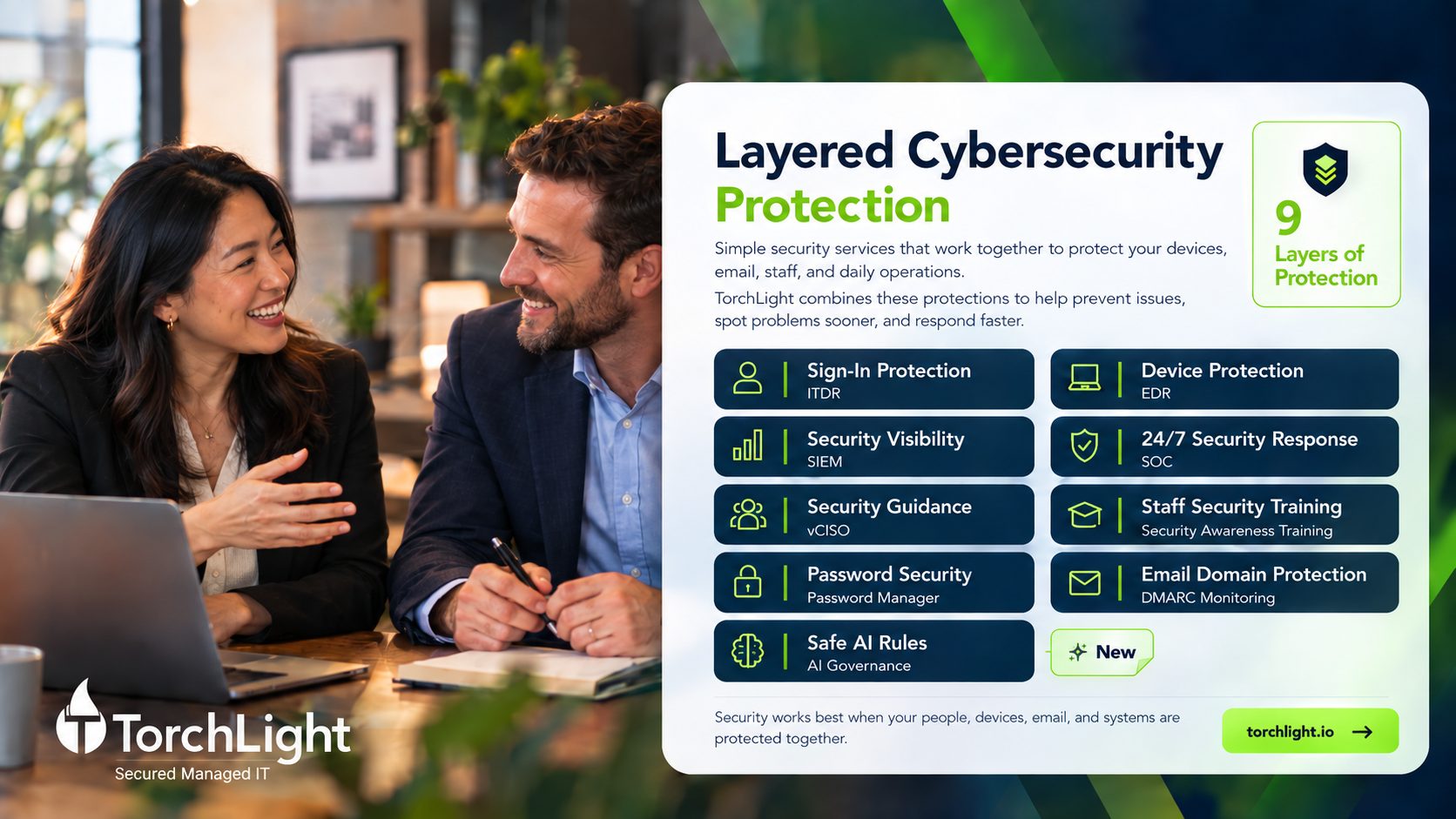
- EDR, identity threat detection, SIEM, DMARC, and vulnerability visibility
- Compliance-ready incident documentation and clear executive reporting
What “Fully Managed Security” Means to TorchLight.
Managed security should mean more than installing security software and forwarding alerts. TorchLight takes responsibility for continuously watching the signals across your environment, determining what actually matters, and coordinating the response when suspicious activity becomes a real incident.
Your organization gets the coverage of a security operations function without having to recruit, staff, and manage an internal SOC around the clock. The result is faster detection, clearer ownership, and documentation leadership can actually use.
The difference is ownership: somebody is watching, somebody is accountable, and somebody acts when it matters.
Human Coverage, 24/7/365
Security analysts continuously monitor your environment so suspicious activity is not waiting for someone to notice it the next business day.
Validate Before Escalating
Alerts are investigated and validated so your team gets meaningful security events instead of another stream of automated notifications and false alarms.
Act, Don’t Just Alert
When a threat is confirmed, the work moves into containment and remediation coordination so an incident doesn’t simply become another ticket somebody else has to figure out.
Evidence After the Incident
Leadership gets clear documentation of what happened, what was contained, what changed, and what matters next for security reviews, audits, and cyber-insurance conversations.
What’s Included in Managed Security Services.
Modern attacks move across identities, endpoints, email, applications, and cloud environments. Effective managed security cannot depend on a single tool or a single source of alerts.
TorchLight brings those security layers together into one managed operating model. Depending on your environment and coverage requirements, we monitor the signals, investigate suspicious behavior, prioritize vulnerabilities, and coordinate action when something needs to be contained.
Multiple security controls. One team responsible for seeing the whole picture.
SOC
Security Operations Center24/7/365 security monitoring backed by analysts who validate alerts, investigate suspicious activity, and coordinate response when a real threat is identified.
EDR
Endpoint Detection & ResponseBehavioral detection watches computers and endpoints for ransomware, fileless attacks, lateral movement, and other suspicious activity that traditional antivirus can miss.
Explore EDR, ITDR & DMARCITDR
Identity Threat Detection & ResponseContinuous monitoring helps identify risky Microsoft 365 logins, token abuse, suspicious access patterns, and identity activity that could lead to account takeover or fraud.
SIEM
Security Information & Event ManagementSecurity signals are brought together and analyzed across the environment so patterns and multi-stage threats become visible instead of remaining isolated inside separate tools.
DMARC Monitoring
Email Authentication & Domain ProtectionContinuous domain monitoring helps reduce spoofing and impersonation attacks that abuse your organization’s name, email domain, and reputation.
Vulnerability Management
Find, Prioritize & Remediate ExposureIdentify weaknesses across the environment, prioritize them by risk, and coordinate remediation so known vulnerabilities are reduced before attackers have an opportunity to exploit them.

Why Fully Managed Security Outperforms Reactive Security.
Modern attacks rarely begin with an obvious server breach. They start with a compromised identity, a convincing email, a stolen session, an exposed endpoint, or activity that looks harmless until the signals are connected.
Reactive security waits for a user, vendor, or tool to recognize that something has already gone wrong. Fully managed security continuously watches those signals, validates suspicious behavior, and gives somebody clear responsibility for taking action before a small event becomes a larger incident.
Catch the signal while it is still manageable, instead of explaining the damage after the fact.
Identity Takeovers
Risky logins, stolen sessions, and compromised Microsoft 365 accounts can look legitimate until identity activity is continuously analyzed.
Ransomware Exposure
An endpoint compromise can become a business-wide incident when suspicious behavior is not detected and contained quickly.
Invoice & Payment Fraud
Phishing and impersonation attacks exploit trusted email conversations to redirect payments and manipulate employees.
Alert Overload
More security tools do not automatically create better security when nobody has responsibility for validating and connecting their alerts.
Audit & Insurance Gaps
Regulators, auditors, and insurers increasingly expect evidence that security controls are active, monitored, and producing defensible records.
Unclear Incident Ownership
When security, IT, and vendors are disconnected, containment slows down while everyone determines who is supposed to act.
A Fully Managed Security Model That Reduces Risk.
The value of managed security is not the number of alerts generated or tools installed. It is what happens to risk when monitoring, investigation, containment, remediation, and reporting operate as one system.
TorchLight combines layered controls with continuous human oversight so threats can be identified earlier, incidents can be contained faster, and leadership has clearer evidence of how the environment is being protected.
The goal is not more security noise. It is fewer surprises, faster action, and a more defensible security posture.
Early Detection & Rapid Containment
Suspicious activity is investigated while it is happening, helping stop smaller events from becoming larger security incidents.
Lower Fraud & Ransomware Exposure
Layered identity, endpoint, email, and monitoring controls reduce both the likelihood of successful attacks and their potential impact.
Audit & Insurance Readiness
Clear reporting and security evidence help support control validation, examinations, cyber-insurance renewals, and compliance conversations.
Executive Visibility
Leadership can understand what was attempted, what was blocked, what changed, and where risk still needs attention without drowning in technical noise.
Always-On Coverage
Threats do not operate on business hours. TorchLight’s 24/7/365 monitoring gives your organization continuous visibility backed by humans who can investigate suspicious activity and coordinate action when it’s necessary.
Alert Validation
Analysts investigate the signal and separate genuine suspicious activity from false positives and routine environmental noise.
Signal confirmedContainment
Affected devices, identities, users, or sessions can be isolated so an active threat has less opportunity to spread through the environment.
Threat movement stoppedRemediation
Persistence is removed, compromised access is reset, and the security gap that enabled the event is addressed so the same path is harder to use again.
Access restored securelyExecutive Reporting
Leadership receives a clear explanation of what happened, what TorchLight did, what changed, and what should be improved next.
Leadership briefedHow TorchLight Responds When a Threat Is Real.
Security response should not become a scramble to decide whether an alert matters, who owns the incident, or which vendor needs to make the next change.
TorchLight follows a repeatable response process: validate what happened, contain the active threat, remediate the underlying issue, and document the incident in terms both technical teams and leadership can use.
Detection is only useful when it leads to clear, coordinated action.
Managed Security for Regulated Organizations.
The consequences of a security incident are different when your organization handles financial data, confidential client information, public services, or systems subject to regulatory and contractual oversight.
TorchLight’s managed security model is built for organizations that need more than threat alerts. They need clear ownership, continuous monitoring, documented response, defensible evidence, and security decisions that can be explained to leadership.
When accountability is high, security has to work as an operating discipline; not a collection of disconnected tools.

Credit Unions & Financial Institutions
Protect member and depositor data, monitor identity and endpoint activity, reduce fraud exposure, and maintain clearer evidence for examinations, audits, and leadership review.
Wealth Management & Family Offices
Defend trusted communications, client data, identities, mobile users, executives, and money-movement workflows where account takeover or impersonation can create immediate financial consequences.
Government & Public Sector
Maintain visibility across departments, employees, contractors, endpoints, and vendors while reducing ransomware and business-email-compromise risk around essential public services.
Compliance-Sensitive SMBs
Give smaller legal, accounting, professional services, and other high-trust teams enterprise-grade security coverage without the cost and complexity of building an internal security operation.
Security With Accountability Built In
Whatever the regulatory framework, the operating requirement is similar: know what is happening, know who owns the response, preserve the evidence, and give leadership a clear view of the risk.
Security Operations
Security analysts identify suspicious behavior, validate what is real, determine scope, and decide what must happen next.
IT Operations
The operational team makes the changes needed to remove the threat, restore secure access, harden the environment, and return users to work.
One Operating Model
When TorchLight owns both the security signal and the operational response, there is no waiting for a separate provider to decide who patches, resets, rebuilds, or changes the environment.
Security Works Better When IT Is Integrated.
Most security incidents eventually require an IT action. A compromised identity needs access changed. An infected endpoint may need isolation or rebuilding. A vulnerability may need patching. A Microsoft 365 incident may require policy and configuration changes.
When security monitoring and IT operations are split between different providers, every handoff introduces delay and ambiguity. TorchLight can bring both sides together so the team that identifies the threat can coordinate the operational changes required to contain and remediate it.
Less waiting. Less finger-pointing. One team accountable for moving the incident from signal to resolution.
Why regulated organizations choose TorchLight over internal IT alone
Internal IT can know your organization extremely well. TorchLight adds broader coverage, specialized cybersecurity experience, regulatory perspective, and operational depth alongside the people who already know your business.
“TorchLight has been more than a vendor to our multi-branch credit union, they are more like our partner … delivered for almost 20 years.”
Regulated-Industry Experience
Serving credit unions since 2007, plus wealth management, municipalities, healthcare, and banks.
Security & Examiner Expertise
CISSP, CISA, and CISM certified team with a former IS&T examiner on staff.
Security Is Built In
Security is built into the service, not sold as an afterthought.
Client retention, because accountable IT keeps its clients.
Managed security services provide ongoing monitoring, threat detection, investigation, response, vulnerability management, and security reporting through an external security team. Instead of relying on individual tools to generate alerts, TorchLight helps monitor the environment continuously, validate suspicious activity, and coordinate action when a real threat is identified.
TorchLight’s managed security services can include 24/7/365 security operations monitoring, Endpoint Detection and Response (EDR), Identity Threat Detection and Response (ITDR), SIEM monitoring, DMARC monitoring, vulnerability management, incident investigation, containment coordination, remediation support, and executive-ready security reporting. The exact service scope depends on the organization’s environment and security requirements.
A Security Operations Center, or SOC, continuously monitors security signals and investigates suspicious activity. A managed SOC gives organizations access to around-the-clock security monitoring and human analysts without requiring them to recruit, staff, and operate an internal security team 24/7.
Antivirus is one security control. Managed security services combine multiple layers of protection with ongoing human monitoring and response. Modern attacks may involve compromised identities, stolen sessions, phishing, cloud applications, endpoints, or unusual behavior that traditional antivirus alone may not detect or address.
Endpoint Detection and Response, or EDR, monitors endpoint behavior for suspicious activity such as ransomware, fileless attacks, malicious processes, and lateral movement. EDR can provide deeper visibility than traditional antivirus and can help security teams investigate and contain threats affecting computers and other endpoints.
Identity Threat Detection and Response, or ITDR, focuses on attacks involving user identities and authentication systems. It can help identify suspicious logins, compromised Microsoft 365 accounts, token abuse, abnormal access patterns, and other activity that may indicate an account takeover or identity-based attack.
Security Information and Event Management, or SIEM, brings security information from multiple systems together so activity can be analyzed in context. This helps security analysts identify patterns that may be difficult to recognize when endpoint, identity, email, network, and cloud alerts remain isolated inside separate tools.
TorchLight first investigates and validates the alert to determine whether the activity represents a real threat. When action is required, the response may include isolating affected devices or identities, containing malicious activity, coordinating remediation, resetting compromised access, addressing the underlying security gap, and documenting what happened for technical teams and leadership.
Absolutely, yes. Organizations that already have internal IT can use TorchLight in a co-managed model. TorchLight can provide security monitoring, threat detection, investigation, specialized cybersecurity expertise, and response support while the internal IT team continues managing day-to-day technology operations.
Managed security services can help organizations demonstrate that security controls are actively monitored, incidents are investigated, vulnerabilities are being addressed, and security activity is documented. This can support conversations with auditors, regulators, compliance teams, and cyber-insurance providers, although managed security services do not by themselves guarantee compliance or insurance approval.
Security incidents frequently require IT changes. A compromised identity may need access disabled, an endpoint may need to be isolated or rebuilt, a vulnerability may need to be patched, or Microsoft 365 policies may need to change. When IT and security operate together, those actions can be coordinated more quickly with fewer handoffs and less uncertainty about who owns the response.
Managed security pricing depends on factors such as the number of users and endpoints, the security controls being managed, monitoring requirements, regulatory needs, existing technology, and the level of response coverage required. TorchLight typically scopes the environment first so the service can be aligned to the organization’s actual risk and operational requirements rather than forcing every customer into the same security package.
Security Intelligence for Better Decisions.
Practical analysis for leaders responsible for cybersecurity, compliance, technology, and organizational risk. These three resources dig deeper into the same threats and operating decisions managed security teams face every day.
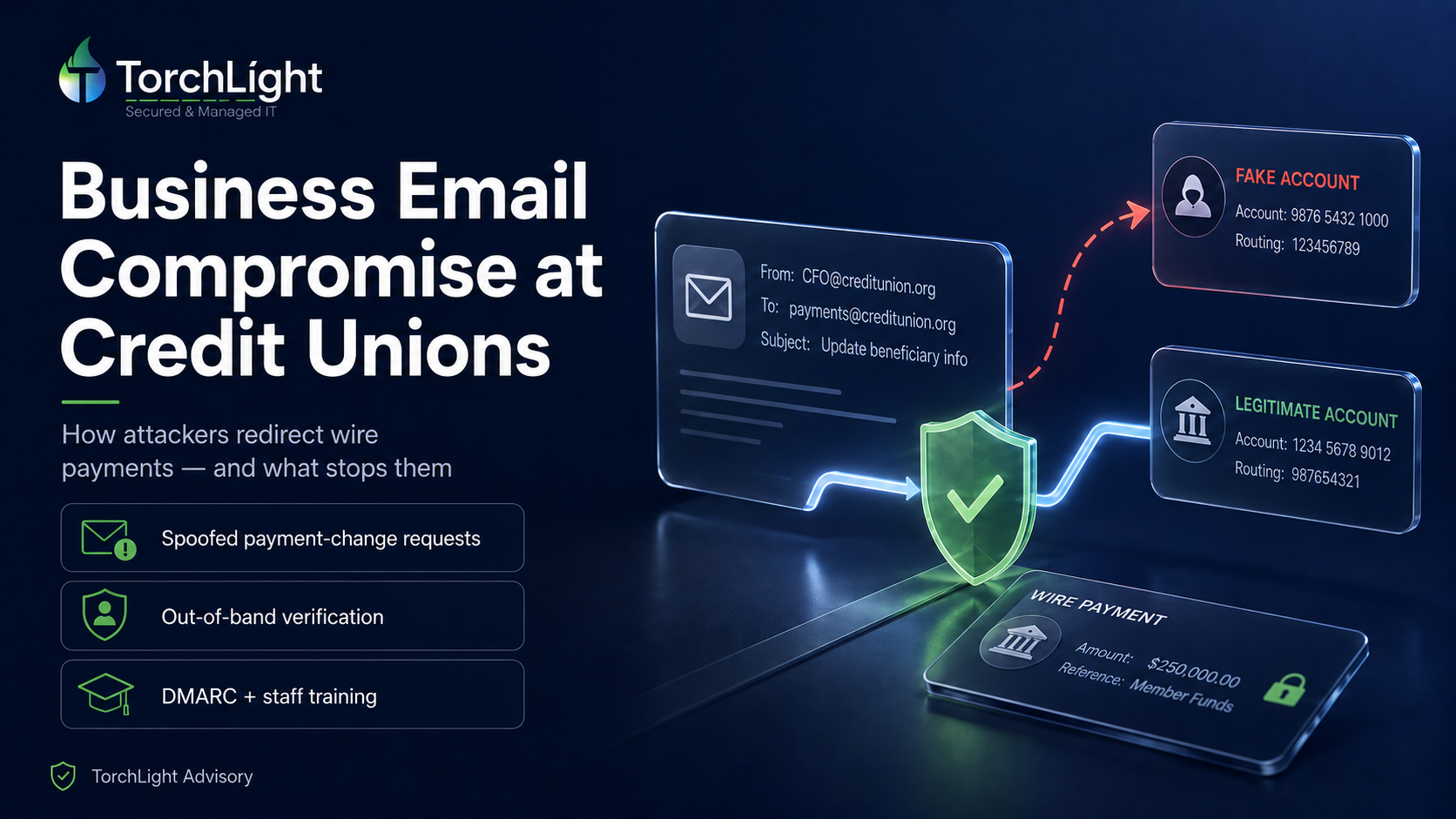
Business Email Compromise at Credit Unions: How Attackers Redirect Wire Payments and What Stops Them
See how attackers impersonate trusted vendors, executives, and members to redirect wire and ACH payments—and how email authentication, out-of-band verification, and disciplined staff processes can interrupt the attack.
Read the BEC Analysis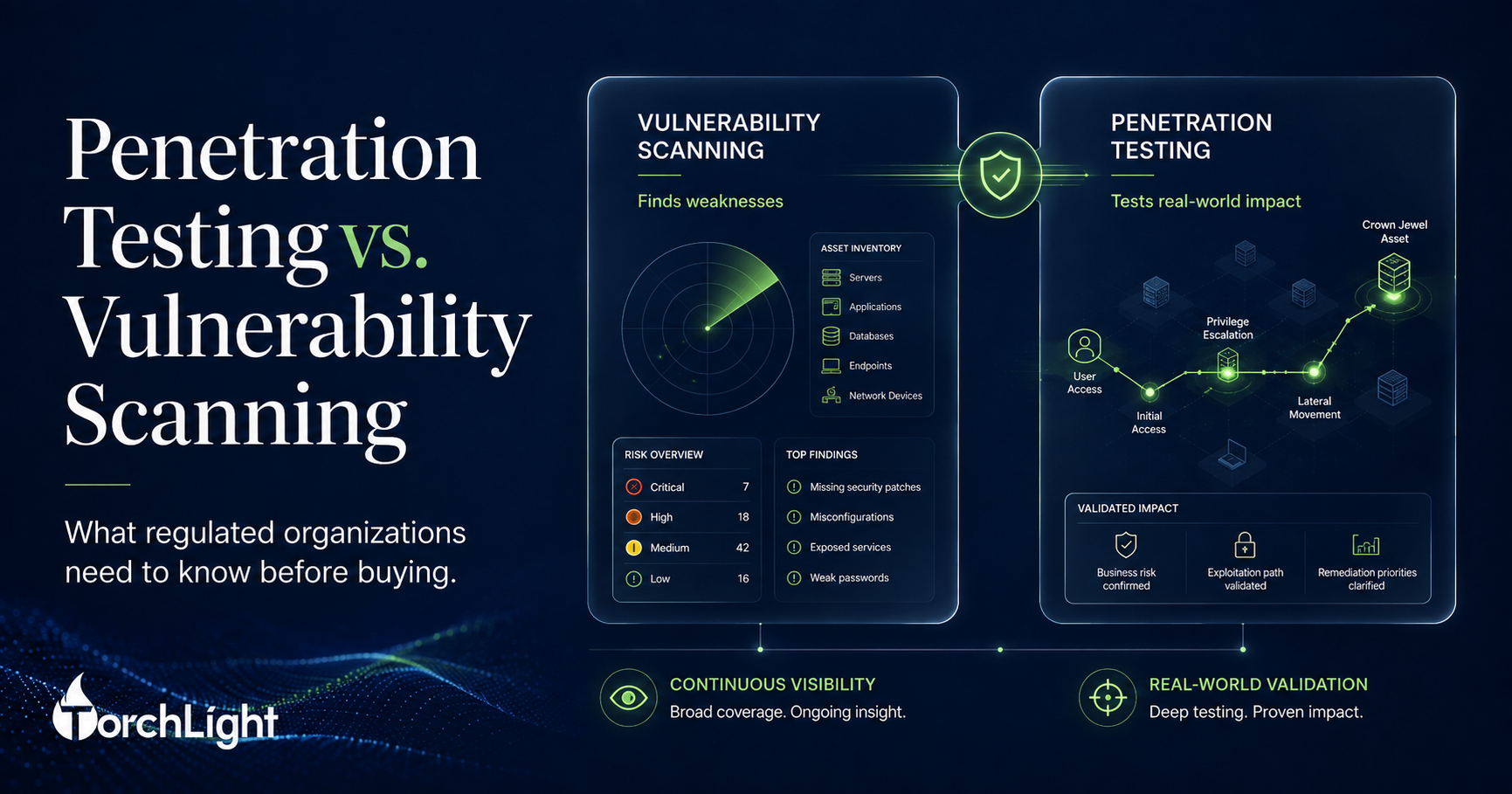
Penetration Testing vs. Vulnerability Scanning
Vulnerability scanning finds potential weaknesses. Penetration testing shows what a real attacker may actually be able to do with them. Learn which question each service answers and what evidence regulated organizations should expect.
Read the Buyer’s Guide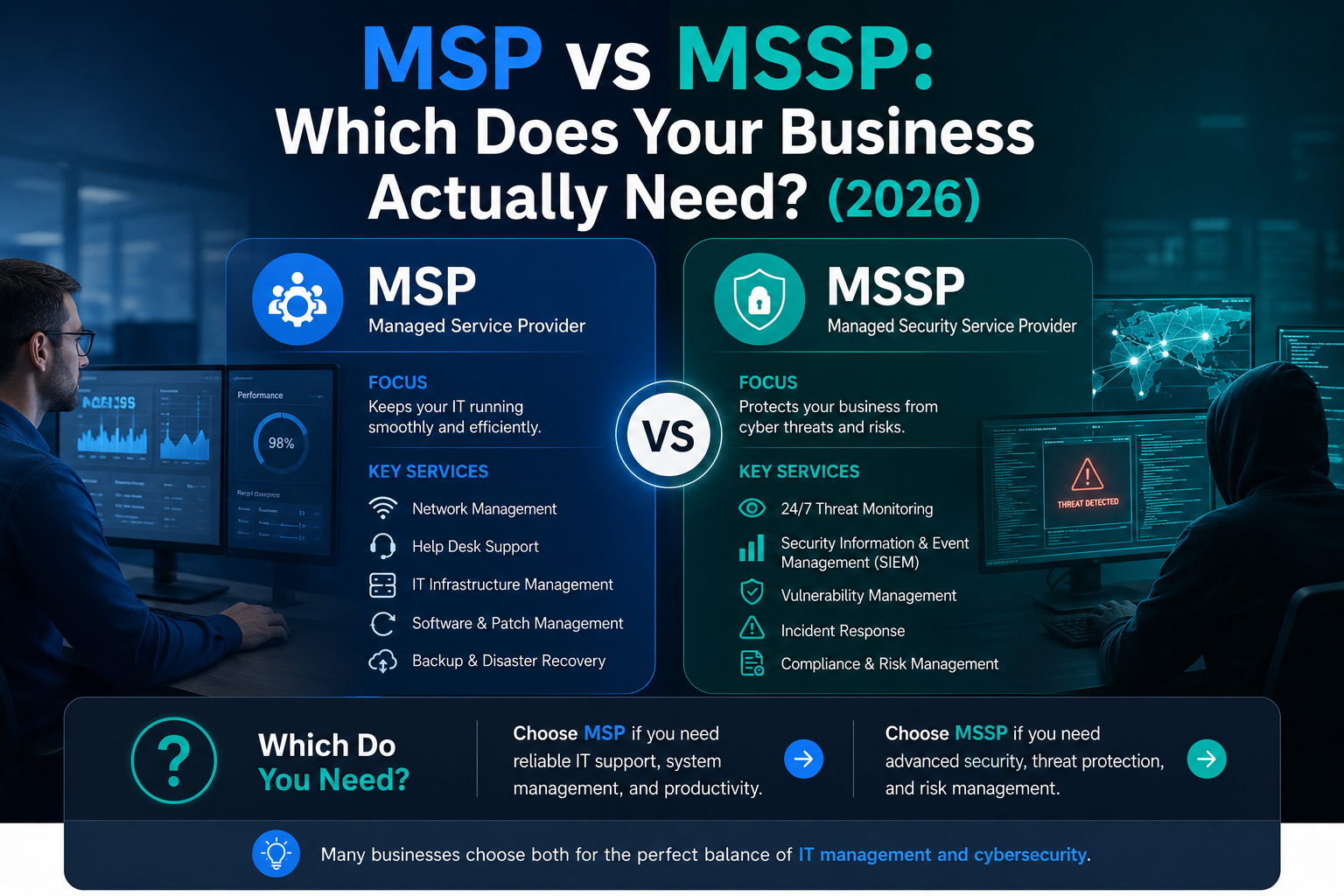
MSP vs MSSP: Which Does Your Business Actually Need?
Understand where managed IT ends, where dedicated managed security begins, and why regulated organizations often benefit from an integrated model that brings both disciplines together.
Compare MSP vs MSSPTell Us What You’re Trying to Protect
Give us a little context about your environment, security concerns, or current provider model. We’ll connect you with the right person at TorchLight.