
Estimated reading time: 5 minutes
Three Days to Patch a 10.0: What Cisco’s Emergency Says About Every Network in 2026
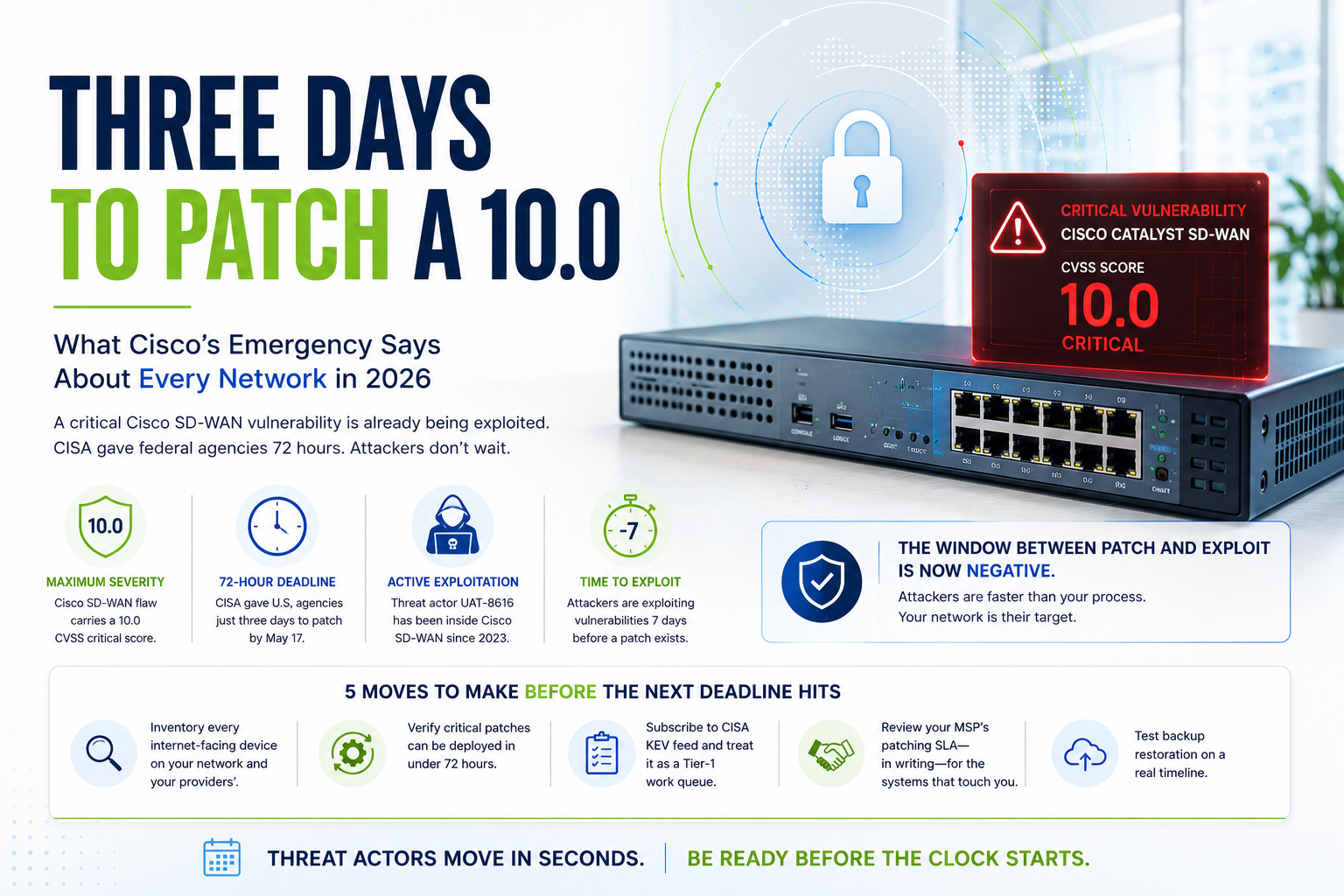
The federal cybersecurity agency known as CISA gave U.S. agencies 72 hours. On May 14, CISA added a fresh vulnerability in Cisco’s Catalyst SD-WAN equipment to its Known Exploited Vulnerabilities catalog, with an enforcement deadline of May 17. The flaw, carries the maximum possible severity score: 10.0 out of 10.0. And the threat actor exploiting it has been quietly working inside Cisco SD-WAN networks since at least 2023.
The three-day window is now a generous timeline. The rest of the threat landscape is moving in seconds.
A 10.0, a 3-Day Deadline, and Hackers Already Inside
The breach is what security professionals call an authentication bypass. In plain language, it means an attacker on the open internet, with no password, can talk to a Cisco Catalyst SD-WAN Controller and walk in as a high-privilege internal account. From there, they can rewrite the network’s plumbing, push configurations across the entire SD-WAN fabric, and inject SSH keys that survive a reboot. Cisco’s own Talos research team attributes the active exploitation to a group it tracks as UAT-8616, which Talos describes as a “highly sophisticated cyber threat actor” that has been targeting the Cisco SD-WAN Vulnerability since at least 2023.
The detail that changes the math: By the time the federal deadline arrived, UAT-8616 had already been operating inside this class of equipment for nearly three years. The patch is not a fix for a future problem, but rather an eviction notice for a tenant nobody knew was there.
The Window Between Patch and Exploit Is Now Negative
Mandiant, the incident-response arm of Google Cloud, released its M-Trends 2026 report last quarter. The report drew on more than five hundred thousand hours of investigations conducted in 2025. But one number reframes everything else. The mean “time to exploit”: the gap between a vulnerability being disclosed and that vulnerability being exploited in the wild, is now negative seven days. Translated: attackers are, on average, weaponizing flaws a week before a patch exists.
The same report tracks a related, equally uncomfortable trend. In 2022, the median delay between an initial-access broker breaching a network and handing that access to a follow-on attacker was over eight hours. In 2025, that handoff dropped to twenty-two seconds.
Twenty-two seconds. Faster than a coffee order, and way faster than most help-desk tickets get acknowledged.
Why This Hits Mid-Market Organizations, Not Just Federal Agencies
A reasonable reaction to a Cisco SD-WAN Vulnerability is to skip the article. If you don’t run Cisco’s enterprise networking gear, why does any of this matter to you?
Because the equipment you don’t run is being run on your behalf. Managed service providers routes traffic through it. Bank’s third-party processors sit behind it. Your largest vendor’s procurement portal terminates on it. Healthcare partner’s electronic health record platforms depends on it. The dominant 2026 attack pattern is supply-chain and trusted-partner compromise.
ShinyHunters, the group that recently claimed roughly 1.5 billion Salesforce records lifted through a single compromised integration, didn’t break Salesforce. They broke a small vendor whose OAuth tokens had access to Salesforce. The downstream victims included Cloudflare, Zscaler, Tenable, Palo Alto Networks, and Proofpoint. Every one of them are companies that sell security software for a living. If those organizations got caught by the trusted-partner pattern, the pattern is the headline, not the brand name.
Moves to Make Before the Next 3-Day Deadline Lands on You
The good news is the playbook is not exotic. The bad news is most organizations have not run it lately.
Things worth fast-tracking this week:
1. Inventory every internet-facing device on your network and on your providers’ networks
2. Verify that critical patches can be deployed in under seventy-two hours, not the monthly cadence most IT teams default to
3. Subscribe to the CISA Known Exploited Vulnerabilities feed and treat it as a Tier-1 work queue
4. Review your managed service provider’s own patching SLA, in writing, for the systems that touch you
5. Test backup restoration on a real timeline, because the M-Trends data shows attackers now specifically target the backup and virtualization layer.
None of this requires more tools. It requires faster decisions, and a partner who can run the queue when the clock starts. That partner can be an in-house team if you have one. More often it is a managed security service provider, a virtual chief information security officer (vCISO), or a dedicated specialist on retainer; somebody whose job description is hour one, not next week’s meeting.
The Trend Line? It Gets Faster from Here
What makes this Cisco story significant is not the vulnerability itself, but the rhythm. A maximum-severity flaw, a 3-day federal mandate, a sophisticated actor who has been resident in the equipment for years, and a broader threat landscape where attackers move from foothold to encryption in seconds. Mandiant’s researchers note that ransomware groups now systematically destroy the ability to recover before they begin negotiating: a recovery deadlock that turns a network outage into a hostage situation with no ransom-free exit.
The organizations that come through these incidents intact are not the ones with the biggest budgets. They are the ones with the shortest distance between alert published and action taken. That distance is a function of preparation, not technology. The 24×7 monitoring, detection and response work that sounds like overhead during a calm quarter is the work that gives a defender minutes instead of seconds.
TorchLight specializes in managed security services for organizations where security and compliance are non-negotiable. With 18+ years serving regulated industries, 24/7 SOC operations, and deep regulatory fluency across GLBA, HIPAA, and SEC requirements, TorchLight delivers security operations leadership can defend.
Ready to explore what partnership looks like? Schedule a consultation to discuss your organization’s specific security needs and regulatory requirements.