
Estimated reading time: 6 minutes
June 9, 2026 – cyber insurance requirements – by Zach Carothers – in Cybersecurity, Compliance
The cyber insurance requirements in 2026 look nothing like the ones from two years ago. The questionnaire is now an audit. The controls you check off are the same controls you will have to prove were running on the day an attacker got in. Insurers are under real financial pressure, and they are passing it straight to policyholders, in tighter underwriting going in and harder scrutiny when a claim comes due.
What Actually Changed in Cyber Insurance
Start with the insurers’ problem. Roughly two-thirds of the global cyber insurance market sits with U.S. policyholders, and carriers are openly worried that one large supply-chain event or cloud outage could hit a wave of customers at once and gut the whole line. That concentration has reshaped how they price and how they pay. Rates have actually softened over the past couple of years, where scrutiny has not.
The loss numbers explain the nerves. Aon put the average global ransomware claim at about $713,000 in 2025, close to double the roughly $374,000 it measured in 2024, and it counted a 38% jump in cyber and technology errors-and-omissions incidents in the United States. Individual attacks are getting more expensive even where overall frequency dips. So carriers are doing two things at once: They are writing more exclusions, and they are checking far more carefully to see if you did what you said you would.
The Make-or-Break Control Is Real MFA
This is where claims now live or die. When a breach happens, the fight between you and your carrier often comes down to one question. Was multifactor authentication actually turned on and enforced where it mattered? Breach specialists at PwC describe the most common disputes as exactly that, the gap between what a company attested to and what the forensic review finds.
Attackers spend their days finding the seams in MFA that was set up once and never hardened. We have written before about why phishing-resistant MFA matters, because criminals routinely slip past multifactor prompts that looked fine on paper. The takeaway for your renewal is blunt. “We have MFA” and “MFA is enforced everywhere, resists phishing, and is logged” are different sentences, and only one of them holds up.
Why Business Interruption Is the Number That Should Scare You
The forensic bill is rarely the worst part. The bigger exposure is downtime, plus the legal tail that follows a breach. As a PwC partner told Cybersecurity Dive, “that tail can rival the incident itself in financial terms.”
Look at Hasbro. After a cyberattack this spring, the company told investors it would absorb about $20 million in remediation costs and expects $40 million to $60 million in product revenue to slip out of the second quarter and into the back half of the year. Now translate that to the organizations we work with. Credit Unions: downtime means members locked out of their own money. Clinics: it means appointments canceled and care delayed. RIAs & Wealth Management: it means no access to client accounts during market hours. Manufacturers: it can translate to months of revenue delay. Recovery speed, not detection alone, is what decides how big the loss gets.
What the New Cyber Insurance Requirements Mean for Your Sector
The pressure lands differently depending on what you do.
Credit Unions: The NCUA already expects you to report a covered cyber incident within 72 hours, and it examines whether your controls match your written policies. Stack a denied insurance claim on top of an exam finding and you have two failures from one event. Underwriters now want MFA across the board, endpoint detection and response, and backups you have actually tested.
Healthcare: HIPAA requires safeguards today, and the proposed Security Rule update would make controls like MFA and encryption explicit rather than optional. Ransomware that takes down scheduling or records is a patient-safety problem and a revenue problem at the same time. Insurers want network segmentation and a recovery plan you have rehearsed.
RIAs and Wealth Managers: SEC Regulation S-P now applies to smaller firms as of June 3, 2026, and it calls for an incident response program, customer notification, and oversight of your vendors. The controls the SEC wants are the same ones your insurer wants. Attest carefully, because one gap can cost you an enforcement action and a denied claim at the same time.
Co-managed IT: For organizations of 50 or more. You are the missing middle that worries insurers most. By some estimates only about one-in-five small and midsize businesses carries cyber coverage, and the mid-market is where underwriting tightened the hardest. A co-managed model is how you keep the controls maintained and documented, so your attestation is true at renewal and still true after an incident.
Education in Washington and California: Schools and colleges hold rich student data under FERPA and run on tight budgets, which makes them favorite ransomware targets. The districts and campuses we support throughout Washington and California now face the same underwriting questions a bank does. Cooperative purchasing helps the budget. It does not lower the bar on controls.
What to Do Before Your Next Renewal
None of this calls for a bigger logo on your security stack. It calls for controls that are real and provable.
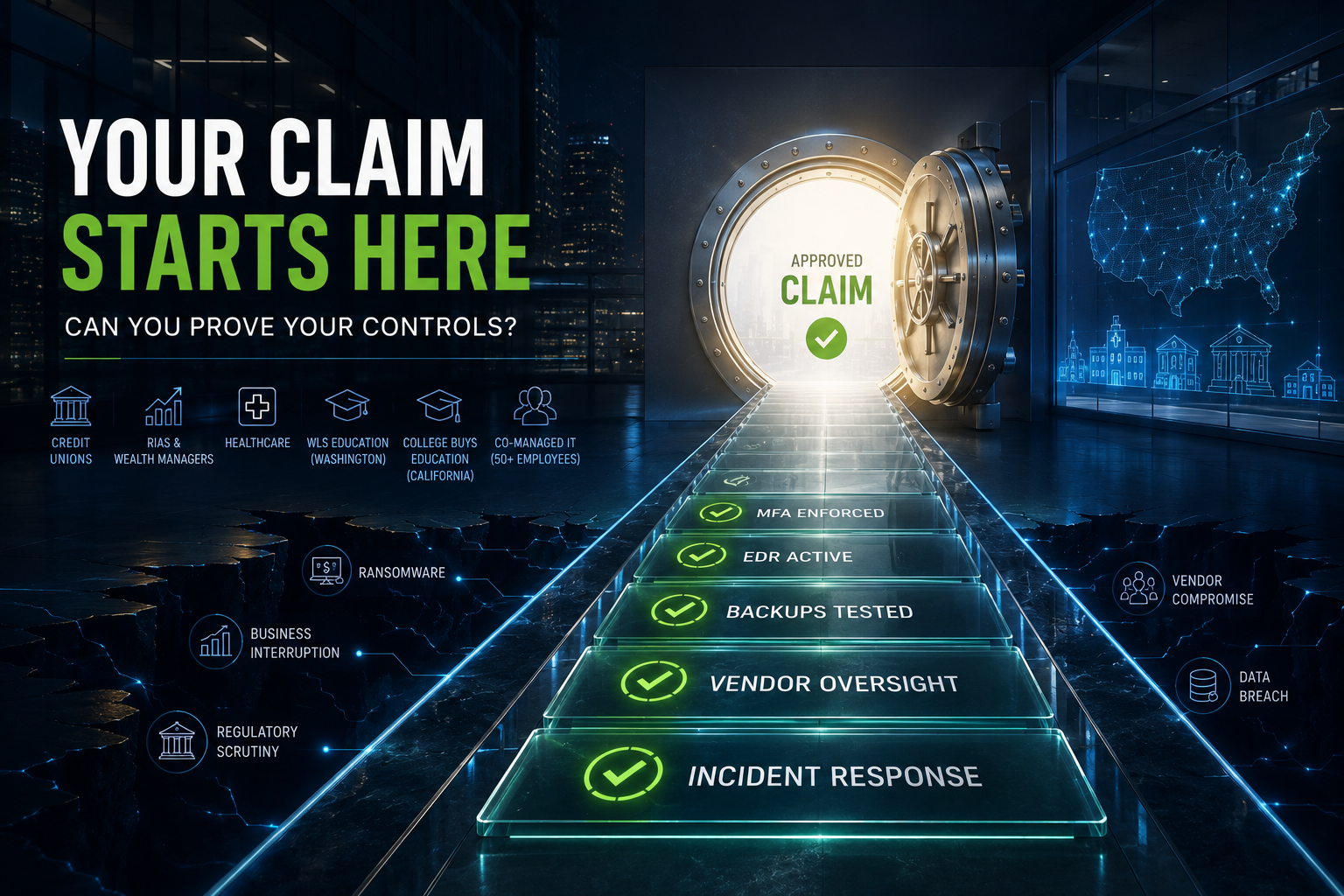
1. Turn on MFA everywhere it can go, make it phishing-resistant where you can, and keep the logs that show it was enforced.
2. Put endpoint detection and response on every device.
3. Keep backups separate from the rest of your infrastructure, and test the restore, not just the backup.
4. Write an incident response plan that maps to your regulator’s actual rule, then run a tabletop against it.
5. Keep tabs on the vendors who touch your data.
6. Add identity detection and threat response for your cloud identities.
Pair all of it with 24×7 monitoring & detection and response, so a single compromised laptop becomes a contained event instead of a six-figure claim you might not win. For most organizations in the middle, the realistic way to run and document all of this is a managed security partner or a virtual CISO who does it every day. At TorchLight Secured & Managed IT, this is what we do.
Cyber insurance used to cover the gap between your security on paper and your security in practice. It does not anymore. It pays when there is no gap.
TorchLight specializes in managed security services for organizations where security and compliance are non-negotiable. With 18+ years serving regulated industries, 24/7 SOC operations, and deep regulatory fluency across GLBA, HIPAA, and SEC requirements, TorchLight delivers security operations leadership can defend.
Ready to explore what partnership looks like? Schedule a consultation to discuss your organization’s specific security needs and regulatory requirements.