
When businesses think about cybersecurity leadership, a Chief Information Security Officer (CISO) often comes to mind. However, hiring a full-time CISO may not be practical for every organization. A vCISO provides businesses with experienced cybersecurity services, leadership, strategy, and guidance on a flexible basis without the cost and commitment of a permanent executive hire.
A vCISO helps startups, small businesses, and mid-sized companies strengthen security programs, manage cyber risks, improve compliance readiness, and develop long-term cybersecurity strategies. This guide explains what a vCISO is and how it works, outlines its key responsibilities, explains how much a vCISO costs, and explains why growing organizations are turning to virtual security leadership.
What is a vCISO?
A vCISO (Virtual Chief Information Security Officer) is an outsourced cybersecurity executive who provides strategic security leadership without being a full-time employee. Similar to a traditional CISO, a vCISO helps organizations manage security policies, risk management, compliance, incident response planning, and overall cybersecurity strategy.
Unlike a permanent executive hire, a vCISO works as a flexible partner, providing expertise based on business needs, whether through occasional guidance or ongoing security management. This allows organizations to strengthen their security posture and improve cybersecurity maturity without the high cost of hiring a full-time CISO.
What Is a vCISO and How Does It Work?
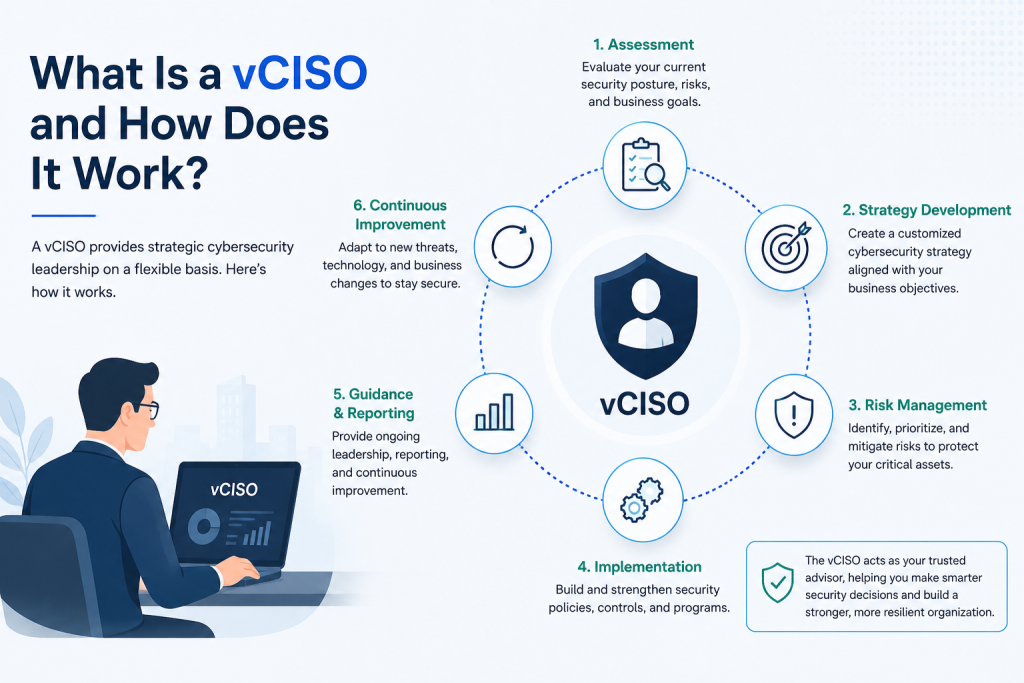
Understanding what a vCISO is and how it works requires looking at the role as a partnership rather than a simple consulting service. A vCISO typically begins by evaluating an organization’s current cybersecurity posture. This includes reviewing:
- Existing security controls
- Technology infrastructure
- Compliance requirements
- Current risks
- Business objectives
- Incident response capabilities
After identifying security gaps, the vCISO develops a roadmap to improve the organization’s cybersecurity program.
A typical vCISO engagement may include:
1. Security Assessment
The vCISO reviews current security practices and identifies vulnerabilities that could expose the business to cyber threats.
2. Cybersecurity Strategy Development
The vCISO creates a security roadmap aligned with business goals, industry requirements, and risk priorities.
3. Risk Management
They help organizations understand their most significant cyber risks and determine how to reduce them effectively.
4. Compliance Support
A vCISO can assist organizations preparing for frameworks and regulations such as:
- SOC 2
- HIPAA
- PCI DSS
- ISO 27001
- NIST Cybersecurity Framework
5. Executive Security Guidance
A vCISO translates technical security issues into business-level insights, helping leadership teams make informed decisions.
What Does a vCISO Do?
The responsibilities of a vCISO can vary depending on the organization’s size, industry, and security needs. However, most vCISO services include several core responsibilities.
1. Developing Cybersecurity Strategy
A vCISO creates a structured cybersecurity plan that addresses current risks and future business needs. This may include:
- Security improvement roadmaps
- Cybersecurity budgets
- Technology recommendations
- Risk reduction strategies
Rather than focusing only on individual security tools, a vCISO helps organizations build a complete security program.
2. Managing Cyber Risk
Every organization faces cybersecurity risks, but not every company understands where its biggest vulnerabilities exist. A vCISO helps identify:
- Critical assets
- Security weaknesses
- Potential attack paths
- Business impact of cyber incidents
This allows companies to prioritize security investments where they provide the most value.
3. Improving Compliance Readiness
Compliance requirements continue to become more complex. Many businesses need cybersecurity leadership to prepare for audits, customer security reviews, and regulatory requirements. A vCISO helps establish:
- Security policies
- Documentation processes
- Risk assessments
- Governance structures
This is especially important as organizations adopt AI technologies, making AI governance frameworks essential for maintaining visibility, accountability, and compliance.
4. Supporting Incident Response Planning
Cyber incidents can happen even with strong security controls. A vCISO helps organizations prepare by developing:
- Incident response plans
- Communication procedures
- Recovery strategies
- Post-incident improvement processes
Having a structured response plan can significantly reduce downtime and business disruption.
Why Are Businesses Hiring vCISOs?

Many organizations address these challenges by combining strategic cybersecurity leadership with reliable managed IT services that provide ongoing technology support, monitoring, and infrastructure management.
- Limited cybersecurity expertise internally
- Increasing compliance requirements
- Growing cyber threats
- Budget limitations
- Lack of strategic security planning
A vCISO provides access to experienced cybersecurity leadership without requiring a company to build a complete internal security department.
Businesses commonly hire vCISOs because they need the following:
1. Executive-Level Security Expertise
A vCISO provides the strategic guidance normally associated with a senior cybersecurity executive.
2. Flexible Security Leadership
Organizations can scale vCISO support based on changing needs.
3. Faster Security Maturity
Instead of spending years developing internal expertise, companies gain immediate access to cybersecurity experience.
4. Better Cost Efficiency
The cost of a vCISO is often significantly lower than hiring a full-time CISO.
How Much Does a vCISO Cost?
One of the most common questions businesses ask is, “How much does a vCISO cost?
The answer depends on several factors, including:
- Company size
- Security requirements
- Industry regulations
- Scope of responsibilities
- Engagement duration
- Experience level of the vCISO
Unlike a full-time executive salary, vCISO pricing is usually structured around flexible consulting models.
Average vCISO costs may range from the following:
| Engagement Type | Estimated Cost |
| Basic advisory support | $2,000–$5,000 per month |
| Ongoing security leadership | $5,000–$15,000+ per month |
| Enterprise-level strategic support | $15,000+ per month |
These ranges can vary depending on the organization’s complexity and the level of involvement required.
What Is the Average Cost of a vCISO?
The average cost of a vCISO depends heavily on whether the business needs occasional guidance or ongoing cybersecurity leadership. For many small and mid-sized companies, a typical vCISO engagement may cost between $3,000 and $10,000 per month.
Organizations requiring advanced security programs, compliance support, or complex environments may invest more due to additional responsibilities.
The overall cost of a vCISO is influenced by the following:
- Number of employees
- Number of systems and applications
- Security maturity level
- Compliance requirements
- Required availability
- Strategic responsibilities
The important factor is not only the monthly fee but the value gained through reduced risk, improved security decisions, and stronger operational resilience.
vCISO Services Cost: Common Pricing Models
Understanding vCISO services cost requires looking beyond a simple monthly price. Unlike traditional employees, vCISOs typically work through flexible engagement models designed around an organization’s cybersecurity requirements. Most providers offer different pricing structures depending on the level of support needed.
1. Monthly Retainer Model
A monthly retainer is one of the most common vCISO pricing approaches. Under this model, businesses pay a fixed monthly fee for ongoing cybersecurity leadership.
A monthly retainer may include the following:
- Security strategy development
- Risk assessments
- Compliance guidance
- Executive reporting
- Policy development
- Security program management
This model works well for organizations that need continuous cybersecurity leadership but do not require a full-time CISO.
2. Hourly Consulting Model
Some businesses choose a flexible hourly arrangement when they need occasional security expertise.
This option is commonly used for:
- Security assessments
- Compliance preparation
- Policy reviews
- Incident response support
- Cybersecurity strategy discussions
While hourly consulting provides flexibility, organizations requiring ongoing security leadership often benefit more from a structured monthly engagement.
3. Project-Based vCISO Services
Some companies hire vCISO experts for specific cybersecurity initiatives.
Examples include:
- Preparing for SOC 2 certification
- Developing security policies
- Creating incident response plans
- Performing cybersecurity risk assessments
- Improving security maturity
Project-based engagements are useful when businesses have a defined security objective with a specific timeline.
Factors That Impact the Cost of a vCISO
The cost of a vCISO is not the same for every organization. Several factors determine how much businesses should expect to invest.
1. Business Size and Complexity
Larger organizations usually require more extensive cybersecurity planning because they often have more employees, more devices, larger networks, multiple applications, and greater amounts of sensitive data.
A startup with a small technology environment may need limited strategic guidance, while a growing enterprise may require ongoing security leadership.
2. Industry Requirements
Certain industries require stronger cybersecurity controls because they handle sensitive information. Industries such as healthcare, financial services, legal, technology, and government contractors often require additional security oversight.
Compliance obligations can increase vCISO consulting costs per month because the role may involve compliance preparation, documentation management, security audits, and regulatory alignment.
3. Current Security Maturity
Organizations with limited cybersecurity processes may require more initial support. A vCISO may need to establish security policies, risk management processes, governance frameworks, employee security training programs, and incident response procedures.
Companies with mature security programs may only need strategic oversight and continuous improvement.
4. Scope of Responsibilities
The broader the vCISO’s responsibilities, the greater the investment.
A vCISO engagement may include:
Basic services:
- Security recommendations
- Risk reviews
- Executive reporting
Advanced services:
- Compliance management
- Security team leadership
- Vendor risk management
- Security architecture reviews
- Incident response coordination
Cost Savings of vCISO vs Full-Time CISO
One of the biggest reasons organizations consider a vCISO is the financial advantage compared with hiring a full-time cybersecurity executive.
A full-time CISO requires more than just a salary. Businesses must also consider:
- Benefits
- Bonuses
- Recruitment expenses
- Training costs
- Executive compensation
- Security tools and resources
According to industry compensation trends, experienced CISOs can command six-figure salaries, especially in organizations with complex security requirements. A vCISO provides access to similar strategic expertise without the long-term financial commitment.
Comparing vCISO and Full-Time CISO Costs
| Factor | Full-Time CISO | vCISO |
| Salary | High annual expense | Flexible monthly cost |
| Benefits | Required | Not applicable |
| Hiring process | Months of recruitment | Faster onboarding |
| Flexibility | Fixed role | Scalable support |
| Expertise access | One individual | Often broader expertise |
| Ideal for | Large enterprises | Startups and mid-sized businesses |
The cost savings of vCISO vs full-time CISO can be significant, especially for companies that need cybersecurity leadership but do not require a full-time executive.
Cost Savings of Hiring a vCISO for Small Startups
For startups, cybersecurity leadership is important from the beginning. However, hiring a full-time CISO may not be financially realistic during early growth stages. The cost savings of hiring a vCISO for small startups come from gaining executive-level security expertise without the expense of building a complete security department.
A startup vCISO can help with:
- Creating foundational security policies
- Preparing for investor security reviews
- Improving customer trust
- Meeting compliance requirements
- Reducing cybersecurity risks
Instead of spending hundreds of thousands of dollars on a full-time security executive, startups can invest in targeted cybersecurity leadership that grows alongside the business.
Cost Benefits of vCISO for Mid-Sized Companies
Mid-sized companies often reach a stage where cybersecurity becomes too complex to manage informally, but may still not need a permanent CISO. The cost benefits of vCISO for mid-sized companies include:
1. Access to Experienced Leadership
A vCISO provides cybersecurity expertise that may otherwise be difficult to recruit and retain.
2. Reduced Hiring Costs
Companies avoid expenses associated with:
- Executive recruitment
- Salary packages
- Benefits
- Long-term employment commitments
3. Improved Security Decision-Making
A vCISO helps leadership teams prioritize security investments based on actual business risks.
4. Stronger Compliance Readiness
Organizations can better prepare for:
- Customer security assessments
- Industry regulations
- Compliance audits
5. Scalable Security Support
As business needs change, companies can increase or decrease vCISO involvement.
When Should a Business Hire a vCISO?
Many businesses wait until after a cybersecurity incident before investing in leadership. However, a vCISO is most valuable when organizations take a proactive approach.
A company should consider hiring a vCISO when:
1. Security Has Become Too Complex
Growing companies often accumulate:
- Cloud platforms
- SaaS applications
- Employee devices
- Customer data
- Third-party integrations
A vCISO helps create structure around these expanding environments.
2. Customers Require Security Assurance
Many businesses now face security questionnaires and vendor assessments before winning contracts. A vCISO can help demonstrate security maturity, compliance readiness, and risk management processes
3. The Business Is Preparing for Compliance
Organizations pursuing frameworks such as SOC 2 or ISO 27001 often benefit from experienced security leadership.
4. There Is No Internal Security Executive
A company may have IT employees but still lack someone responsible for strategic cybersecurity decisions. A vCISO fills that leadership gap.
How to Choose the Right vCISO Provider
Selecting a vCISO provider requires more than comparing pricing. Businesses should evaluate experience, approach, and security expertise.
Consider these factors:
1. Industry Experience
Choose a provider that understands your industry’s risks and compliance requirements.
2. Strategic Approach
A strong vCISO should focus on long-term security improvement, not only fixing immediate issues.
3. Technical Understanding
The right partner should understand:
- Security architecture
- Cloud environments
- Risk management
- Compliance frameworks
- Incident response
4. Clear Communication
A vCISO must communicate effectively with both technical teams and executive leadership. Cybersecurity decisions affect the entire business, so security guidance should be understandable and actionable.
Why Security-Focused Organizations Prefer vCISO Services
Modern businesses need more than cybersecurity tools. They need strategy, leadership, and a clear understanding of risk. A vCISO provides organizations with strategic cybersecurity direction, improved risk visibility, better compliance preparation, stronger security governance, and executive-level expertise.
For many growing organizations, a vCISO represents the right balance between security maturity and financial efficiency. Organizations can close gaps by combining managed IT operations with managed security services for continuous monitoring, faster response, and stronger protection.
Final Thoughts
Understanding what a vCISO is means recognizing the value of having experienced cybersecurity leadership without the cost and commitment of a full-time executive. A vCISO helps businesses develop security strategies, manage risks, improve compliance readiness, and strengthen their overall security posture while providing flexible support based on their needs.
As cyber threats continue to evolve, organizations need proactive security guidance that aligns with business goals. TorchLight helps businesses build stronger cybersecurity programs through strategic leadership, risk management, and compliance expertise.
For companies looking to improve security without hiring a full-time CISO, a vCISO partnership can provide the expertise, flexibility, and cost efficiency needed to move forward confidently. Contact us today.
FAQs
1. What is a vCISO?
A vCISO, or Virtual Chief Information Security Officer, is an outsourced cybersecurity executive who provides strategic security leadership, risk management, compliance support, and security guidance without being a full-time employee.
2. How does a vCISO work?
A vCISO evaluates an organization’s security posture, identifies risks, develops cybersecurity strategies, improves compliance readiness, and provides ongoing security leadership based on business needs.
3. How much does a vCISO cost?
The cost of a vCISO varies depending on engagement scope, company size, and security requirements. Most organizations invest between a few thousand dollars per month and $15,000+ monthly for ongoing strategic support.
4. What is the average cost of a vCISO?
The average cost of a vCISO typically ranges from $3,000 to $10,000 per month for many small and mid-sized organizations, although complex environments may require higher investment.
5. Is a vCISO cheaper than hiring a full-time CISO?
Yes. A vCISO is often more cost-effective because businesses avoid full-time executive salary costs, benefits, recruitment expenses, and long-term employment commitments.
6. What services are included in vCISO services?
vCISO services commonly include cybersecurity strategy, risk assessments, compliance support, security policies, incident response planning, executive reporting, and security program development.
7. When should a startup hire a vCISO?
Startups should consider hiring a vCISO when they need cybersecurity leadership, are preparing for compliance requirements, handling sensitive data, or need to demonstrate security maturity to customers or investors.