
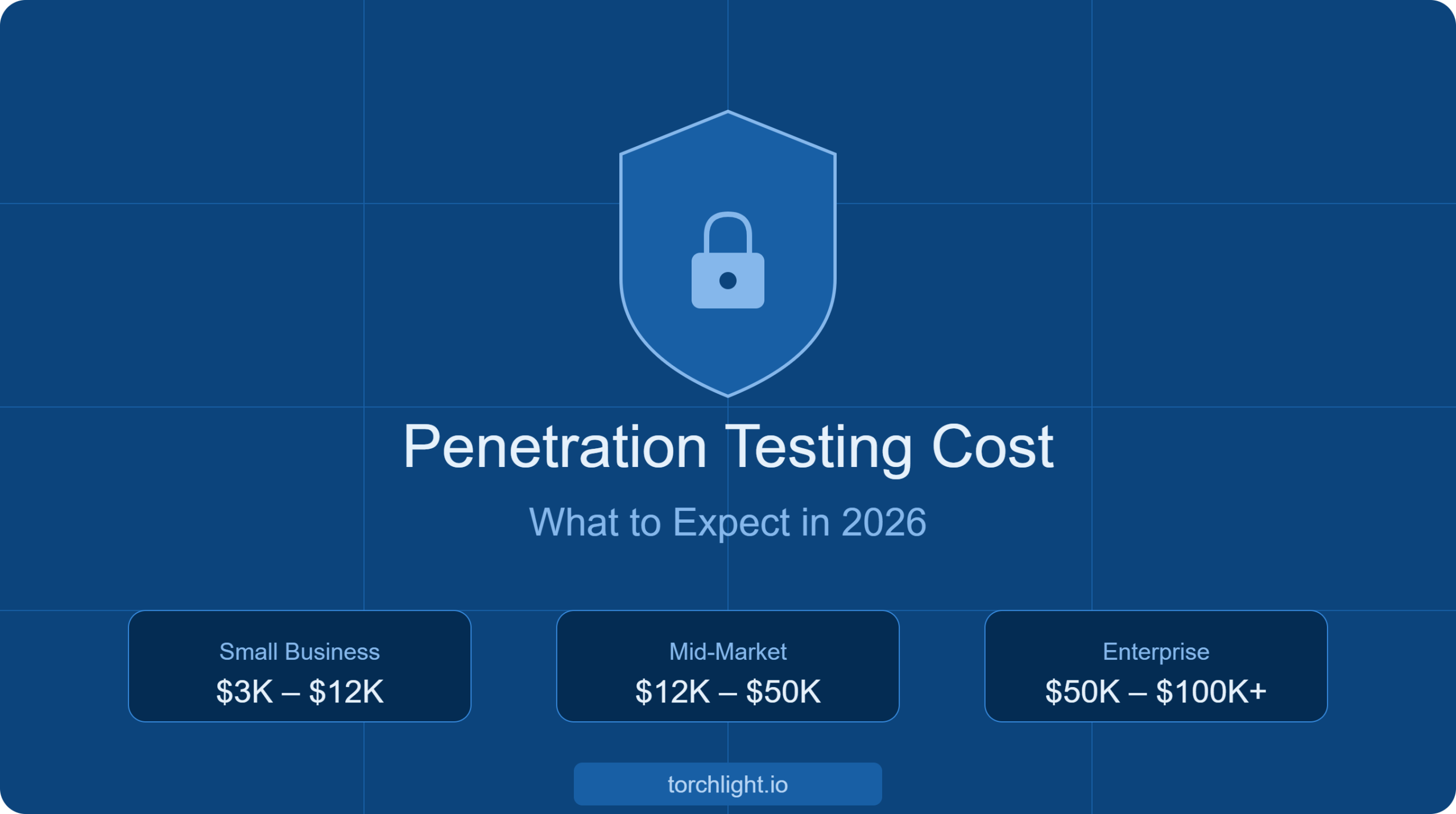
If you’ve been tasked with budgeting for a penetration test, or justifying the expense to leadership, you’ve probably already discovered that penetration testing cost isn’t as straightforward as a line item on a vendor’s website. Prices vary wildly, scope is rarely apples-to-apples, and the cheapest option is often the most expensive mistake you can make.
This guide breaks down penetration testing pricing in 2026 with real numbers, the factors that drive cost up or down, what small businesses should expect, and how to evaluate whether you’re getting genuine value or an expensive rubber stamp. Whether you’re a credit union preparing for an NCUA exam, a healthcare organization under HIPAA, or a compliance-sensitive small business, this is the resource you need before you make a decision.
What Is Penetration Testing and Why Does It Matter in 2026?
Penetration testing, commonly called a “pen test,” is a simulated cyberattack conducted by certified security professionals to find exploitable vulnerabilities in your systems before real attackers do. Unlike automated vulnerability scans, a pen test involves a human tester applying real-world attack techniques to probe your defenses.
In 2026, the stakes have never been higher:
- Cyber insurance underwriters now require documented pen test results as a condition of coverage or renewal
- Regulators including NCUA, FDIC, and HIPAA auditors expect independent validation of security controls
- Ransomware groups increasingly target small and mid-sized businesses that lack mature security postures
A penetration test is no longer a “nice-to-have.” For regulated organizations in particular, it is a prerequisite for compliance, insurability, and stakeholder trust.
Related: Learn how TorchLight’s Penetration Testing Services deliver compliance-ready reports with regulator-friendly language and prioritized remediation roadmaps.
How Much Does a Penetration Test Cost in 2026?
Let’s get to the numbers. Penetration testing pricing in 2026 spans a wide range depending on scope, methodology, and provider. Here is what organizations can realistically expect:
Penetration Testing Cost by Test Type
| Test Type | Typical Price Range | Best For |
| External Network Penetration Test | $3,000 – $15,000 | Testing internet-facing assets |
| Internal Network Penetration Test | $5,000 – $20,000 | Testing insider threat exposure |
| Web Application Penetration Test | $4,000 – $25,000 | Custom apps, portals, SaaS integrations |
| Social Engineering / Phishing Test | $1,500 – $8,000 | Human vulnerability assessment |
| Wireless Network Penetration Test | $2,000 – $10,000 | On-site Wi-Fi infrastructure |
| Physical Penetration Test | $3,000 – $15,000 | Physical access and tailgating |
| Full Red Team Engagement | $25,000 – $100,000+ | Enterprise-level adversarial simulation |
| Compliance-Scoped Test (HIPAA, PCI, NCUA) | $5,000 – $30,000 | Regulated industry requirements |
Important: These ranges reflect U.S. market pricing in 2026. Offshore providers may quote significantly less, but often deliver automated scan reports repackaged as manual tests, which will not satisfy most regulators or cyber insurance carriers.
Key Penetration Testing Cost Factors
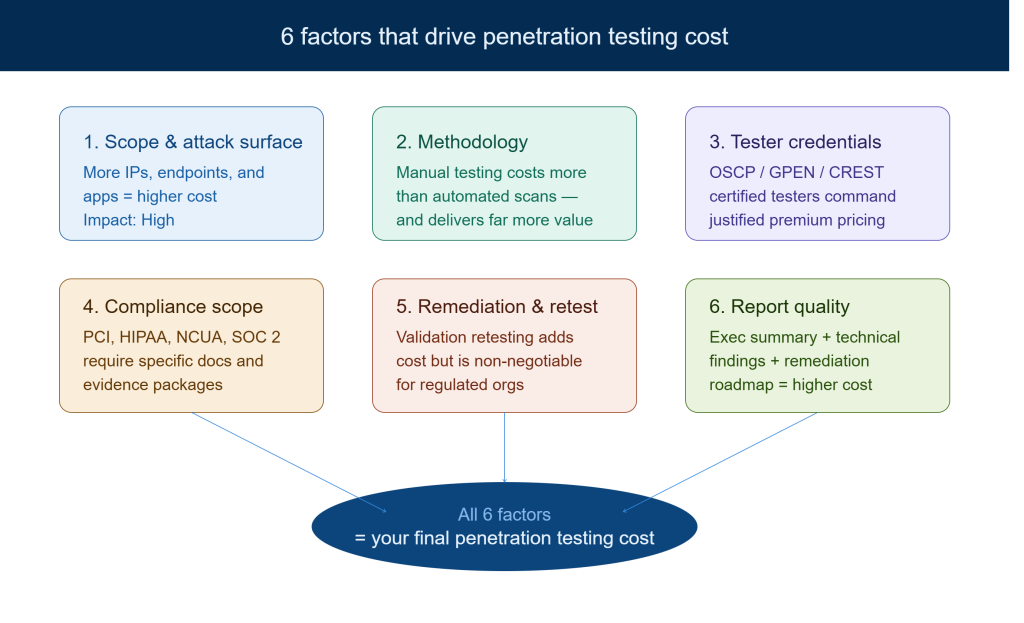
Understanding what drives penetration testing cost factors helps you scope engagements wisely and avoid paying for more, or less, than you need.
1. Scope and Attack Surface Size
The more systems, IP addresses, applications, and endpoints in scope, the higher the cost. A small business with 50 endpoints and a simple network will pay far less than a multi-branch financial institution with complex infrastructure.
2. Test Methodology
Automated scanning is cheap. Manual exploitation by a certified ethical hacker is not, and for good reason. Manual testing finds vulnerabilities that automated tools routinely miss, including logic flaws, chained attack paths, and misconfigurations buried in custom workflows.
3. Tester Credentials and Experience
Providers with OSCP (Offensive Security Certified Professional), GPEN, CEH, or CREST-certified testers charge a premium. That premium is justified: their findings hold up under regulatory scrutiny, their reports are written for both technical remediation teams and executive leadership, and their methodology is documented and reproducible.
4. Compliance Requirements
A penetration test scoped for PCI DSS, HIPAA, NCUA, or SOC 2 compliance requires specific documentation, evidence packages, and report formats. This adds cost relative to a standard commercial test, but the output directly satisfies auditors and reduces exam risk.
5. Remediation Support and Retesting
Many providers charge for the initial test only. Others include a remediation consultation and a retest to validate that critical findings were resolved. If you’re using the test to satisfy a regulator or insurer, retesting is not optional, factor it into your budget.
6. Report Quality
The deliverable matters enormously. A low-cost test often produces a 10-page automated scan dump. A proper engagement produces an executive summary for leadership, a technical findings report for your IT team, a prioritized remediation roadmap, and evidence documentation for your auditors. These are not equivalent products.
Network Penetration Testing Cost: A Closer Look
Network penetration testing cost is the most common entry point for organizations new to pen testing, and also the most misunderstood line item.
External vs. Internal Network Tests
| Factor | External Network Test | Internal Network Test |
| What it tests | Internet-facing IPs, firewalls, VPNs, exposed services | Internal network segmentation, lateral movement, privilege escalation |
| Typical duration | 3–5 days | 5–10 days |
| 2026 price range | $3,000 – $15,000 | $5,000 – $20,000 |
| Regulatory relevance | Required for PCI, NCUA, HIPAA | Often required for full compliance validation |
| Who needs it | Every organization | Organizations with insider threat exposure or sensitive internal data |
A common mistake is purchasing only an external test when regulators expect both. For credit unions, community banks, and healthcare organizations, an internal network test is typically required to demonstrate adequate controls over lateral movement and privilege abuse.
Pen Test Cost for Small Business
One of the most frequently asked questions we hear from compliance-sensitive organizations is: what is the pen test cost for small business?
The good news: small business penetration testing has become more accessible in 2026. The bad news: low-cost options often fail to satisfy regulators and insurers.
Small Business Penetration Testing Cost Guide
| Business Size | Typical Scope | Estimated Cost |
| 1–25 employees | External network + basic internal | $3,000 – $6,000 |
| 26–100 employees | External + internal + 1-2 web apps | $6,000 – $12,000 |
| 101–250 employees | Full network + web apps + phishing | $12,000 – $25,000 |
| 250+ employees (regulated) | Compliance-scoped full engagement | $20,000 – $50,000+ |
For small businesses under compliance mandates, including community banks, credit unions under NCUA examination, RIAs, family offices, and HIPAA-covered healthcare practices, the cost of not testing often exceeds the test itself. A single regulatory finding, cyber insurance claim denial, or breach response event can dwarf years of pen testing budgets.
Related: See how TorchLight’s Managed Security Services pair continuous monitoring with periodic validation so your security posture is always audit-ready, not just in testing cycles.
What Should Be Included in Penetration Testing Pricing?
When evaluating quotes, use this checklist to compare providers fairly:
| Deliverable | Should Be Included | Watch For |
| Scoping call and pre-engagement documentation | ✅ Yes | Providers who skip this often produce generic reports |
| Manual testing by certified professionals | ✅ Yes | “Pen test” quotes that are actually automated scans |
| Executive summary report | ✅ Yes | Technical-only reports without leadership-ready language |
| Technical findings report with CVSS scores | ✅ Yes | Reports without severity ratings or remediation guidance |
| Prioritized remediation roadmap | ✅ Yes | Long findings lists with no prioritization |
| Evidence package for auditors/insurers | ✅ Needed for regulated orgs | Generic PDFs that won’t satisfy NCUA/HIPAA examiners |
| Remediation consultation | Ask | Often charged separately |
| Retest / validation of fixes | Ask | Critical for compliance use cases |
Red Flags in Low-Cost Penetration Testing
Not all pen tests are created equal. These warning signs indicate you may be buying compliance theater rather than genuine security validation:
- Deliverable within 24–48 hours: A real manual test takes days. If results arrive the same day, it is almost certainly a scan report.
- No scoping call: Professional testers need to understand your environment before they can quote accurately or test effectively.
- No evidence of tester certifications: Ask for OSCP, GPEN, CREST, or equivalent credentials. Reputable firms provide them without being asked.
- Flat-rate “packages” with no customization: Security environments are not uniform. A $500 flat-rate “pen test” is a product, not a professional service.
- Reports that don’t mention your specific systems: A clear sign the output was generated from an automated tool, not a human tester engaging with your actual environment.
Penetration Testing ROI: Is It Worth the Cost?
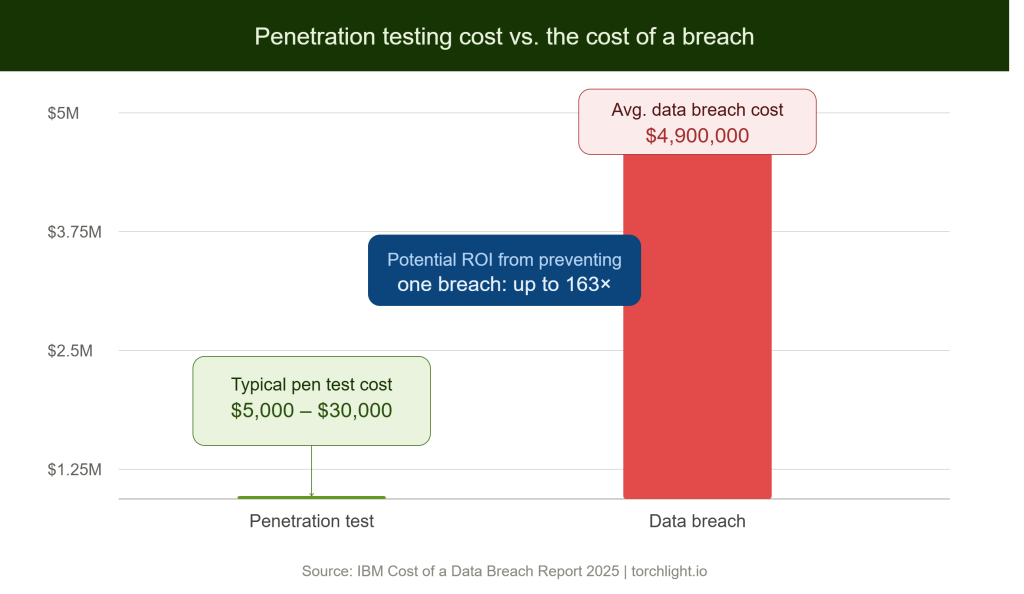
Here is the framing that shifts the conversation for leadership: penetration testing is not an expense, it is a risk transfer mechanism.
Consider the real-world math:
- The average cost of a data breach for a small-to-mid-size business in 2025 was over $4.9 million (IBM Cost of a Data Breach Report)
- Cyber insurance claims are routinely denied when organizations cannot demonstrate that reasonable security controls, including periodic penetration testing, were in place
- NCUA and FDIC regulatory findings carry remediation costs, reputational damage, and in some cases civil money penalties
- A penetration test that costs $10,000 and prevents a $500,000 breach response is not a cost, it is a 50x return on investment
The NIST Cybersecurity Framework, which serves as the foundational standard for regulated industries, explicitly recommends regular penetration testing as part of the “Identify” and “Protect” functions, making it not just good practice but best-practice alignment (NIST CSF 2.0).
Related: Explore how TorchLight’s Audits, Assessments & Compliance Services integrate penetration testing findings into a complete compliance evidence package for your next regulatory exam.
How Often Should You Conduct a Penetration Test?
Frequency recommendations vary by industry and risk profile:
| Industry / Compliance Standard | Minimum Recommended Frequency |
| PCI DSS | Annually + after significant changes |
| HIPAA (healthcare) | Annually recommended; required after changes |
| NCUA (credit unions) | Annually; some examiners expect more frequently |
| FDIC / OCC (community banks) | Annually at minimum |
| SOC 2 | Annually |
| General commercial (no specific mandate) | Annually or biannually |
| High-risk organizations / recent breach | Every 6 months or continuously |
In high-change environments, after a cloud migration, major application deployment, merger, or acquisition, retesting should occur regardless of the calendar schedule.
Frequently Asked Questions About Penetration Testing Cost
How much does a penetration test cost for a small business?
For a small business with fewer than 50 employees, a properly scoped external and internal network penetration test typically runs between $4,000 and $10,000 in 2026. This assumes a manual test by certified professionals and a compliance-ready deliverable. Automated scan services advertised at lower prices generally do not satisfy regulators or cyber insurance carriers.
What is the difference between a vulnerability scan and a penetration test?
A vulnerability scan uses automated tools to identify known vulnerabilities. A penetration test goes further, a human tester attempts to actually exploit those vulnerabilities, chain attack paths together, and demonstrate real-world impact. Penetration tests are significantly more expensive but provide evidence of exploitability, not just exposure.
Why do penetration testing prices vary so much?
The range reflects enormous variation in scope, methodology, tester expertise, and deliverable quality. A three-day manual external network test by OSCP-certified testers producing a compliance-ready report is a fundamentally different product from a 24-hour automated scan. Both may be advertised as “penetration tests.”
Does cyber insurance require penetration testing?
Increasingly, yes. Most cyber insurance underwriters in 2026 require evidence of annual penetration testing as a condition of coverage, and many are requiring retest documentation to confirm critical findings were remediated. Claims can be, and are, denied when insurers determine that reasonable security practices, including pen testing, were absent.
How long does a penetration test take?
Scope determines duration. A focused external network test may take 3–5 days of active testing. A comprehensive engagement covering internal network, web applications, phishing simulation, and compliance scoping may take 2–4 weeks from kickoff to final report delivery.
What does a penetration test report include?
A professional penetration test report includes an executive summary, a detailed technical findings section with severity ratings (typically using CVSS scoring), a prioritized remediation roadmap, methodology documentation, and evidence documentation. For regulated organizations, the report should also include language and artifacts suitable for submission to auditors, examiners, and cyber insurance carriers.
Can I do a penetration test myself?
Organizations sometimes conduct internal assessments using their own IT staff. These can supplement professional testing but should not replace it, particularly for compliance purposes. Regulators and insurers expect independent, third-party validation. An internal team testing its own infrastructure has inherent conflicts of interest and scope blind spots that a qualified external tester does not.
Making the Right Investment in 2026
Penetration testing cost is ultimately a function of what you need the test to accomplish. If you need a checkbox to say you ran a test, you can find inexpensive options. If you need an independent validation that will satisfy your NCUA examiner, support a cyber insurance renewal, give your board confidence in your security posture, and produce a clear roadmap for your IT team, that is a different investment, and it is worth making correctly.
The organizations that treat penetration testing as a strategic function, not an annual annoyance, are the ones that convert security investment into measurable risk reduction, lower insurance premiums, and regulatory confidence.
Ready to get a penetration test scoped for your organization’s specific compliance requirements and risk profile? Request a no-obligation consultation with TorchLight’s security team, we’ll scope the engagement, explain exactly what you’ll receive, and ensure the deliverable works for your auditors, your insurer, and your leadership team.