
Last updated: August 31, 2026 · Author: Zach Carothers · Reading time: 6 minutes
Penetration Testing vs. Vulnerability Scanning | A Buyer’s Guide
If you are a CEO, CFO, COO, CIO, compliance officer, or board member, you have probably seen both terms in audit requests, cyber insurance questionnaires, regulatory exams, or vendor proposals.
They sound similar. They are not the same thing.
The easiest way to understand the difference is this:
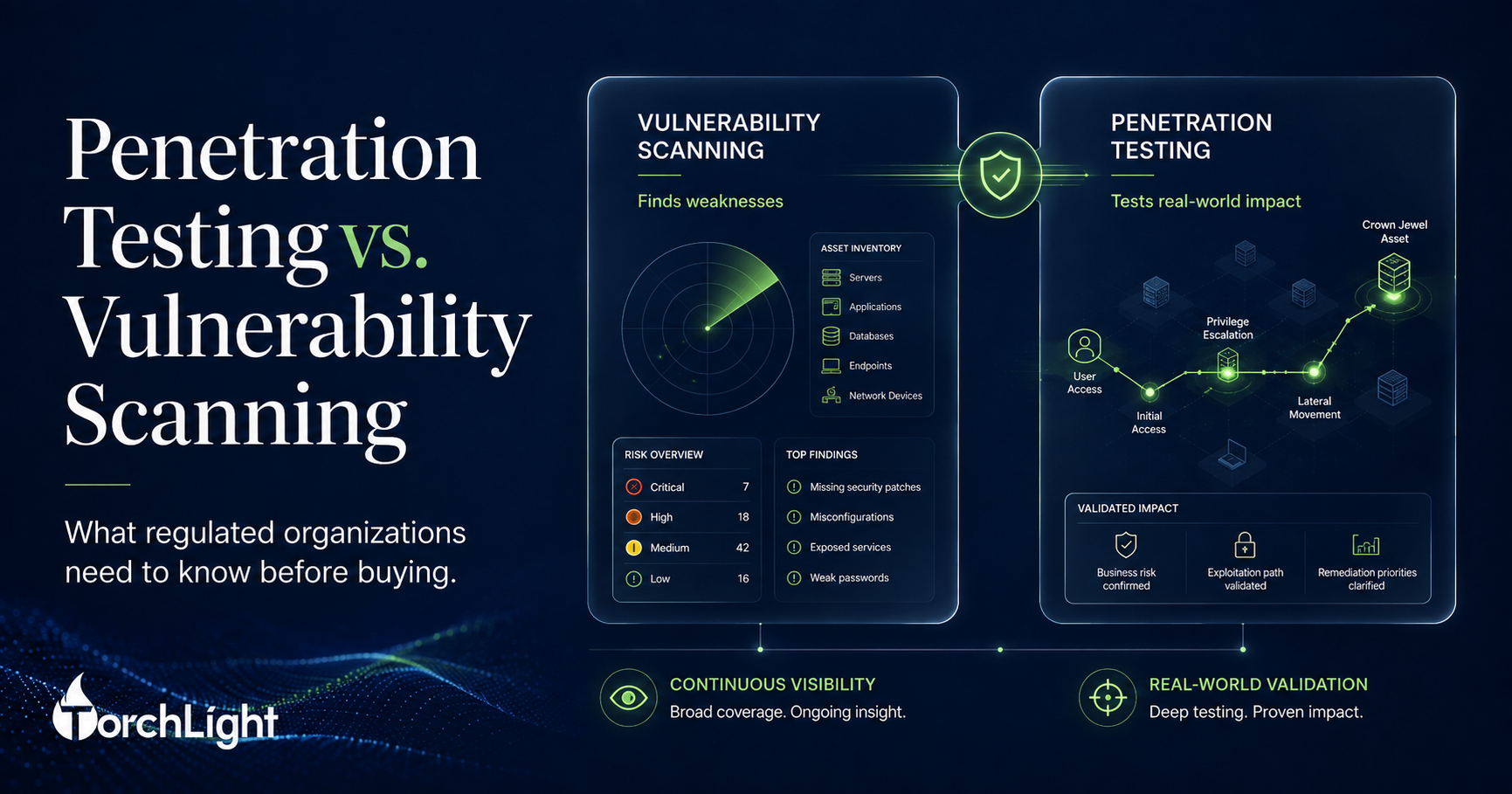
Vulnerability scanning identifies where you may be vulnerable. Penetration testing shows what an attacker could actually do about it.
For regulated organizations, that difference matters because buying the wrong service can leave you with the wrong answer or the wrong evidence.
Vulnerability Scanning vs. Penetration Testing
| Vulnerability Scanning | Penetration Testing | |
|---|---|---|
| Main question | Where might we have weaknesses? | What could an attacker actually do with them? |
| How it works | Mostly automated | Led by a human security professional, often using automated tools as well. |
| What you receive | A list of potential problems to investigate and fix | Proof of what can actually be exploited and where an attacker could go next |
| Best use | Ongoing security maintenance | Periodic testing of real-world risk |
Think of vulnerability scanning as inspecting a building for unlocked doors or broken windows.
A penetration test asks: Can someone get through that door? If they do, where can they go next?
What Vulnerability Scanning Tells You
NIST, the National Institute of Standards and Technology, defines vulnerability scanning as a way to identify systems and the weaknesses associated with them.
In practical terms, scanners look for known security problems such as outdated software, missing patches, exposed systems, weak configurations, and known vulnerabilities.
The Center for Internet Security, or CIS, makes the same distinction in its current CIS Critical Security Controls v8.1. CIS organizes 18 cybersecurity best practices into separate control areas. Control 7 covers Continuous Vulnerability Management, while Control 18 separately covers Penetration Testing.
Finding a possible weakness is not the same as proving what someone could do with it.
What Penetration Testing Tells You
A penetration test is intentionally designed to go even further.
A trained security professional attempts to use weaknesses in the same way a real attacker might, but in a controlled and authorized environment. The tester may also use automated scanners, but the scan is only the beginning.
A scanner might report several separate weaknesses. A penetration tester asks whether they can be connected to reach something important.
If they can, you no longer have unrelated technical findings. You have a working path into the organization.
The Purchasing Question: What Are You Actually Being Asked to Prove?
A polished vulnerability report does not automatically make an engagement a penetration test. And one penetration test each year does not eliminate the need to look for vulnerabilities during the rest of the year.
Before buying either service, TorchLight Secured & Managed IT recommends to start with the requirement.
Need to continuously identify weaknesses?
You likely need vulnerability scanning or continuous vulnerability monitoring.
Need to understand whether those weaknesses can actually be used against you?
You likely need penetration testing.
Need to satisfy a regulator, examiner, insurer, contract, or board requirement?
First, you have to determine exactly what evidence that requirement expects.
Credit Unions and Banks
NCUA does not prescribe the exact same penetration-testing schedule for every federally insured credit union. Its approach is more risk-based.
Credit unions are expected to maintain an effective information security program and regularly test key controls, with the frequency and nature of testing driven by risk. NCUA guidance recognizes vulnerability scanning and penetration testing as security practices.
Federal banking guidance follows a similar model: important security controls must be regularly tested, with the type and frequency based on the institution’s risk.
The executive question: Can we show an examiner that our testing fits our size, systems, risks, and business?
FTC Safeguards Rule
The FTC Safeguards Rule is more specific.
For covered financial institutions, the Rule requires either effective continuous monitoring or periodic security testing. Without effective continuous monitoring, it calls for annual penetration testing and vulnerability assessments at least every six months, plus assessments after material changes to operations or business arrangements or when circumstances may materially affect the security program.
That specific cadence does not apply to financial institutions maintaining customer information concerning fewer than 5,000 consumers. Those smaller institutions are still subject to the Rule’s broader requirement to regularly test or otherwise monitor their safeguards.
Colleges and Universities
Many colleges and universities participating in federal Title IV student-aid programs agree through their Program Participation Agreements to comply with the FTC Safeguards Rule. GLBA compliance is also examined through the annual Title IV compliance audit.
California Community Colleges add state-level cybersecurity requirements tied to certain funding, including annual cybersecurity self-assessments and twice-yearly remediation reporting.
For colleges in California, Washington, and elsewhere, start with federal Title IV and GLBA obligations, then add applicable state, insurance, contractual, and institutional requirements.
Healthcare and HIPAA
The current HIPAA Security Rule does not require every healthcare organization to perform one penetration test each year or vulnerability scans every six months.
Instead, covered organizations and business associates must identify risks to electronic protected health information, evaluate safeguards, and make security decisions based on those risks.
HHS has proposed a more prescriptive Security Rule requiring vulnerability scanning at least every six months and penetration testing at least once every 12 months.
As of August 2026, those requirements are still proposed. The federal government’s July 2026 regulatory agenda lists July 2027 as the anticipated date for final action. The current HIPAA Security Rule remains in effect and enforceable.
RIAs and Investment Advisers
For SEC-registered investment advisers, the amended Regulation S-P requirements now apply to all covered advisers. They require written safeguards and incident-response procedures for protecting customer information, but they do not establish a universal annual penetration-test or six-month vulnerability-scan schedule.
The SEC’s broader proposed cybersecurity rule for investment advisers was withdrawn in 2025.
Some advisers not required to register with the SEC may instead fall under the FTC Safeguards Rule, and state requirements may add another layer. Washington, for example, requires state-registered advisers to maintain written cybersecurity policies designed to protect electronic and physical records.
PCI DSS
PCI DSS v4.0.1 also separates the activities.
Requirement 11.3 covers internal and external vulnerability scanning, generally at least every three months and after significant changes. Requirement 11.4 separately covers internal and external penetration testing, generally at least every 12 months and after significant changes.
PCI DSS is primarily an industry security standard rather than a government regulation, although a few states, notably Nevada, have written PCI DSS requirements into state law.
So Which One Do You Need?
For most regulated organizations, the answer is usually both.
Vulnerability scanning tells you what needs attention.
Penetration testing tells you what could actually happen.
At TorchLight, we believe the right conversation starts before anyone discusses tools, packages, or pricing.
What regulation applies? What systems matter most? What does your auditor or examiner expect? What does your cyber insurance policy require? What evidence do you need? And most importantly, what business outcome are you trying to prevent?
A vulnerability scan should not be sold as a penetration test. A penetration test should not replace ongoing vulnerability management.
Your organization should understand exactly what it is buying, why it is buying it, and what question the testing is supposed to answer.
If your organization is in need of testing or scanning, or you want to discuss your environment further, you can book a free 30-minute consultation here.
About TorchLight
TorchLight is a Secured & Managed IT provider focused on making cybersecurity an enabler of every next opportunity. Our team delivers 24×7 monitoring, detection and response, virtual CISO services, and incident response for regulated mid-market organizations. Our tagline: Risk Aligned. Reward Defined.
Sources
- NIST: Computer Security Resource Center Glossary, Vulnerability Scanning
- Center for Internet Security: CIS Critical Security Controls v8.1 (Control 7, Continuous Vulnerability Management; Control 18, Penetration Testing)
- NCUA: Cybersecurity Resources
- eCFR: 16 CFR Part 314, Standards for Safeguarding Customer Information (FTC Safeguards Rule)
- FTC: FTC Safeguards Rule, What Your Business Needs to Know
- U.S. Department of Education, Federal Student Aid: Cybersecurity Compliance (Title IV / GLBA)
- California Community Colleges Chancellor’s Office: Security Assessments and Federal Regulations
- HHS: The HIPAA Security Rule
- Federal Register: HIPAA Security Rule to Strengthen the Cybersecurity of Electronic Protected Health Information (proposed rule, January 6, 2025)
- McDermott Will & Schulte: Final Action on HIPAA Security Rule Modifications Now Projected for July 2027 (2026)
- SEC: SEC Adopts Rule Amendments to Regulation S-P (May 16, 2024)
- Dechert: SEC Withdraws Significant Number of Rule Proposals (June 2025)
- Washington State Legislature: WAC 460-24A-120, Compliance Procedures and Practices (investment advisers)
- PCI Security Standards Council: PCI DSS (v4.0.1, Requirements 11.3 and 11.4)
- Nevada Legislature: NRS 603A.215, Security Measures for Data Collectors (PCI DSS requirement)