
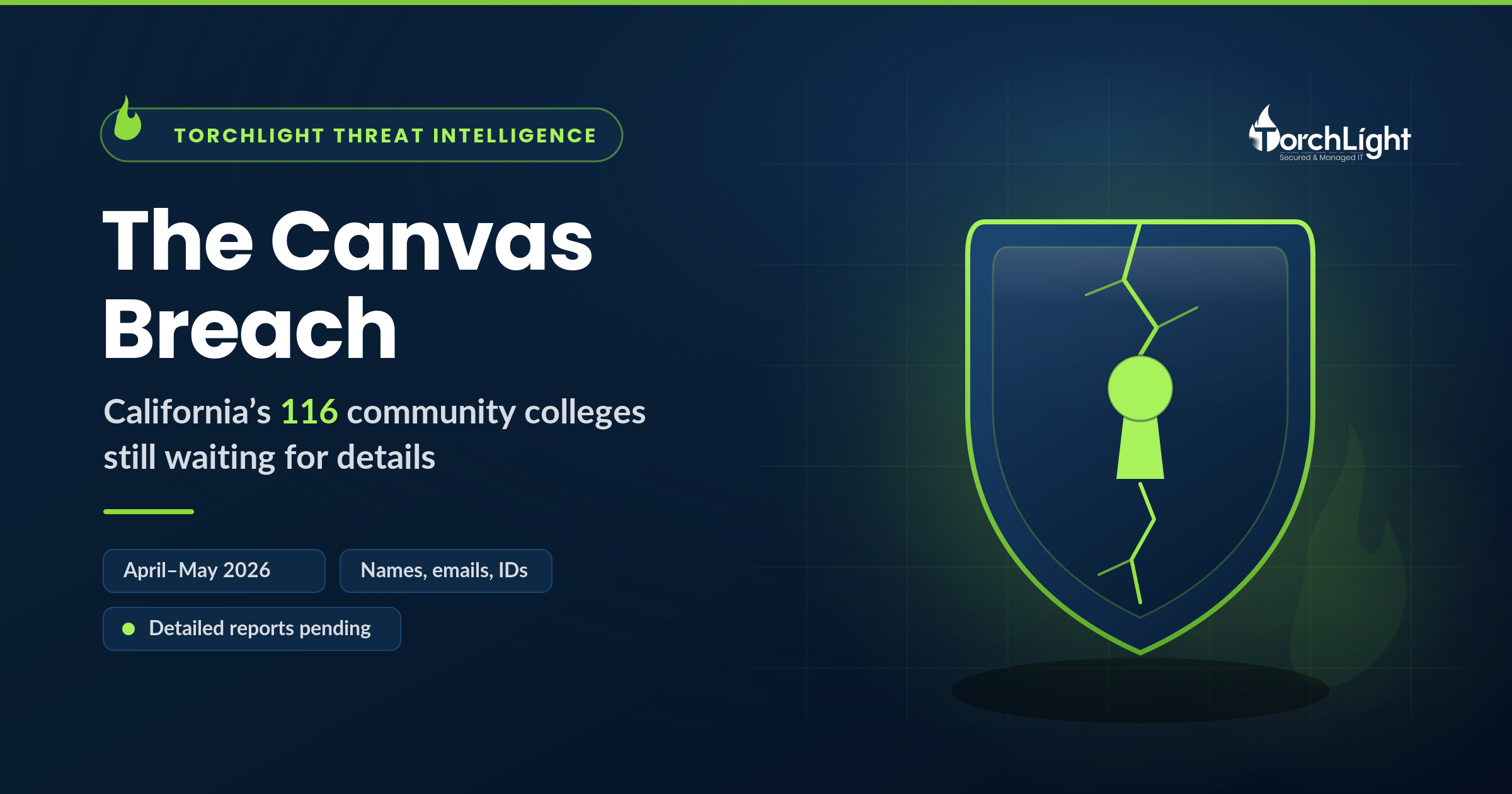
In April-May 2026, Instructure’s Canvas exposed student names, emails, student IDs, and messages across the platform used by all 116 California community colleges. On July 14, Instructure paused delivery of detailed breach reports over a security threat to ShareFile, the third-party platform used to send them. On July 21, Instructure said the threat never touched Canvas or the breach data, and that delivery would resume. Until those reports arrive, your district still can’t confirm what was actually accessed.
Key Facts at a Glance
- What happened: Instructure’s Canvas learning management system exposed student names, emails, student IDs, and user messages.
- When: April-May 2026.
- Who is in scope: All 116 California community colleges run on Canvas, so every district falls within the incident’s scope. Which colleges had records actually accessed has not been confirmed.
- The complication: On July 14, 2026, Instructure paused delivery of detailed breach reports over a security threat to ShareFile, the third-party platform used to send them. On July 21, Instructure said the threat was limited to ShareFile’s on-premise servers, never touched Canvas or the breach data, and that delivery would resume.
- Current status: Until the detailed reports arrive, districts still cannot confirm how many records were accessed or whether data left the system.
- Compliance impact: Any required breach notifications run through California law (Civil Code 1798.29), not FERPA, and cannot be finalized until the scope is known.
Does this affect my California community college?
Potentially, yes: All 116 California community colleges run on Canvas, so every district falls within the scope of the April-May 2026 breach. Whether student records were actually accessed at your specific college has not been confirmed, and the July 14 pause in detailed reporting is why the scope is still open.
Until you know what information was accessed and whether it was exfiltrated, your incident response is incomplete. Every one of the 116 colleges runs on the same platform, so all sit inside the same potential exposure; the missing detailed reports are the gap between “we use Canvas” and “here is exactly what happened at our college.”
What data was exposed in the Canvas breach?
The breach exposed student names, emails, student IDs, and user messages across the California Community Colleges system. The list of data types is confirmed. There is no evidence that passwords, Social Security numbers, financial information, or dates of birth were involved. What remains unclear is how many specific records were accessed and whether information left the system.
The detailed reports that would answer those questions were paused on July 14 (see below), which is why the scope is still open.
| What we know | What’s still unknown |
|---|---|
| Data types exposed: names, emails, student IDs, user messages | How many specific records were accessed |
| All 116 California community colleges run on Canvas (in scope) | Which specific colleges had records accessed |
| Detailed report delivery was paused, then set to resume | Whether the data was exfiltrated (left the system) |
Why did the paused breach reports matter?
On July 14, 2026, Instructure paused delivery of the detailed breach reports after a security threat was disclosed against ShareFile, the third-party platform it used to deliver them. For about a week that raised the prospect of a second vendor failure stacked on top of the first. On July 21, Instructure clarified that the ShareFile threat was confined to ShareFile’s on-premise servers, did not involve Canvas or any Instructure system, and that user data was never at risk; delivery was set to resume.
The scare was short-lived, but it exposed the real issue: concentration risk. One LMS vendor (Instructure) puts thousands of institutions in the same blast radius, and when the response itself runs through a single delivery vendor, even a precautionary pause stalls answers for everyone at once.
How does this affect compliance and breach notification?
FERPA (the Family Educational Rights and Privacy Act) governs the privacy of student education records, but it does not contain a breach-notification requirement; it only requires institutions to keep a record of disclosures. The duty to notify affected people comes instead from California’s breach-notification law (Civil Code 1798.29), which requires public agencies, including community college districts, to notify California residents whose unencrypted personal information was, or is reasonably believed to have been, acquired by an unauthorized person. Colleges that participate in federal student aid also face reporting expectations under the GLBA Safeguards Rule and the U.S. Department of Education.
You cannot finalize those notifications until you know what was actually accessed. The Department of Education’s Canvas Security Alert (updated May 29, 2026) remains useful guidance, but without the detailed reports, your assessment and your notification timeline stay uncertain.
What should we be doing this week?
Four actions move you forward even while the detailed reports are still landing:
- Verify your Canvas data inventory. Confirm exactly how many student records Canvas held in your district and which data types your instance contained.
- Check the official incident report. The California Community Colleges System maintains a Canvas Incident Report with coordinated guidance for all 116 colleges.
- Plan vendor risk into your next LMS procurement. When you evaluate or renew an LMS contract, require documented breach-response protocols, independent security audits, and contractual guarantees about transparency during incidents.
- Build a response timeline. Document every communication from Instructure and the data-delivery vendor. Your board and auditors will need a clear record of when you learned what.
What’s the broader lesson about EdTech concentration?
EdTech concentration operates on two levels. First, a single LMS vendor serves thousands of schools simultaneously (Instructure serves roughly 8,000 institutions). Second, incident response itself can concentrate risk: when recovery depends on a single delivery vendor, even a precautionary pause cascades into the response phase.
The question for your district is simple but hard: how many critical workflows depend on a single EdTech vendor, and what happens to your incident response when that vendor or its partners stumble?
What’s the practical next step?
Start by reviewing the Canvas Incident Report from the CCC Security Center and the Department of Education’s Technology Security Alert. For detailed background on how vendor trust became a central theme, DataBreaches.net offers a thorough analysis.
Your IT team is lean, and most colleges lack the capacity to audit EdTech vendor security practices during procurement or to negotiate incident-response guarantees. A vendor risk review, an incident response tabletop, and a board briefing on EdTech concentration can be completed in weeks, not months, and can inform your next LMS procurement. The FCC’s E-rate Cybersecurity Pilot can help fund this kind of work, but it is limited to K-12 schools and libraries; community colleges are not E-rate eligible. California community colleges should instead look to state channels: systemwide cybersecurity funding through the California Community Colleges Chancellor’s Office, and potential subrecipient funding under the State and Local Cybersecurity Grant Program (SLCGP) administered by Cal OES.
Need help assessing EdTech vendor risk?
If your district needs help with EdTech vendor risk, incident response readiness, or exploring cybersecurity funding options, TorchLight can help. Schedule a 30-minute consultation at no cost and no commitment. We’ll help you identify your most critical vendor dependencies and what a vendor risk program could look like for your organization.
Schedule a free 30-minute consultationFrequently Asked Questions
Does the Canvas breach affect my California community college?
All 116 California community colleges run on Canvas, so every district is within scope of the April-May 2026 breach. Whether records were actually accessed at your college is not yet confirmed, and the July 14 reporting pause is why the full scope is still open.
What data was exposed in the Canvas breach?
Student names, emails, student IDs, and user messages across the California Community Colleges system. The data types are confirmed; the number of records and whether data was exfiltrated remain unclear. There is no evidence that passwords, Social Security numbers, or financial data were involved.
Why did Instructure pause breach-report delivery on July 14, 2026?
Because of a security threat to ShareFile, the third-party platform used to send the detailed reports. On July 21 Instructure clarified the threat was limited to ShareFile’s on-premise servers, did not involve Canvas or the breach data, and that delivery would resume.
How does the Canvas breach affect FERPA compliance?
FERPA governs the privacy of education records but does not require breach notification. For California community college districts the notification duty comes from state law (Civil Code 1798.29); Title IV aid participants also face GLBA and Department of Education reporting expectations. Notifications can’t be finalized until the accessed data is known.
What should California community colleges do about the Canvas breach now?
Verify your Canvas data inventory, review the CCC Security Center incident report and the Department of Education alert, document every vendor communication, and build vendor risk requirements into your next LMS procurement.
Can E-rate Cybersecurity Pilot funding cover this work for community colleges?
No. The FCC’s Cybersecurity Pilot is limited to K-12 schools and libraries that meet E-rate eligibility; community colleges are not eligible. California community colleges should look to state systemwide cybersecurity funding via the Chancellor’s Office and the State and Local Cybersecurity Grant Program (Cal OES) instead.
About TorchLight
Sources
- California Community Colleges Security Center: Canvas Incident Report
- California Community Colleges Chancellor’s Office: Statement on Canvas Cybersecurity Incident
- Instructure: Security Incident Update & FAQs
- U.S. Department of Education: Technology Security Alert, Canvas LMS (updated May 29, 2026)
- U.S. Department of Education Student Privacy: Data Breach guidance (FERPA)
- California Civil Code § 1798.29 (breach notification for public agencies)
- FCC: Schools and Libraries Cybersecurity Pilot Program
- Cal OES: State and Local Cybersecurity Grant Program (SLCGP)
- DataBreaches.net: The breach that won’t end — Canvas and the EdTech vendor trust problem