
Estimated reading time: 6 minutes
July 7, 2026 – Tempel Steel – by Zach Carothers – in Cybersecurity, Awareness
Tempel Steel Data Breach Settlement: Incident Response Lessons for 2026
Key takeaways
-Lesson for regulated sectors: even an unregulated company with a small breach drew a lawsuit in weeks. Your detection-to-notification timeline is the liability.
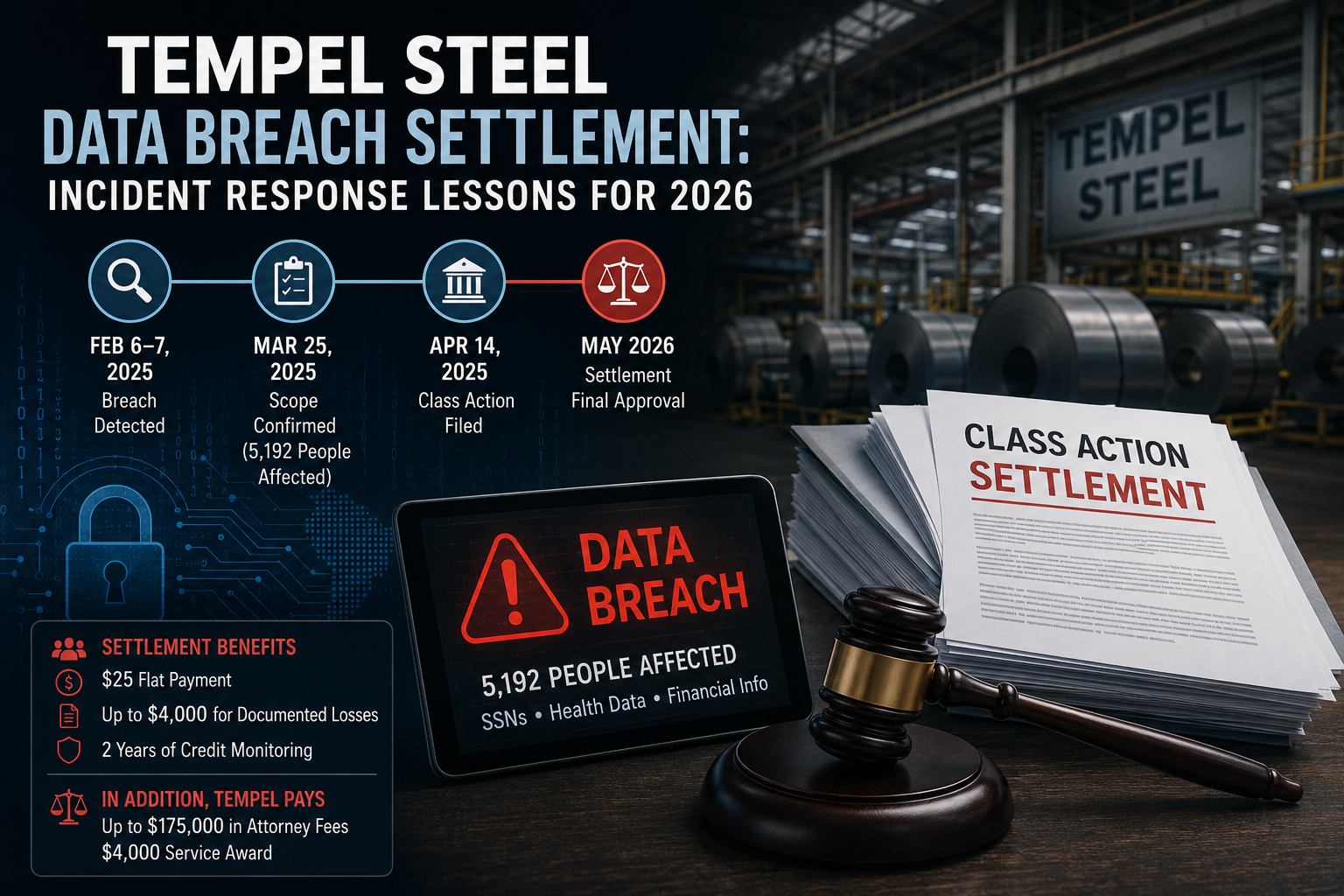
-Tempel Steel (a Chicago steel-lamination manufacturer) was breached Feb 6–7, 2025 and confirmed the scope on March 25, 2025.
-A class action (Buckner v. Tempel Steel, Cook County, IL) was filed April 14, 2025, about 20 days after confirmation.
-The breach exposed roughly 5,192 employees’ and plan participants’ records, including SSNs and health data.
-The settlement is claims-made: up to $175,000 in attorney fees and a $4,000 service award are paid on top of member benefits (a flat $25, or up to $4,000 for documented losses, plus 2 years of credit monitoring).
Tempel Steel finished confirming it had been breached on March 25, 2025. 20 days later, it was the defendant in a class action lawsuit.
What the Tempel Steel Settlement Teaches Us About Incident Response Timelines in 2026
Tempel Steel Company, a Chicago electrical and magnetic steel lamination manufacturer, detected unusual network activity on February 6, 2025. Devices went offline, and an unauthorized actor viewed and exfiltrated files for over roughly 24 hours. It took until March 25 to finish the review and determine that about 5,192 people, employees and health-plan participants, had data exposed: names, Social Security numbers, driver’s license numbers, health insurance and medical information, and financial account details. The suit, Buckner v. Tempel Steel, landed in the Circuit Court of Cook County on April 14, 2025. The court took up final approval of the settlement in May 2026.
From 0-100 in Only 67 Days
What strikes me about this case isn’t the breach. Ransomware happens, and most organizations will face an incident eventually. What matters is the speed of everything that followed: how long detection-to-scope took, how fast the plaintiffs’ counsel moved, and how the settlement was built. Those details say something uncomfortable about how co-managed IT environments actually perform under pressure, especially in regulated sectors where the clock is shorter and the penalties are steeper.
Why This Matters if You’re in Financial Services, Healthcare, or Education
If you operate in one of these sectors, you already live under heightened scrutiny. Financial regulators expect breach notification in days. HIPAA, requires notifying affected individuals within 60 days of discovery. Educational institutions face a patchwork of state and federal rules that converge on one expectation: move quickly.
But this usually flies under the radar: Steel manufacturing has no industry-specific cybersecurity regulation, so Tempel faced comparatively little sector pressure. Even so, because the stolen data included group health plan information, HIPAA’s breach rules were still in play for that slice of records, and plaintiffs’ attorneys still filed within three weeks. Now, imagine the same scenario at a credit union, a clinic, or a school district, where the regulators are already watching and the record counts run higher. The exposure multiplies.
Tempel’s notification letters went out around early April 2025, roughly eight weeks after detection and about a week after it finished scoping the incident. That cadence is common in manufacturing. In a regulated environment it is a liability, because regulators measure the gap between “we know we were breached” and “we told the people affected.”
The Settlement Structure is a Lesson in Itself
Class members with no documented harm can claim a flat $25, no paperwork required. Those with proof can claim up to $1,000 in ordinary out-of-pocket costs or up to $4,000 for documented fraud or identity theft losses, and everyone was offered two years of credit monitoring.
If you’re an IT leader, you should take a second to think on this one: the attorneys’ fees (up to $175,000), the $4,000 award to the named plaintiff, the monitoring, and the administration costs do not come out of members’ payments. Tempel pays them separately, on top. A breach that touches roughly 5,192 people is not a one-time cleanup cost. It is a multi-year liability with several meters running simultaneously.
Three Moves Worth Making Right Now
1. Audit your incident response timeline, not just your plan.
Most co-managed environments have a plan on paper. What matters is whether detection-to-notification runs in days, not weeks. Document how long it actually takes you to identify a breach, scope it, notify leadership, and engage counsel. If any single step runs longer than 48 hours, that is a gap a regulator will notice.
2. Decide who owns exfiltration detection.
Tempel’s incident involved both ransomware (devices going dark, usually obvious fast) and exfiltration (files quietly leaving, much harder to see). If you rely on file-integrity monitoring alone, you can miss the theft entirely. Ask your security provider whether your 24/7 monitoring and response actually watches outbound data movement, not just endpoint encryption.
3. Map what your regulator expects before you need it.
Different regulators run different playbooks. HIPAA notifications become public above certain thresholds, some financial regulators expect private notice first, and education rules vary by state. Have counsel lay out the exact notification sequence for your industry and state, then work backward so your incident process supports that sequence under real pressure.
We’ve been inside organizations where the incident response plan gets refreshed once a year and then lives in a folder nobody opens. Tempel is a reminder of why that fails. When a breach hits, you do not calmly follow the binder. You fall back on the people, the tooling, and the timeline already built into daily operations. If detection takes weeks, if your security team has no direct line to leadership, if exfiltration monitoring is thin or absent, the binder will not save you.
The leaders we work with are already asking the right questions: Do we have the visibility we need? Can we detect exfiltration at all? Could we move faster than Tempel did? If you are asking them too, we welcome the conversation. This is not about buying a bigger tool. It is about building an operational rhythm where detection, scoping, and notification move at the speed your regulators actually expect.
Tempel Steel settlement:
https://tempeldatasettlement.com/
Tempel’s official breach notice
https://www.mass.gov/doc/2025-599-tempel-steel-company-llc/download
HIPAA requires notification within 60 days
https://www.hhs.gov/hipaa/for-professionals/breach-notification/index.html
TorchLight specializes in managed security services for organizations where security and compliance are non-negotiable. With 18+ years serving regulated industries, 24/7 SOC operations, and deep regulatory fluency across GLBA, HIPAA, and SEC requirements, TorchLight delivers security operations leadership can defend.
Ready to explore what partnership looks like? Schedule a consultation to discuss your organization’s specific security needs and regulatory requirements.