
Phishing volume and sophistication have surged in 2026, driven by generative AI that lets attackers produce flawless, personalized lures at scale. Traditional email filters and “spot the typo” training can’t keep up.
Executive Summary
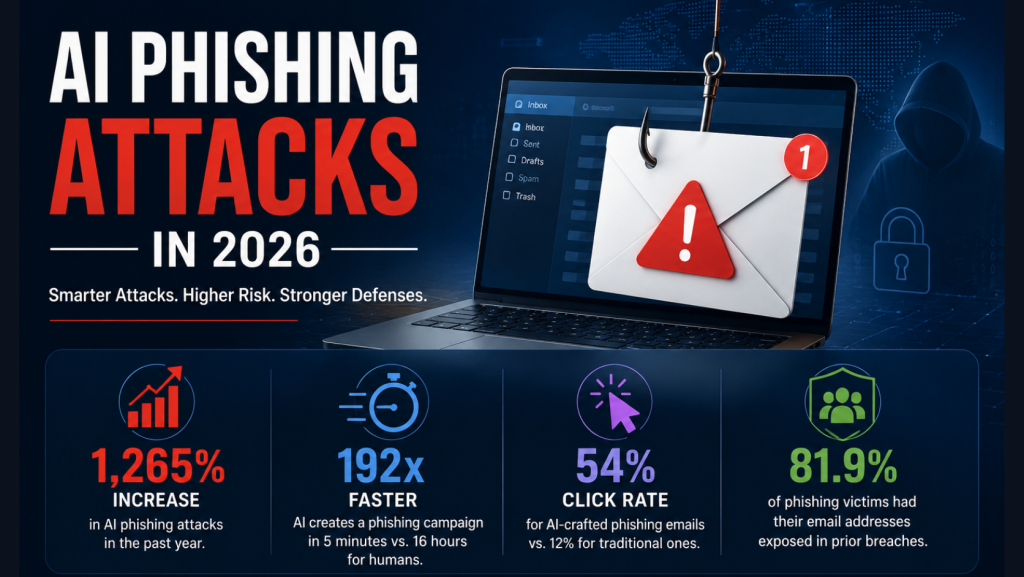
If your inbox feels like it has more phishing attempts than it did six months ago, it’s not your imagination. Generative AI has eliminated the grammatical errors that used to flag suspicious emails, lowered the technical barrier so anyone can launch a campaign, and accelerated attack creation from hours to minutes. The result: a 1,265% increase in AI phishing in the past year, click-through rates that have jumped from 12% on traditional phishing to 54% on AI-crafted lures, and a malicious email reaching corporate inboxes every 19 seconds. For regulated industries, this is no longer just a nuisance, it’s a regulatory, financial, and reputational threat.
Key Takeaways
- AI Has Industrialized Phishing: A 1,265% increase in AI phishing attacks, with 82.6% of phishing emails now containing AI-generated content (SentinelOne).
- Attackers Are 192x Faster: IBM X-Force documented how AI phishing attacks can be constructed through a sophisticated phishing campaign in 5 minutes, a task that previously took human operators 16 hours.
- The “Bad Grammar” Rule Is Dead: AI phishing emails achieves 54% click rates vs. 12% for human-written attempts. Telling employees to watch for typos is no longer effective advice.
- Phishing Is Multi-Channel Now: Vishing surged 442%, QR phishing jumped 400%, and callback phishing rose 500% in Q4 2025. Email-only defenses miss a growing share of attacks.
- Vendor Compromise Spreads the Damage: The 2025 Marquis Software breach hit at least 74 banks and credit unions, exposing data for up to 1.35 million people.
- Phishing-Resistant MFA Is Now Table Stakes: FIDO2 keys and passkeys defeat credential theft even when employees click. SMS-based MFA can be bypassed in real time.
- Continuous Monitoring Catches What Filters Miss: Layered defenses combining EDR, ITDR, DMARC, and 24/7 SOC analysis are the only approach holding up against AI-driven phishing attacks.
Why AI Phishing Attacks Have Surged: Three Drivers
1. AI Eliminated the Quality, Personalization, and Speed Bottlenecks
For two decades, the easiest way to spot phishing was awkward phrasing or formatting that didn’t match a legitimate sender. That advice is now actively misleading. Modern large language models produce native-fluency English in seconds, mimic professional tone, and adapt to any of forty languages without translation tells. An attacker who couldn’t write a convincing English email in 2022 can now generate flawless lures at the skill level of a senior copywriter.
AI phishing attacks now automate the reconnaissance that used to take hours. Modern phishing operations scrape public data, ingest information from prior breaches (81.9% of phishing victims had email addresses exposed in earlier breaches), and generate unique, personalized lures referencing the recipient’s actual name, manager, projects, and vendors. When an email pulls in details only an insider would know, even a well-trained employee defaults to trust.
And the math is impossible for defenders. IBM X-Force documented an AI system constructing a sophisticated phishing campaign in 5 minutes using 5 prompts, a task that took human security experts 16 hours. Okta’s threat intelligence team has documented attackers building complete phishing sites in under 30 seconds. When attackers can deploy new infrastructure in minutes, blocklist-based defenses simply cannot keep pace.
2. Polymorphic Content Broke Signature-Based Filtering
Most legacy email security tools recognize patterns from previously seen attacks. That entire approach assumes phishing is repetitive. Modern AI phishing attacks broke that assumption.
Cofense research found that in 2025, 76% of initial infection URLs were unique even though 94% shared IP addresses. At the file level, 82% of malicious attachments carried unique hashes while delivering identical underlying payloads. Pattern matching can’t catch what it has never seen before.
3. Phishing-as-a-Service Commoditized the Attack
Phishing-as-a-Service (PhaaS) offerings on dark-web markets sell complete attack toolkits, templates, hosting, credential harvesting infrastructure, and even customer support to anyone with a few hundred dollars.
In one incident at a federal civilian executive branch agency, CISA observed the threat actor first deploying the Line Viper malware, a user-mode shellcode loader, and then using Firestarter, which enables continued access even after patching.
Tools like WormGPT and FraudGPT are sold openly as LLMs with safety guardrails removed, purpose-built for fraud. Initial Access Brokers specialize in phishing their way into networks and selling that access to ransomware operators. Phishing is no longer the domain of skilled criminals. It’s a service available to anyone.
The Tactics Bypassing Modern Filters
QR Code Phishing (Quishing). A QR code embedded in a PDF looks like an image to most email security tools. Filters scan text and links; they don’t decode pixels. The recipient scans the code with their phone, lands on a credential-theft page, and every filter your organization paid for has been bypassed.
Trusted-Platform Abuse. Attackers route the actual payload through SharePoint, Google Drive, Dropbox, or OneDrive. The email link goes to a real domain with a valid certificate. The filter sees a trusted platform and marks it safe. The actual phishing page is one click deeper. This approach turns your legitimate vendor relationships into attack infrastructure.
Callback Phishing. Instead of a link or attachment, the email contains a phone number and manufactured urgency. The recipient calls, and a human attacker walks them through “resolving” the issue, which involves installing remote access software, sharing credentials, or authorizing wire transfers. VIPRE recorded a 500% increase in callback phishing in Q4 2025. Phone numbers don’t trigger URL filters at all.
Voice Cloning and Deepfake Vishing. Modern voice-cloning AI requires as little as three seconds of recorded audio, available from any earnings call or podcast appearance, to produce a convincing replica of someone’s voice. Attackers now combine phishing emails with follow-up phone calls using a cloned voice of the recipient’s manager or CFO.
Increasing AI Phishing Attacks: What This Means for Regulated Industries
Credit unions and community banks face compounding pressure. The 2025 Marquis Software breach, a single vendor compromise, propagated through at least 74 institutions, exposing data for up to 1.35 million people. Deloitte projects that generative AI could push U.S. fraud losses to $40 billion by 2027, up from $12.3 billion in 2023. The NCUA continues to flag generative AI-enabled attacks as a top concern, on top of GLBA examinations and rising cyber insurance requirements.
Healthcare organizations face a structural vulnerability: clinical staff are time-pressured and trained to act quickly on requests that look legitimate. Combined with HIPAA breach notification requirements, a single compromised account that exposes PHI triggers regulatory reporting, OCR scrutiny, and potential fines.
Wealth management firms face targeted AI phishing attacks combining high-net-worth client data with authority to move significant funds. AI-generated lures against advisors increasingly include detailed knowledge of client portfolios and prior communications.
Government and public sector agencies remain primary targets. Phishing is still the leading initial access vector, and AI has made nation-state-quality phishing available to ordinary criminals.
Why Traditional Defenses Are Failing Against AI Phishing Attacks
Most organizations built phishing defenses around three pillars. In 2026, all three have material gaps.
Email gateways were designed for a different era. Signature-based filters worked when phishing was repetitive. Polymorphic AI content defeats them by being unique every time, driving a 47.3% increase in phishing emails bypassing email gateways.
“Spot the typo” training is now misleading advice. Research tracking 12,511 employees at a U.S. financial technology firm found that generic, compliance-focused training showed no statistically significant effect on click rates against AI phishing attacks.
SMS-based MFA can be bypassed in real time. Modern phishing kits use “adversary-in-the-middle” techniques to capture credentials and one-time codes simultaneously. SMS is no longer phishing-resistant; it’s phishing-delayed.
For more on why even well-resourced programs are losing ground, see Why Advanced Cybersecurity Tools Still Fail – And What to Do Instead.
What Actually Works in 2026
Effective defenses share a common pattern: they assume the email will get through, the user might click, and the credential could be stolen, then layer controls so no single failure becomes a breach.
- Phishing-Resistant MFA. FIDO2 keys and passkeys can’t be intercepted by adversary-in-the-middle kits because the cryptographic exchange is bound to the legitimate domain. Highest-ROI defensive investment of 2026.
- 24/7 SOC Monitoring. When phishing succeeds, detection speed determines whether it’s a contained incident or a catastrophic breach. Industry-leading SOCs detect threats in minutes; organizations without continuous monitoring average 207 days (IBM Cost of a Data Breach Report).
- Identity Threat Detection and Response (ITDR). Catches compromised credentials in use, often within minutes of theft, through impossible-travel detection, unusual access patterns, and privilege-escalation alerts.
- Endpoint Detection and Response (EDR). Provides forensic visibility and rapid containment when phishing leads to malware execution. See AV vs EDR vs MDR vs ITDR for how the layers fit together.
- DMARC Monitoring. Prevents attackers from spoofing your domain to phish your customers, vendors, and employees.
- Modern Security Awareness Training. Continuous, threat-informed simulations, not annual checkbox training. When paired with phishing-resistant MFA, well-designed programs reduce susceptibility from ~33% to under 5%.
- Out-of-Band Verification. Any payment change, vendor banking update, or wire instruction received via email should be verified by phone using a previously known number, never a number provided in the email.
Concerned that your current defenses aren’t keeping up? Schedule a no-obligation security assessment to see where your coverage stands.
Why TorchLight?
TorchLight was founded in 2007 to serve organizations that couldn’t afford to get security or compliance wrong. Across 18+ years, the focus has been on regulatory compliance, continuous risk management, and outcomes leadership can defend to boards, examiners, and insurance carriers.
That experience matters more than ever in 2026, because the phishing surge isn’t a problem any single tool solves. TorchLight delivers it as an integrated program:
- 24/7/365 SOC with trained human analysts, not just automated alerts.
- Layered email defense combining EDR, ITDR, DMARC, and modernized awareness training, see EDR, ITDR, and DMARC Services.
- Regulatory fluency across GLBA, HIPAA, SEC, NIST, and state-specific obligations.
- Unified accountability for managed IT and managed security under one team.
- vCISO leadership for organizations that need strategy and policy guidance more than another tool, see vCISO / vCIO Services.
Frequently Asked Questions
Are phishing emails actually getting through more often?
Yes. Cofense documented a 204% increase in AI-driven phishing bypassing perimeter controls, with one malicious email reaching corporate inboxes every 19 seconds. Your perception is accurate.
Is employee training still worth doing?
Yes, but the program has to evolve. Annual checkbox training has minimal effect against AI phishing. Continuous, threat-informed training with realistic simulations, paired with phishing-resistant MFA, reduces susceptibility from ~33% to under 5%.
How to stop AI-generated phishing attacks?
Organizations stop AI-generated phishing attacks through layered defenses that include phishing-resistant MFA, EDR, ITDR, DMARC enforcement, continuous SOC monitoring, modern security awareness training, and out-of-band verification processes. Because AI phishing attacks can bypass traditional email filters and mimic legitimate communication, organizations need continuous monitoring and identity-focused security controls rather than relying solely on email gateways.
What’s the single most effective control?
Phishing-resistant MFA (FIDO2 keys or passkeys). Even if an employee enters credentials on a perfect fake site, those credentials cannot be reused on the real account. It’s the only control that defeats adversary-in-the-middle kits.
How does this affect cyber insurance?
Significantly. Carriers now require 24/7 monitoring, EDR, phishing-resistant MFA, DMARC, and documented incident response. Premiums for organizations without these controls have risen sharply, and some coverage is being declined entirely.
Final Verdict: How Worried Should You Be?
Worried enough to act, not worried enough to panic.
The AI phishing attacks surge in 2026 is real, the underlying drivers are structural, and the threat will continue to outpace any single defensive control. But the organizations holding up against AI-driven phishing aren’t doing anything magical. They’re layering proven controls: phishing-resistant MFA, continuous SOC monitoring, EDR and ITDR, DMARC, modernized training, and out-of-band verification, and treating phishing defense as an ongoing program rather than a one-time project.
For organizations in regulated industries, the question isn’t whether to invest in modern phishing prevention defense. It’s whether you’ll do it before the next breach forces the conversation.
TorchLight specializes in managed security services for organizations where security and compliance are non-negotiable. With 18+ years serving regulated industries, 24/7 SOC operations, and deep regulatory fluency, TorchLight delivers phishing defense leadership that can defend.
Ready to see what modern phishing protection and defense looks like for your organization? Schedule a consultation to discuss your specific environment and security gaps.