
Estimated reading time: 6 minutes
June 18, 2026 – FortiBleed – by Zach Carothers – in Cybersecurity, Vulnerability Alert
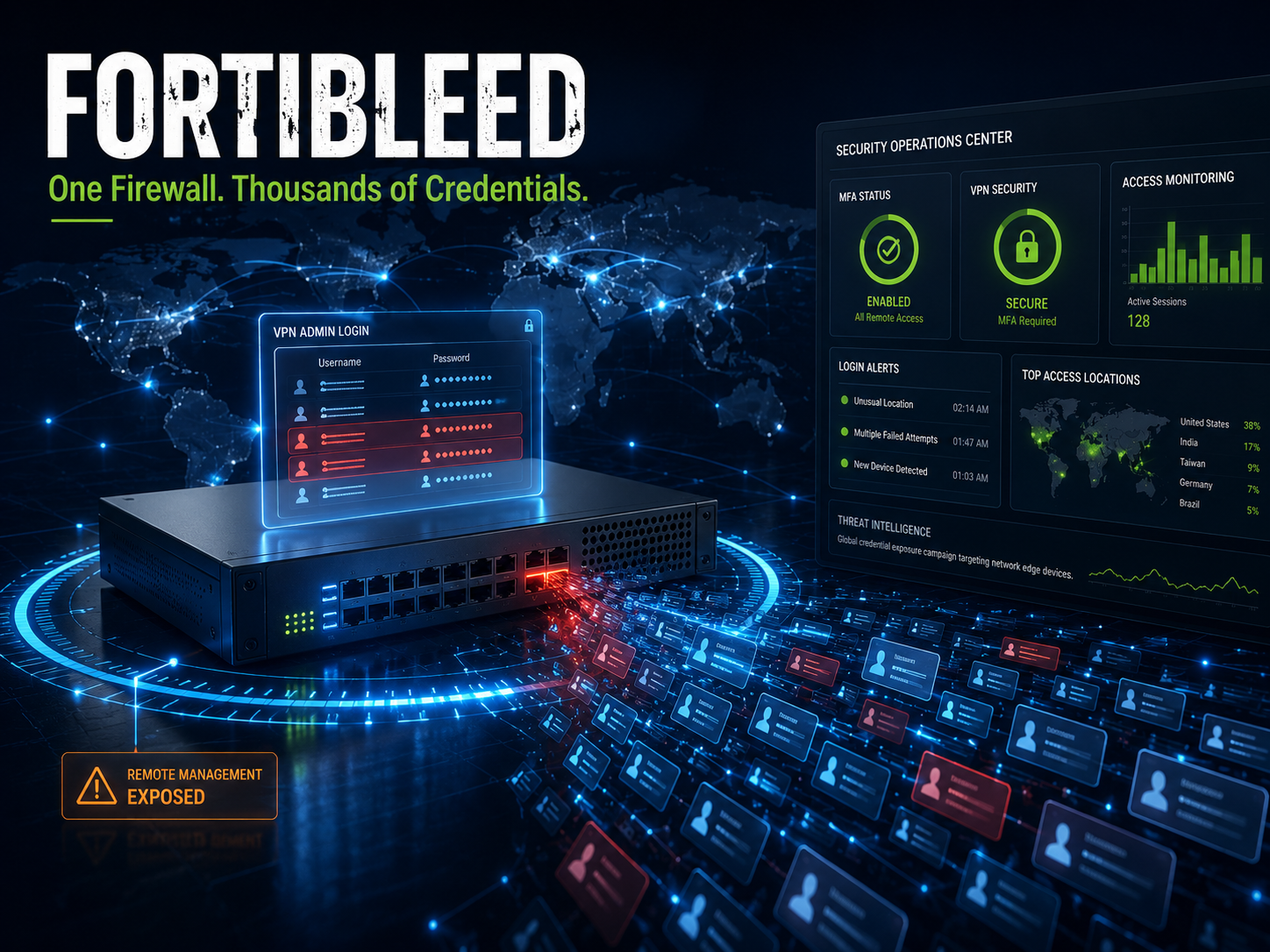
FortiBleed is the name now attached to one of the largest exposures of firewall credentials on record. On June 17, 2026, researchers revealed a dataset holding working Fortinet and FortiGate VPN logins for 73,932 firewalls, spread across more than 21,600 organizations in 194 countries. The records include usernames, email addresses, and plaintext passwords. By one estimate the list covers roughly half of every Fortinet firewall reachable from the internet. If your organization runs a FortiGate. Assume you are on the list until you prove otherwise.
What FortiBleed Is, in Plain Terms
Security researchers found an exposed server holding the dataset, reviewed it, and confirmed that many of the credentials are real and current. The data appears to have been pulled from exported FortiGate configuration files, which is why it carries details like administrator email addresses that normally live only inside a device config. Most of the affected firewalls are still online, and many of them run recent FortiOS versions. Hudson Rock published a free FortiBleed lookup tool so you can check whether your domain is in the set.
Fortinet told reporters that the credentials appear to come from earlier incidents and brute-force activity rather than a newly disclosed vulnerability. Researchers say the exact origin is still unconfirmed. For a defender, that debate does not change the job in front of you. Tens of thousands of live logins are in criminal hands right now, and the clock started the moment the dataset went public.
Why FortiBleed Is More Dangerous Than the Last Fortinet Leak
In 2025, the Belsen Group dumped configs and VPN credentials for about 15,000 FortiGate devices. FortiBleed is roughly five times larger, and Beaumont notes it hits different IP addresses, so this is a new and bigger collection, not a rerun of the old one. The campaign behind it was industrial in scale. Diachenko’s analysis describes about 1.16 billion login attempts against 320,777 FortiGate targets, plus another 2.1 billion attempts against 163,650 Microsoft SQL Server systems. The operators intercepted VPN authentication hashes, cracked them on a 45-GPU cluster, and used the recovered logins to move into internal Active Directory environments. This was not a smash and grab. It was a credential factory.
The Detail Most Coverage Is Missing: Strong Passwords Did Not Save Anyone
Many of the exposed passwords were long and complex, the kind a written policy would call strong. They were stolen or cracked anyway, because they came out of device configurations and intercepted hashes, not from someone guessing a weak password. There are two lessons to take away from this. Password strength is not the control that would have stopped this. And patching alone was not enough either, since recent FortiOS versions show up in the data. If your plan for remote access is “long passwords and stay current on updates,” FortiBleed just proved that plan incomplete. The control that actually closes this door is phishing-resistant MFA on every remote login, paired with getting the firewall’s management interface off the public internet.
That second point is the real root cause. Beaumont reported that a majority of the affected devices expose their FortiGate management interface directly to the internet. A firewall is your front door. Putting its admin panel on the open internet is like mounting the deadbolt on the outside.
Who FortiBleed Hits: This Crosses Every Industry
The named organizations read like a global directory: Foxconn, Samsung, Comcast, Siemens, Lenovo, PwC, Accenture, Oracle, AT&T, Mercedes-Benz, Toyota, and numerous government agencies and critical infrastructure operators. The most affected sectors are telecommunications, IT services, financial services, government, healthcare, education, and manufacturing. The most affected countries include the United States, India, Taiwan, Mexico, and Turkey. Researchers say organizations in several countries were fully compromised, and a Turkish NATO defense contractor allegedly had classified documents stolen.
For the businesses we work with, that sector list is not abstract. Financial services means credit unions, banks, and wealth firms. Healthcare means clinics and the patient records they hold. Education means school districts and colleges. IT services means the managed and co-managed providers who hold the keys to dozens of other networks at once. If a managed provider’s FortiGate is in this set, every client behind it is exposed too. That multiplier is what makes FortiBleed a board-level event rather than a single firewall ticket.
What to Do About FortiBleed in the Next 24 Hours
Treat this as an active incident, not a news item. Work the list in order.
1. Rotate beyond the firewall. If a VPN account shared a password with email or other systems, rotate those too, and watch for the account surfacing in stolen-credential markets.
2. Check exposure. Run your domains through Hudson Rock’s free FortiBleed lookup, and treat a match as a confirmed compromise, not a maybe.
3. Rotate every Fortinet credential. Change all SSL VPN user passwords and every administrator login on the device. Assume the ones in the dataset are already burned.
4. Enforce MFA on everything that touches the VPN, phishing-resistant where you can. This is what makes a stolen password useless on its own.
5. Pull the management interface off the internet. Restrict admin access to an internal network or a controlled jump path. Do not leave the FortiGate admin panel facing the world.
Hunt, do not assume. Review VPN and Active Directory logs for logins from unusual locations, odd hours, and signs of lateral movement. The operators behind this used these credentials to reach AD.
Fortibleed: Quick Answers
Is FortiBleed a new Fortinet vulnerability?
No. Fortinet says the credentials trace to earlier incidents and brute-force activity, not a newly disclosed flaw. The danger is the live credentials themselves, which work whether or not a new bug exists.
How do I know if my organization is affected?
Check your domains in Hudson Rock’s free FortiBleed lookup tool, and treat any match as a confirmed compromise that needs immediate password rotation.
What is the single most important fix?
Rotate all Fortinet VPN and administrator passwords, then enforce MFA on remote access so that one stolen password is never enough by itself.
The Real Lesson: Your Edge Devices Are the New Perimeter
TorchLight specializes in managed security services for organizations where security and compliance are non-negotiable. With 18+ years serving regulated industries, 24/7 SOC operations, and deep regulatory fluency across GLBA, HIPAA, and SEC requirements, TorchLight delivers security operations leadership can defend.
Ready to explore what partnership looks like? Schedule a consultation to discuss your organization’s specific security needs and regulatory requirements.